


















What Is an NIE in Spain? (Número de Identidad de Extranjero)
Nobody enjoys dealing with identification numbers, especially not in a new country where every office feels like a different universe. But here we are — talking about the NIE. If you’re wondering what the NIE in Spain is, trying to decode its meaning, or just figuring out why every bank manager, notary, or estate agent keeps asking for it, you’re in the right place.
The short version: the NIE is a small number with outsized consequences. It quietly decides what you can and cannot do in Spain. Let’s break it down the way we explain it to our clients.
At a Glance
Ready to start? Get your NIE online with professional support — we confirm the right route and prepare the file for you.
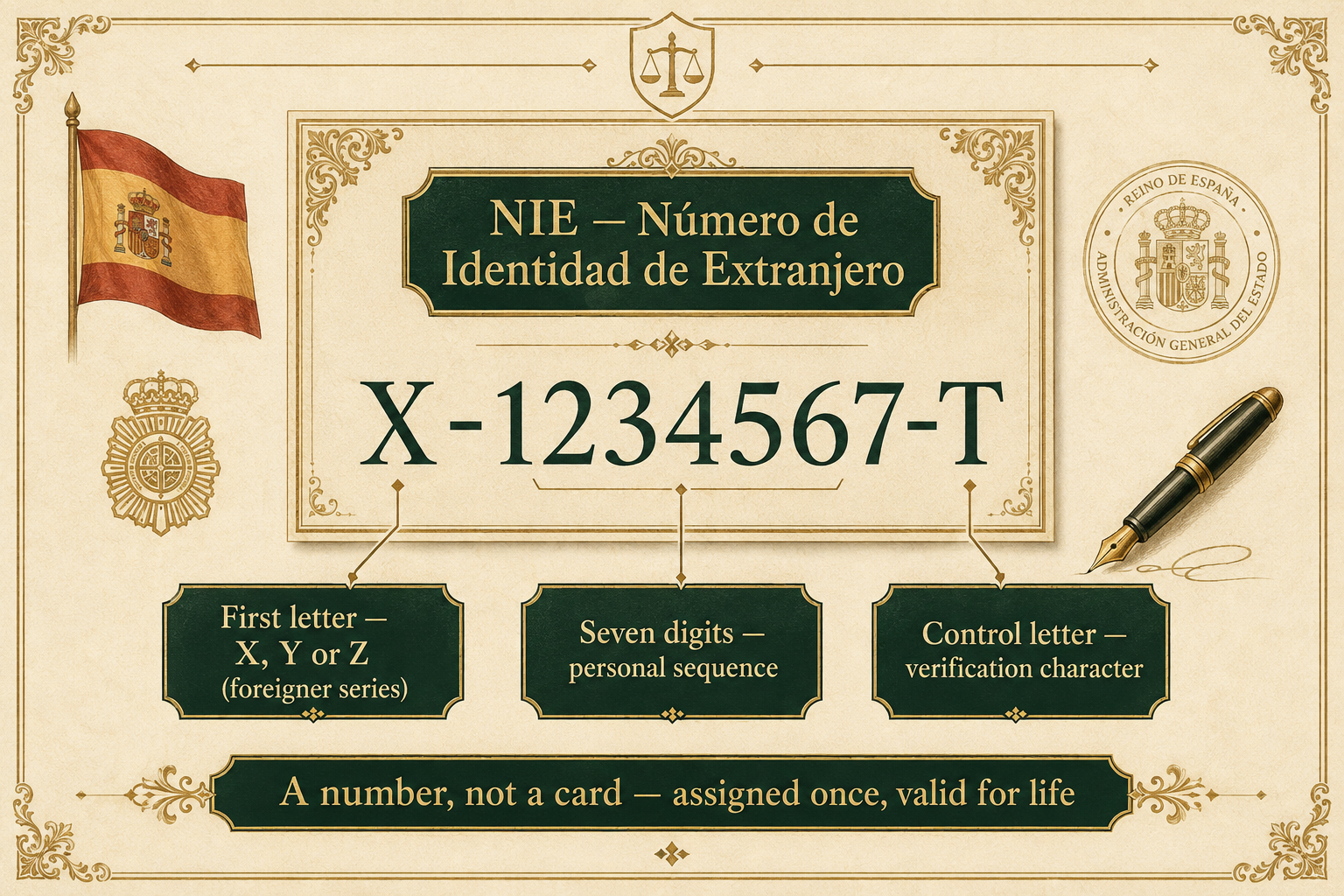
What Is an NIE (Número de Identidad de Extranjero)?
Stripped down to essentials, the NIE is nothing more than your foreigner identification number in Spain. Not a card. Not an ID document. Just a number — but one with consequences.
It looks something like X‑1234567‑T, and once you get it, it stays with you forever. The number has three parts:
- The leading letter — X, Y, or Z — marks the foreigner series. Newer numbers use Y or Z as earlier series ran out.
- Seven digits — your personal sequence within the series.
- The control letter — a verification character calculated from the digits.
Official reference: the Spanish Ministry of the Interior defines the NIE as the unique identification number assigned to any non-Spanish national interacting with Spanish authorities. It is issued by the Policía Nacional through the Oficinas de Extranjería or Spanish consulates abroad.
Key points
- It functions as your official identification number as a foreigner in Spain.
- It never expires.
- It’s required for taxes, banking, property, employment, residency — practically everything.
- EU citizens, non-EU citizens, residents, and non-residents — everyone receives the same format.
If Spain were to run on a single rule, it would be this: no NIE, no paperwork.
What Is an NIE Used For?
Here’s the moment we see people’s eyes widen. The NIE isn’t just for immigration or taxes. It’s everywhere.
You’ll need an NIE to:
- Open a bank account.
- Buy or sell property (even if you’re staying one week).
- File taxes or receive a tax refund.
- Sign an employment contract.
- Start a company or register as self-employed.
- Connect electricity, internet, or water in your home.
- Receive inheritance.
- Register a car.
- Sign long-term rental agreements.
Basically, if a piece of paper might end up in a public office, the NIE will be involved.
Who Needs an NIE in Spain?
The short answer? Anyone who isn’t Spanish and plans to do something even mildly official.
More specifically:
- EU citizens — for taxes, banking, rentals, buying property, and residency paperwork.
- Non-EU citizens — for visas, permits, TIE cards, and everything that follows.
- Residents — the NIE is printed on your residence card.
- Non-residents — especially property buyers and investors.
- Students, freelancers, digital nomads — modern life requires modern paperwork.
We often joke with clients: you can fly into Spain without an NIE, but you can’t really live here without one.
NIE vs NIF vs TIE vs DNI
Four codes, endless confusion. Here is the one-paragraph version: the NIE is a number for foreigners, the NIF is the tax number for Spanish citizens, the TIE is the physical residence card for non-EU residents, and the DNI is the Spanish national ID card. Only two of them are physical cards — and only one of them is yours to get as a foreigner before residency. For the deep dive, see the NIE vs NIF guide.
| Feature | NIE | NIF | TIE | DNI |
|---|---|---|---|---|
| Who receives it | Foreigners | Spanish citizens | Non-EU residents | Spanish citizens |
| What it is | A number | A tax number | A physical card | A physical card |
| Format | Letter + 7 digits + letter | Digits + letter | Card showing your NIE | Digits + letter |
| Purpose | Identification in all official procedures | Taxes and official acts | Proves legal residence | National identity document |
| Lifetime validity | Yes — never expires | Yes | Card renews; NIE stays | Card renews |
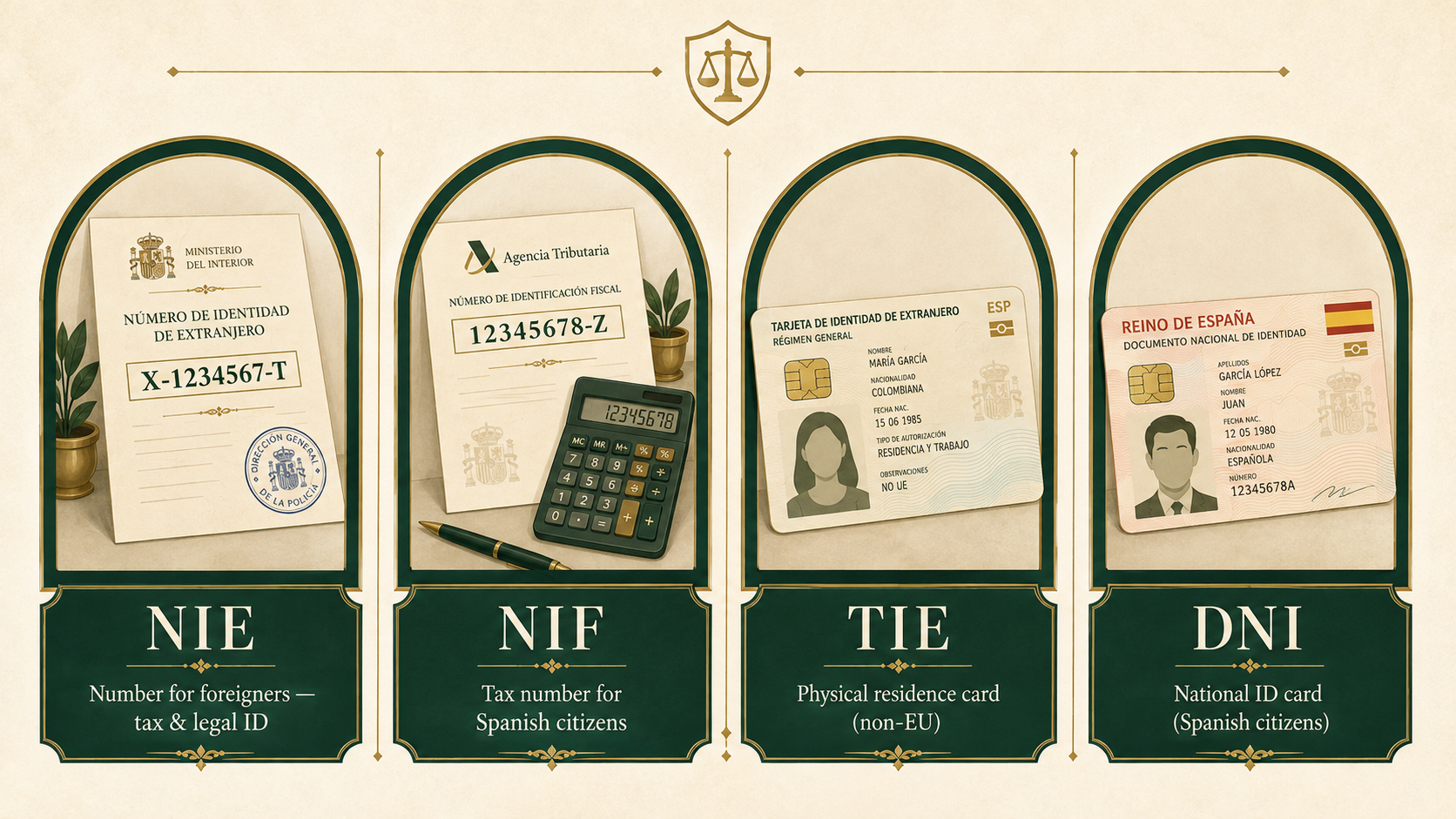
Not sure which number or document your situation calls for? Get your NIE online and the e-residence team will confirm exactly what you need.
NIE vs TIE: Key Difference
This mix-up happens constantly, so let’s make it easy:
- NIE = a number.
- TIE = a physical card (your residence card).
You can have an NIE without residency, but you can’t have a TIE without an NIE. Think of the NIE as your username and the TIE as your membership card. One exists without the other; the other does not.
Types of NIE in Spain
People are often surprised that the NIE comes in different “contexts”, even though the number itself never changes.
1. NIE for Non-Residents
This is the NIE issued to people who don’t live in Spain but need the number for property, tax, or financial purposes. It arrives as a white A4 certificate — the “NIE blanco”.
2. NIE for Residents
Once you become a resident, your NIE is simply printed onto your TIE.
3. NIE for EU Citizens
It appears on the green Certificado de Registro — not the most aesthetically pleasing document, but it works. Requirements are covered in the NIE Verde guide for EU citizens.
How to Get an NIE in Spain
Here’s where the simplicity ends and reality begins — the complete step-by-step application guide covers the full process.
Three ways to apply:
- In Spain, through the National Police.
- At a Spanish consulate abroad.
- Via a legal representative — yes, someone can do it for you if paperwork isn’t your hobby.
Official reference: instructions are published by the Spanish National Police (Policía Nacional).
Required documents
- EX-15 form.
- Passport + photocopies.
- Proof of purpose (buying a property, signing a contract, etc.).
- Fee payment: Modelo 790, code 012.
- Confirmation of your appointment.
If you prefer a smoother process, our team offers a guided option through the NIE Spain online application service.
Common Mistakes When Applying for an NIE
We’ve seen everything from dramatic to mildly amusing. Avoid these:
- Choosing the wrong appointment type.
- Forgetting to pay the application fee.
- Submitting an incomplete EX-15.
- Bringing weak proof of purpose.
- Passport data inconsistencies.
And of course — expecting everything to make perfect sense.
Conclusion
The NIE is a tiny number with a surprisingly large impact. Once you have it, Spain suddenly becomes a lot more accessible. Without it, you’ll hit walls you didn’t even know existed.
Want to skip the slowest parts of the process? Get your NIE online and our team will prepare the application for you.
Frequently asked questions about the Spanish NIE
What does NIE stand for and what does it mean?
NIE stands for Número de Identidad de Extranjero — Foreigner Identity Number. It is the unique identification number Spain assigns to any non-Spanish national who interacts with Spanish authorities, banks, notaries, or the tax office. It identifies you in every official procedure, but it is not a residence permit and not an ID card. See the NIE Spain online service for the application options.
What does an NIE number look like? Can you give an example?
An NIE looks like X-1234567-T: a leading letter (X, Y, or Z), seven digits, and a final control letter. That exact format is used for EU and non-EU citizens alike. To see how it appears on the real certificate, check the example of the NIE document.
How long is the NIE valid?
The NIE number itself is permanent and never expires — it stays with you for life. The printed certificate has no official expiry date either, though some Spanish banks ask for a recently issued certificate for KYC purposes. That is a bank policy, not a government rule. More detail: does the NIE number expire?.
What is the difference between NIE, NIF, TIE and DNI?
NIE is the identification number for foreigners. NIF is the tax number for Spanish citizens. TIE is the physical residence card issued to non-EU residents — the card carries your NIE. DNI is the national ID card for Spanish citizens. You can hold an NIE without any card. Full breakdown: NIE vs NIF guide.
What is an NIE used for?
Practically every official or financial action in Spain: opening a bank account, buying or selling property, filing taxes, signing an employment contract, registering as self-employed, connecting utilities, receiving an inheritance, registering a car, or signing a long-term rental agreement.
Who issues the NIE in Spain?
The NIE is issued by the Spanish National Police (Policía Nacional), through the Oficinas de Extranjería in Spain or through Spanish consulates abroad. A legal representative with a notarised Power of Attorney can also obtain it on your behalf.
How do I read an NIE number?
The number has three parts: an initial letter — X, Y, or Z — marking the foreigner series, seven digits that form your personal sequence, and a final control letter used for verification. See the anatomy of the NIE number for the full breakdown.
What does the NIE document look like?
For non-residents it is a white A4 certificate (the "NIE blanco") showing your name, date of birth, nationality, and the NIE number, stamped by the police. EU citizens registering residence receive the green Certificado de Registro — see the NIE Verde guide. Non-EU residents see the number printed on their TIE card. See the example of the NIE document.
Does the NIE expire?
No. It stays with you for life.
Can I work with only an NIE?
No. You’ll need a valid residence permit or visa.
Do EU citizens need an NIE?
Yes — for taxes, banking, rentals, or buying property.
Can I get an NIE urgently?
Sometimes, especially if there’s a time‑sensitive property transaction.
What Is an NIE: Quick Reference
| Item | Fact |
|---|---|
| Full name | Número de Identidad de Extranjero — Foreigner Identity Number |
| Issued by | Policía Nacional — Oficinas de Extranjería in Spain and Spanish consulates abroad |
| Validity | Permanent — the number never expires |
| Form | A number (format X-1234567-T) printed on a certificate — not a card |
| Main uses | Banking, property, taxes, employment, utilities, inheritance, rentals |
| EU citizens | Same number; printed on the green Certificado de Registro when registering residence (EX-18) |
| Non-EU citizens | Same number; printed on the TIE residence card once resident |
Reviewer and Sources
Reviewed by: E-Residence Team · Licence No. 62802L · Last updated:
Spanish NIE procedures and document practices can vary by office, consulate, and applicant profile. Always check official sources and obtain case-specific advice before submitting documents.
Official sources
- Ministerio del Interior — definition of the NIE (interior.gob.es)
- Dirección General de la Policía / Policía Nacional — NIE procedures and forms (sede.policia.gob.es)
- BOE — Ley Orgánica 4/2000 (BOE-A-2000-544)
- BOE — Real Decreto 1155/2024 (BOE-A-2024-21999)