


Spain · Agencia Tributaria · Non-resident income tax
Non-Resident Tax in Spain for Property Owners — We File Your Modelo 210
Non-residents who own property in Spain file a Modelo 210 every year — even when the home stands empty and no rent comes in. We work out which returns your year requires, calculate the tax for free so you see the exact amount first, and file every return with the Agencia Tributaria for you — in your language, with no digital certificate of your own.
- Since 2013
- 17,000+ clients
- 2,836 Trustpilot reviews
 Agencia Tributaria Colaborador social
- Free — our fee covers the filing
- Imputed income · Rental income · Capital gains
- 19% EU/EEA · 24% other countries
- No digital certificate, no Spanish bank
What clients say
Three things to know before you file
Which Modelo 210 do you need?
Start from how each property was used during the year. Most owners fall into the first three cases; the other three decide how many returns you file.
The property was empty, or you used it yourself
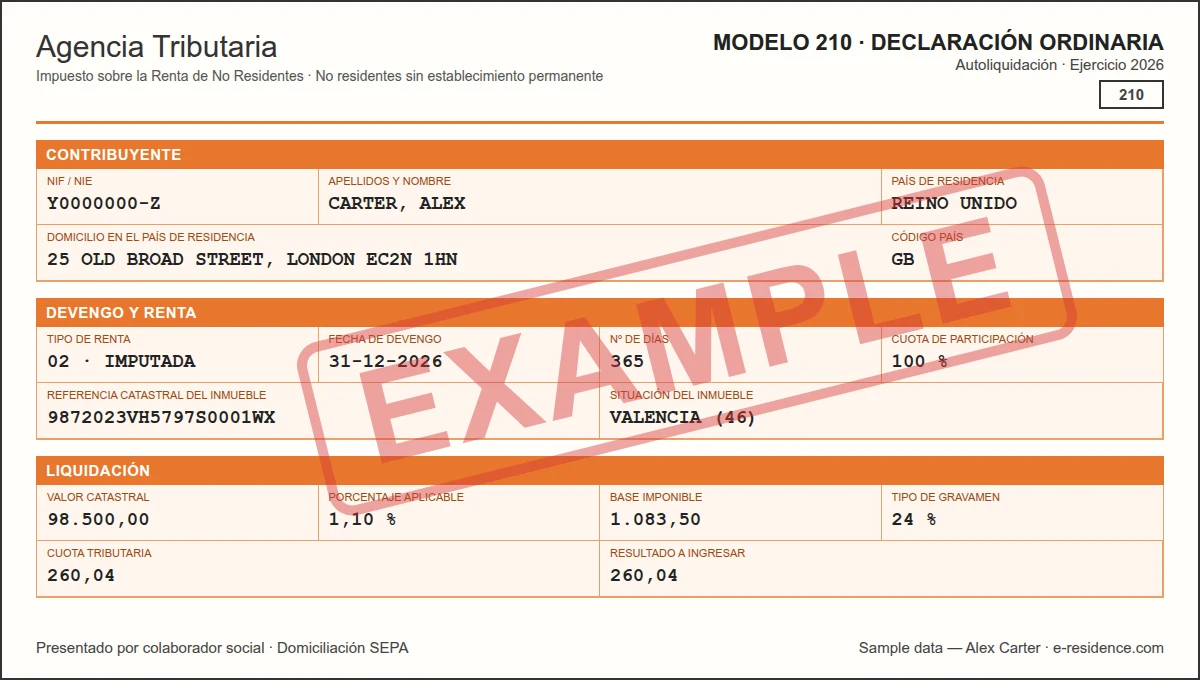
You declare imputed income (renta imputada): a notional income the Agencia Tributaria assumes from the cadastral value, even if you never set foot in Spain that year. It is pro-rated by the number of days the property was at your disposal.
You rented it out
You declare the rental income for the calendar year — short-term and long-term lets alike — in one annual return or period by period. EU/EEA residents deduct the costs linked to the letting; other owners are taxed on the gross rent. Any days it was not rented still need an imputed-income return.
You sold it
You declare the capital gain. The buyer retains 3% of the price and pays it to the Agencia Tributaria on your behalf with Modelo 211; your Modelo 210 settles the real figure, refund or balance. The months before the sale still need their own return.
More than one cadastral reference
A garage, a storage room or a separate plot with its own referencia catastral is its own property for the Agencia Tributaria — and gets its own Modelo 210, even when it belongs to the same owner and sits in the same building.
You co-own the property
Each owner files their own return for their share of the income, the expenses and the property. Two owners, two returns — for every situation that applies to the property.
Other Spanish-source income
Interest, dividends and similar income arising in Spain can also require a Modelo 210 — unless Spanish tax was already withheld at source, in which case nothing more is filed.
The tax calculation is free — you pay only for the filing
What you pay
The same lines you will see at checkout: the tax calculation costs nothing, and the price of the return depends on its type and on the number of owners.
- Tax calculation Free
We work out the tax on every return your year requires and show you the exact amount before anything is filed.
- Imputed income €99 1 owner
Annual return for a property that stood empty or that you kept for your own use.
2 owners €1793 owners €2594 owners €339
- Rental income €149 1 owner
Annual return for holiday rentals and long-term lets, with expenses deducted where the law allows.
2 owners €2793 owners €4094 owners €539
- Capital gains €299 1 owner
One-off return on the sale of a property, including the claim for any excess of the buyer's 3% retention.
2 owners €3793 owners €4594 owners €539
- Garage or storage room Add-on +€99
Per unit with its own cadastral reference, declared on its own return alongside the main property.
Included in every filing
- Filing with the Agencia Tributaria and the official receipt as a PDF
- No digital certificate or Cl@ve of your own — we file as a registered collaborator
- Payment instructions that work without a Spanish bank account
- Deadline reminders for your next annual returns
- Your property and owner details kept for next year
- Support in your language, from the first question to the filed return
Rates and deadlines at a glance
What each return taxes, at which rate, and when it is filed. The windows are the ones that apply from the 2026 tax year — the first returns under them are filed in 2027.
| Situation | What you declare | Tax base and rate | Filing window |
|---|---|---|---|
| Empty, or used by you | Imputed income, pro-rated by days | 2% of the cadastral value (1.1% if the value was revised in the last ten years), taxed at 19% for EU/EEA residents or 24% for everyone else | 1 April – 31 December of the following year (direct debit until 23 December) |
| Rented out | Rental income for the calendar year, in one annual return or period by period | Net rent for EU/EEA residents, gross rent for everyone else, at 19% or 24% | Tax due: 1–20 April of the following year · Nil result: 1–20 January · Refund: from 1 February |
| Sold | The capital gain, less the 3% the buyer retained | Gain taxed at 19%, whatever your country of residence | Three months after the buyer's one-month deadline for Modelo 211 — about four months from the sale |
| Interest, dividends, other income | Each type of income, unless Spanish tax was withheld at source | Generally 19% | Quarterly: the first 20 days of April, July, October and January |
What changed for the 2026 tax year
These windows were introduced by Orden HAC/623/2026. Imputed income for 2025 still follows the old rule and can be filed at any point during 2026. From 1 January 2027 the form itself changes as well: it gains an annex for rental expenses and fields for the number of days and your ownership share. The official calendar is published by the Agencia Tributaria.
From your property details to the filed return
Julia lives in Germany, rents out her flat in Valencia for ten months a year and sold a garage with its own cadastral reference in June. Her year runs like this.
- She orders and tells us how each property was used
- We calculate the tax on all four returns — free
- She approves the figures before anything is filed
- We file each return and send her the receipts
Rental income for the ten months the flat was let. Imputed income on the flat for the two months she used it herself. Imputed income on the garage from 1 January to the day it was sold. And the capital gain on the garage, filed in the window after the buyer’s Modelo 211. Nothing about her year is unusual — and it still adds up to four separate filings, each with its own deadline.
Where owners get it wrong
Most Modelo 210 problems are not about the numbers. They come from filing one return when the year required several, or from assuming that another tax already covered it.
- Filing a single return when several apply — renting for part of the year still leaves the other days to be declared as imputed income.
- Treating rental income and imputed income as one thing. They are different returns with different windows, even though both use Modelo 210.
- Assuming a sale is the only obligation that year. The months before the sale still need their own return.
- Covering all properties in one filing. Each cadastral reference, and each co-owner, needs its own.
- Taking the IBI direct debit as proof that Spanish tax is dealt with. The town hall’s bill says nothing about your income tax return.
Trusted by people relocating across the EU
E-Residence has handled EU tax-ID and relocation paperwork since 2013 — here is what clients say about it.
Frequently Asked Questions
How do I file Modelo 210 online?
You tell us how each property was used during the year and send the documents we ask for; our team works out which returns apply, calculates the tax and shows it to you before anything is filed. Once you confirm, we file every return with the Agencia Tributaria as a registered collaborator, using our own digital certificate, and send you the official receipt.
What do you need from me to file Modelo 210?
Your NIE and passport and the latest IBI receipt for each property — it carries the cadastral value and the cadastral reference — plus the purchase date and your ownership share. For rental income we also need the rental income for the year, from contracts or platform statements, and, if you live in the EU or EEA, the related expenses. For a sale we need the purchase and sale deeds, the costs of both, and the buyer's Modelo 211.
When is the Modelo 210 deadline?
It depends on the return. From the 2026 tax year onwards (Orden HAC/623/2026), imputed income is filed between 1 April and 31 December of the following year, and rental income with tax due between 1 April and 20 April of the following year. Imputed income for 2025 can still be filed at any point during 2026. A capital gain on a sale is filed within three months after the one month the buyer has to file Modelo 211 — roughly four months from the sale.
Can I file and pay Modelo 210 from abroad?
Yes. Filing is done online, so you never need to travel to Spain, and you do not need a Spanish bank account to pay. Since February 2024 the Agencia Tributaria accepts direct debit from accounts in any SEPA-zone country — the EU, the UK, Switzerland and Norway among them — and it also accepts card payment or a bank transfer from abroad with a payment identifier. We send you the payment instructions that fit your case.
What is Modelo 210?
Modelo 210 is the Agencia Tributaria's self-assessment form for the Impuesto sobre la Renta de No Residentes (IRNR) — the income tax paid by people who are not tax residents of Spain on income that arises in Spain. Non-resident property owners use it to declare imputed income on a home kept for their own use, income from renting it out, and the gain when they sell.
Do I need to file Modelo 210 if my property was empty all year?
Yes. A property that is available to you and not rented out is treated by the Agencia Tributaria as producing a notional income — the renta imputada — whether you spent the summer there or never visited. It is calculated from the cadastral value and declared once a year, pro-rated for any days the property was rented or not yet yours.
Is there an English version of Modelo 210?
No. There is no official English Modelo 210 to download and fill in: the return is completed in the Agencia Tributaria's own system, in Spanish, and filing it online requires a Spanish digital certificate or Cl@ve. That is the part we take off your hands — you deal with us in your language, and we complete and file the Spanish return.
I already pay IBI. Do I still have to file Modelo 210?
Yes. IBI is the local property tax: the town hall bills it, usually by direct debit, and you owe it simply for owning the property. Modelo 210 is the national income tax return for non-residents, and nobody bills you for it — you or your representative have to work it out, file it and pay it. Paying one does not replace the other.
What tax rate do non-residents pay on Modelo 210?
The general rate is 19% for residents of an EU or EEA country with tax information exchange and 24% for residents of any other country — the UK has been in the 24% group since Brexit. Capital gains on a sale are taxed at 19% for everyone.
Can I deduct expenses from my rental income?
If you live in an EU or EEA country, yes: costs directly linked to the rental — IBI, community fees, insurance, repairs, mortgage interest, agency fees, depreciation — can be deducted for the period the property was let, and you are taxed on the net figure. Residents of other countries, the UK included, are currently taxed on the gross rent with no deductions.
Is the tax calculation really free?
Yes. Calculating the tax on every return your year requires is included at no charge, and you see the exact amounts before anything is filed. Our fee covers preparing and filing the returns.
Does your fee include the tax I owe to the Agencia Tributaria?
No. Our fee covers working out, preparing and filing your returns. The tax itself is owed to the Agencia Tributaria and paid to it directly, and you see both amounts separately before we file.
How do I know my Modelo 210 has been filed?
You receive the official receipt the Agencia Tributaria issues for each filed return, together with a copy of the return itself, as PDFs. Keep them: they are your proof of filing, and you will need them when you sell the property.
What happens if I never filed Modelo 210?
The obligation does not go away: the Agencia Tributaria can claim the last four years. Filing late on your own initiative costs a surcharge that grows with every month of delay, plus interest after a year; if the Agencia Tributaria asks first, a penalty is added on top. Unfiled years also surface when you sell. Catching up voluntarily is always the cheaper route, and we can file the missing years for you.
What if I co-own the property with someone else?
Each co-owner files their own Modelo 210 for their share — a couple owning a flat 50/50 files two returns per situation, not one. We prepare all of them in the same order, and the price per return falls with every additional co-owner.
Does a garage or storage room need its own Modelo 210?
Yes, if it has its own cadastral reference (referencia catastral) and its own IBI receipt — the Agencia Tributaria treats it as a separate property. We file it alongside the main property for a fixed add-on fee.
I sold my property. What happens to the 3% the buyer withheld?
The buyer retains 3% of the price and pays it to the Agencia Tributaria on your behalf with Modelo 211. Your own Modelo 210 then declares the actual gain at 19%: if the tax due is lower than the 3% retained, you claim the difference back; if it is higher, you pay the balance. The months before the sale still need their own imputed or rental income return.
Is E-Residence connected to Estonia's e-Residency?
No. E-Residence is not connected to Estonia's e-Residency program. We are a Tax & Accounting services company working with non-residents in Spain, Portugal and Italy — tax numbers, tax returns and related relocation documents. Estonia's e-Residency is a different service — a digital identity for non-Estonians to start an EU company in Estonia, available at e-resident.gov.ee.
Related services and guides
Every return your year requires, calculated free and filed for you
Share the details of your property and our team will work out which returns apply, calculate the tax and file each one with the Agencia Tributaria.
File your Modelo 210- Tell us how each property was used this year
- Get the free calculation for every return
- Approve the figures, and we file and send you the receipts
Reviewer and Sources
Reviewed by: E-Residence Team · Last updated:
This information is for general guidance on the Spanish non-resident income tax return and does not constitute legal or tax advice. Rates, bases, filing windows and payment methods reflect the rules of the Agencia Tributaria as of October 2026, including the changes introduced by Orden HAC/623/2026 for the 2026 tax year onwards. For specific situations, consult a qualified Spanish tax professional.
Official sources
- Agencia Tributaria — Impuesto sobre la Renta de No Residentes sin establecimiento permanente: modelo y plazo de declaración (sede.agenciatributaria.gob.es)
- Agencia Tributaria — Formas de presentación y pago del modelo 210 (sede.agenciatributaria.gob.es)
- Agencia Tributaria — Nota sobre las modificaciones en los plazos de presentación del modelo 210, Orden HAC/623/2026