

















Your Trusted Source for Notarisation Services
Online Notary Service
Online notarisation lets a licensed notary certify a copy of your document, or witness your signature over a secure video session, without an in-person visit. The notary verifies your identity and, for signatures, confirms you are signing willingly, then applies a digital seal and certificate — the notarised document is emailed to you as a PDF.
- 17,000+ served online
- 4.9/5 · Excellent
- 100% hassle-free
- Supported since 2013
What clients say
What is online notarisation?
A Notary Service is a professional service where a licensed notary public acts as an impartial witness during the signing of important documents. This service includes verifying the identities of the signers, ensuring they are signing willingly and with a full understanding of the document’s content. The notary oversees the signing process to prevent fraud, then applies an official seal and signature to certify the authenticity of the documents, making them legally binding. Notary services are commonly required for legal, financial, and real estate documents such as affidavits, contracts, and deeds.
- No in-person meeting with a notary.
- Secure video conferencing with a licensed notary.
- A digital seal and certificate, emailed to you.
- Contracts, affidavits, wills, and power of attorney forms.
What we can notarise online
Everything is handled remotely — notarisation by a notary public licensed in the European Union, and certified translation by an authorised sworn translator. There are four services:
| Service | What the notary does | Typical uses | You receive |
|---|---|---|---|
| Certified true copy | Reviews the document you submit and certifies that the copy matches it, after a remote identity check. | Copies of a passport or national ID, diplomas, transcripts and other documents an authority asks to see in certified form. | A certified copy as a PDF by email, usually within 24 hours (excluding weekends and public holidays). Physical delivery on request. |
| Signature notarisation | Verifies your identity, then witnesses and certifies your signature live, during a video session. | Contracts, affidavits, declarations and consent forms that must carry a notarised signature. | The signed, notarised document as a PDF by email, usually 24–48 hours after identity verification. |
| Power of attorney (PoA) | Witnesses and notarises your signature on a power of attorney — one document per session. | Letting a representative act for you abroad, for example signing on your behalf in a transaction you cannot attend. Check first that the receiving authority accepts a remotely notarised PoA. | The notarised PoA as a PDF by email, usually within 24–72 hours, depending on scheduling. |
| Notarial (sworn) translation | Arranges a certified translation by a sworn translator authorised in the EU, or coordinates notary certification, depending on what the destination country requires. | Documents that have to be submitted in another language — certificates, contracts and official records. | The certified translation as a PDF by email (physical copy on request), usually in 3–7 working days. |
These are standard processing times, not guarantees: the notary can decline a document that does not meet legal or technical standards, and the institution that receives it always decides whether to accept it.
Requirements for obtaining a certified copy
To begin, you only require one form of identification.
A valid passport or EU National ID
We cater to all nationalities. Take a look at our illustrative guide for specific document requirements.

What steps do I need to take to get a certified document?
With E-Residence, we streamline the process for obtaining your certified documents with an apostille stamp. You can expect to receive them within a few hours to a few days.
- Send your documents Upload your documents through a quick online form
- Verify your identity in minutes Multiple forms of authentication
- Get certified document Receive your certified documents in a few days
With us, notary services no longer cost you time or stress.
In detail: before, during and after
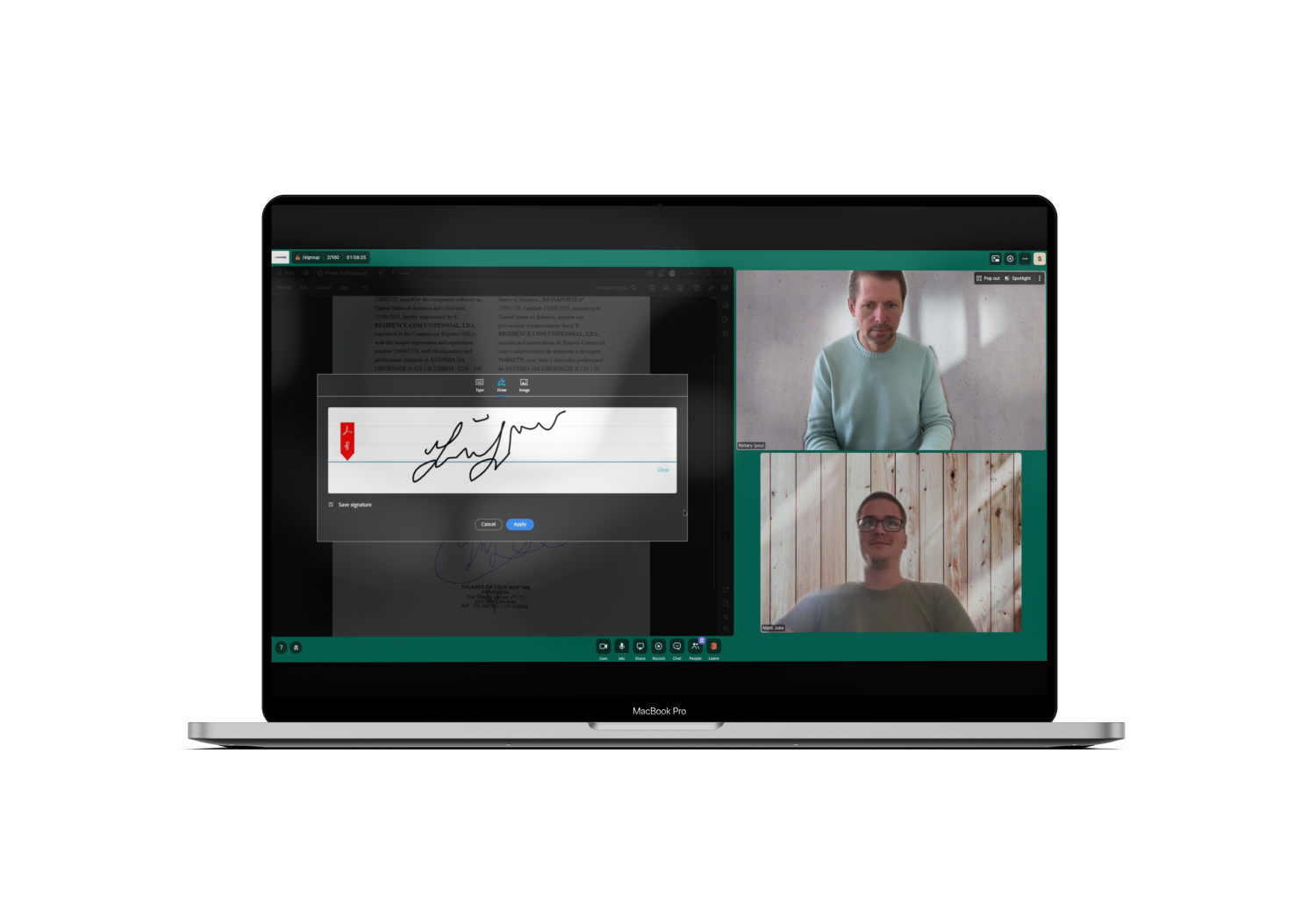
A certified true copy does not need a live session: you complete a remote identity check, and the notary reviews your document and certifies the copy. Signature and power-of-attorney notarisations are completed live, in a video session with the notary.
Before
- Prepare the final version of your document. The notarisation covers only the exact version you submit — any later change needs a new session.
- Don’t sign it in advance if it needs a notarised signature: the notary has to witness you signing.
- Check that your name matches your ID exactly. A mismatch between the document and your passport or ID can get it rejected by the authority that receives it.
- Have the essentials ready: a valid passport or national ID, and — for a live session — a stable internet connection and a device with a camera and microphone.
During the video session (signature and power of attorney)
- Identity check. You confirm who you are with biometric verification and your ID document.
- Live signing. You and the notary e-sign the document while connected by video.
Afterwards
- The notary attaches a digital seal and certificate, and the notarised document is emailed to you as a PDF. For certified copies, physical delivery can be requested separately.
- Ask the institution that will receive it whether it also needs an apostille or legalisation — the next section explains the difference.
Notarisation, certified copy or apostille: which do you need?
These terms are often used interchangeably, but each one proves something different. A receiving authority may ask for one of them, or for several in combination.
| Document step | What it proves | Who issues it | When you need it |
|---|---|---|---|
| Notarised signature | That you are who you say you are and that you signed the document yourself, willingly. | A notary public. | Contracts, affidavits, declarations and powers of attorney that must be signed in front of a notary. |
| Certified true copy | That a copy matches the original document. | A notary public or another official authorised to certify copies. | When an authority, bank or university accepts a certified copy instead of your original passport, diploma or certificate. |
| Apostille | That the signature and seal on a public document — including a notarial act — are genuine, so it is recognised in other Hague Convention countries. | The competent authority of the country where the document was issued (for Portuguese documents, the Procuradoria-Geral da República). | When a document issued in one Hague Convention country will be used in another. Within the EU it is not always required. |
| Consular legalisation | The same as an apostille, for countries that are not party to the Hague Apostille Convention. | The destination country’s embassy or consulate, after authentication in the issuing country. | When the destination country is outside the Hague Apostille Convention. |
Acceptance is always decided by the institution that receives your document, and it may ask for an apostille or legalisation on top of the notarisation — check its requirements before you book. Within the EU, a notarised document is sometimes accepted without an apostille. An apostille comes from the country where the document was issued, so a notarial certificate is apostilled in the notary’s own country; our Portugal apostille service covers documents issued in Portugal.
Who needs notarisation?
Notarisation is essential for a variety of individuals and organisations, including:
| Who | Why it matters |
|---|---|
| Individuals | Anyone signing legal documents such as wills, power of attorney, affidavits, and parental consent forms often needs notarisation to ensure the documents are valid and enforceable. |
| Homebuyers and Sellers | Real estate transactions, including deeds, mortgage documents, and property transfers, typically require notarisation to confirm the identities of the parties involved and to prevent fraud. |
| Business Owners | Companies often need notarised documents for contracts, loan agreements, corporate resolutions, and other legal paperwork to comply with regulatory requirements and ensure their authenticity. |
| Immigrants and Expats | Those applying for visas, passports, or other immigration documents may need notarisation to authenticate their paperwork. |
| Students and Professionals | Notarisation may be necessary for diplomas, transcripts, and professional licences, especially when applying for positions or further education abroad. |
Notarisation adds a layer of trust and legal recognition to important documents, making it a vital process for many legal and official transactions.
Examples: how people use online notarisation
Granting a power of attorney
You need someone to act for you in another country — signing on your behalf, or handling a procedure you cannot attend. That normally requires a notarised power of attorney, and often an apostille as well. You sign the PoA in a video session with an EU-licensed notary and receive the notarised PDF by email. Requirements differ by country and procedure, so confirm with the receiving authority or your representative that a remotely notarised PoA is accepted before you book. For a Spanish NIE, follow the route in our NIE by power of attorney guide instead: that PoA is signed before a local notary, apostilled, and sent to Spain as a physical original.
Sending a certified copy of your passport
A foreign bank, employer or public office asks for a certified copy of your passport rather than the original. With a certified true copy, an EU-licensed notary certifies that the copy matches your passport, and you receive it as a PDF — usually within 24 hours, excluding weekends and public holidays.
Applying to study or work abroad
A university or professional body asks for certified copies of your diploma and transcripts. A certified true copy lets you send them without parting with the originals. If the institution is in another Hague Convention country, ask whether it also wants an apostille.
Signing a contract or affidavit remotely
A company, landlord or authority abroad needs your notarised signature on a contract, affidavit or declaration. The notary verifies your identity and witnesses your signature live over video, and the notarised document reaches you by email, usually within 24–48 hours. Keep the document final before the session: any change afterwards needs a new notarisation.
What online notarisation can’t do
It is not available for documents that by law require an in-person appearance. Some acts must also be signed before a particular authority — a Spanish property purchase, for example, is formalised in a deed signed before a Spanish notary, either in person or through a representative acting under a power of attorney. We do not review the legal content of your document, and the notary can decline one that does not meet legal or technical standards. The institution receiving it always has the final say on acceptance, including whether it needs an apostille or legalisation.
Secure your document with us
Are you looking for a reliable and efficient notary service that you can trust? Look no further. We specialise in certifying, notarising, and attesting all kinds of documents, from contracts and agreements to affidavits and more. Our team of licensed notaries is committed to providing you with swift and secure services, ensuring your documents are legally binding and internationally recognised.
Obtaining a certified copy of your passport/ID is a hassle-free process designed to save you time and stress. Instead of dealing with the intricacies of the certification process on your own, many people find it incredibly beneficial to engage our services.
In doing so, you can avoid long queues and language difficulties, and skip the bureaucratic back-and-forth entirely.
We are the #1 accounting firm on Trustpilot — supporting seamless relocations since 2013.
Bank-level security and data encryption
All services are provided remotely
International notarisation service
What clients say about notarising online
Read the reviews of our clients who have already used our services and see how simple and convenient it is.
Easy to apply and I received my NIE very quickly. It made my life so much easier.
I went for the 5-10 day package and received my NIE within 5 working days. The communication was excellent.
Excellent experience, communication, cost compared to others, and speed of receiving the NIE, all fantastic.
Frequently asked questions
What is Remote Online Notarisation (RON)?
Remote Online Notarisation (RON) is a digital service that allows you to notarise your documents online, without the need for an in-person meeting with a notary. Utilising secure video conferencing technology, you can connect with a licensed notary to complete the notarisation process from the comfort of your own home or office.
How Does Remote Online Notarisation Work?
- Initiate the Process: Schedule an appointment and upload the documents you wish to notarise through our secure portal.
- Identity Verification: You will be required to verify your identity using multiple forms of authentication.
- Sign & Notarise: Both you and the notary will e-sign the documents.
- Completion: The notary will attach a digital seal and certificate, and the notarised document will be emailed to you.
Is Remote Online Notarisation Secure?
Absolutely. Our platform uses state-of-the-art encryption and multi-factor authentication to ensure the utmost security and confidentiality of your documents.
What Types of Documents Can Be Notarised Online?
Most types of documents can be notarised online, including contracts, affidavits, wills, and power of attorney forms. However, certain documents may still require in-person notarisation depending on jurisdictional laws. Please contact us for more information.
What Do I Need for Remote Online Notarisation?
You will need:
- A stable internet connection
- A computer, tablet, or smartphone with a camera and microphone
- Valid identification (e.g., passport, driving licence)
- The document(s) you wish to notarise
Can I Notarise International Documents?
In most cases, yes. An Apostille can be provided for international acceptance. Please consult with us to ensure that your documents will be accepted by the foreign jurisdiction in question.
How Much Does Remote Online Notarisation Cost?
The cost may vary depending on the type and number of documents you need to notarise. The pricing starts from €100.
Can Multiple People Sign a Document?
Yes, multiple signers can participate in a single remote online notarisation session, provided each signer can be properly identified and authenticated.
Can I use an online notary for documents I need in Portugal?
In most cases, yes. Our online notarisations are performed by a notary public licensed in the European Union, and Portugal is both an EU member state and a party to the Hague Apostille Convention. Within the EU, a notarised document may be accepted without an apostille, but the receiving authority decides — so confirm its requirements before you book. If what you need apostilled is a document issued in Portugal, our Portugal apostille service covers that; it does not apply to a notarial certificate issued in another EU country, which is apostilled in the country where it was issued.
Is an online notary the same as a 'notario online'?
Not exactly. 'Notario online' is how many Spanish speakers search for remote notarisation, but a Spanish notario is a public official whose role goes beyond witnessing signatures — for example, property purchases in Spain are formalised in a public deed (escritura) signed before a Spanish notary. Our service covers certified true copies, signature notarisation and powers of attorney, carried out over video by an EU-licensed notary. It is not available for documents that by law require you to appear in person.