


















Spanish NIE for Buying Property in Spain: A Guide for UK Buyers
Written and reviewed by the E-Residence Team, Licence No. 62802L. Last updated: August 2026.
If you are buying property in Spain from the UK, a Spanish NIE is not optional. It is the foreigner’s identification number that lets you sign the deed, pay the purchase taxes and register the home in your name. The good news: you do not have to travel to Spain to get one.
This guide explains what the NIE does in a property purchase, how British buyers obtain it remotely after Brexit, and where it fits in the timeline so it is ready before completion. If you are just starting out, see our guide on getting a Spanish NIE from the UK.
Excellent ★★★★★ 4.9 / 5 on Trustpilot
Read our reviews on uk.trustpilot.com
2,500+ reviews · E-Residence · Licence No. 62802L · Avenida da Liberdade 129, Lisbon
Why you need an NIE to buy property in Spain
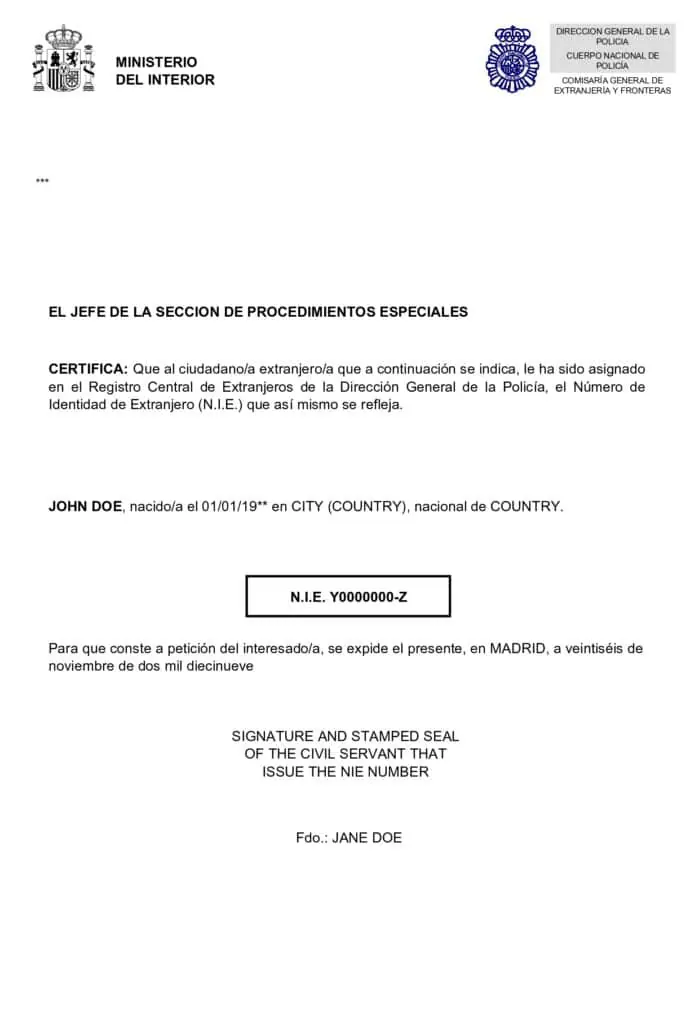
Example of a Spanish NIE certificate issued by the Ministerio del Interior.
The NIE (Número de Identificación de Extranjero) is the identification number every non-Spanish buyer must have before completing a purchase. A Spanish notary will not sign the deed of sale without it. You need your NIE to:
- sign the deposit contract (contrato de arras) and the final deed of sale (escritura) before a notary;
- pay the purchase taxes — Transfer Tax (ITP) on a resale, or VAT (IVA) plus Stamp Duty (AJD) on a new build;
- register the property in your name at the Land Registry (Registro de la Propiedad);
- open a Spanish bank account and set up utility contracts.
Each buyer needs their own NIE. If you are buying jointly — as a couple, with family or with friends — every co-owner named on the deed needs one.
The NIE is not residency
An NIE is an identification and tax number, nothing more. It does not give you the right to live in Spain, and it is not a residence permit or a visa. Buying a holiday home or an investment property does not make you a Spanish resident, and you do not need to become one to own property in Spain.
Which NIE do UK buyers need?
There is more than one kind of NIE, and the right one depends on your status:
- Non-resident NIE — the one most UK buyers need. As a non-EU national buying a property you do not plan to live in, you apply for the non-resident NIE on form EX-15.
- Temporary NIE — issued to EU and EEA citizens; since Brexit this no longer applies to UK nationals.
- TIE (Tarjeta de Identidad de Extranjero) — the physical residence card for people who actually live in Spain. You do not need it to buy a holiday home or an investment property.
If you later move to Spain, your NIE stays the same — you simply add residency on top. The number is yours for life.
From the UK to Spain: your status after Brexit
Until 31 December 2020, UK nationals dealt with Spain as EU citizens, which meant a lighter-touch process. Since 1 January 2021 the UK is a third country, so British buyers are treated as non-EU nationals.
In practice this means you apply for the non-resident NIE, and you now have to show documentary evidence of why you need it — for a buyer, that is usually your deposit contract or the details of the property. The NIE number itself is unchanged.
If you apply from the UK rather than in person, the Power of Attorney you sign has to be legalised for use in Spain. That involves a Notary Public and an Apostille — the next section walks through it.
How to get your NIE without leaving the UK
You can authorise a representative in Spain to apply for your NIE, and even sign the purchase on your behalf. The document that allows this is a Power of Attorney (in Spanish, a poder). For UK residents the chain works like this:
- You sign a Power of Attorney before a UK Notary Public — not a standard solicitor. A Notary Public is the officer recognised internationally for documents intended for use abroad.
- The FCDO Legalisation Office (Foreign, Commonwealth & Development Office) adds an Apostille under the 1961 Hague Convention. Because both the UK and Spain are parties to the Convention, the Apostille is all you need — there is no separate consular legalisation.
- A sworn translator (traductor jurado) translates the document into Spanish.
- Your representative in Spain files the NIE application and can sign the deed for you.
Prefer to do it in person? The Spanish consulates in London, Manchester and Edinburgh can issue a Power of Attorney directly, which skips the apostille step but means booking an appointment and attending in person. Either way, this is the practical route to getting a Spanish NIE from the UK.
What you will need to apply
For a non-resident NIE as a property buyer, expect to provide:
- a valid passport — make sure it has at least six months left to run, as some consulates ask for that;
- the completed application form (EX-15), signed;
- proof of why you need the NIE — for a buyer, usually the deposit contract (contrato de arras) or the property details;
- proof that the application fee has been paid (form Modelo 790, código 012);
- if you are applying remotely, the apostilled Power of Attorney and its sworn translation.
Getting the paperwork right the first time is what prevents a rejected application — the most common cause of delay.
Where the NIE fits in your purchase timeline
Timing matters, because the NIE has to be ready before completion and obtaining one through the immigration office can take weeks. A typical purchase runs:
| Stage | What happens |
|---|---|
| Offer and reservation | You reserve the property, often with a holding deposit. |
| Deposit contract (contrato de arras) | Commonly around 10% of the price; the deal becomes binding. |
| NIE in hand | Apply early, and do not leave it until the week of completion. |
| Completion (escritura) | You, or your representative under Power of Attorney, sign the deed before the notary and pay the balance. |
| Taxes and registration | The purchase taxes fall due (often within 30 days); the deed is then registered at the Land Registry. |
Applying for your NIE as soon as you start house-hunting keeps the timeline from slipping.
Proof of funds and your UK tax position
Spanish notaries and banks must check the source of your money under anti-money-laundering rules, so you will be asked to show where the funds come from. UK buyers usually do this with bank statements and HM Revenue & Customs documents — for example an SA302 tax calculation and the matching Tax Year Overview, which are the standard proof of declared income for self-employed applicants and are often requested if you apply for a Spanish mortgage.
Owning property in Spain does not remove your UK tax obligations. As a UK tax resident you remain accountable to HM Revenue & Customs, while Spain taxes the Spanish property. The two systems interact, so it is worth speaking to a tax adviser before you buy. This guide is general information, not tax advice.
Taxes you pay when buying
The main tax depends on whether the property is a resale or a new build:
| Property type | Main tax | Notes |
|---|---|---|
| Resale homes | Transfer Tax (Impuesto de Transmisiones Patrimoniales, ITP) | The rate is set by each autonomous community, so it varies by region. You file it on form Modelo 600, usually within about 30 days of signing the deed. |
| New builds | VAT (IVA) plus Stamp Duty (Actos Jurídicos Documentados, AJD) | Both apply on a newly built property bought from a developer. |
After completion you also take on ongoing obligations as a non-resident owner. Even if you never rent the property out, Spain charges Non-Resident Income Tax (IRNR) on a deemed income worked out from the property’s cadastral value, declared on form Modelo 210. You also pay the local property tax (IBI) to the town hall each year.
Rates and rules change and differ by region, so confirm the current figures with a Spanish tax adviser, or directly with the Spanish tax agency (Agencia Tributaria), before you budget. This guide is general information, not tax advice.
A few things that trip UK buyers up
From handling these applications day to day, the same avoidable problems come up:
- Leaving the NIE too late. Appointments can be weeks out, so apply as soon as you start house-hunting.
- A passport close to expiry. Renew it before you apply, not after a rejection.
- Applying at the wrong consulate. London, Manchester and Edinburgh each cover set regions of the UK — apply to the one for your area, which is not always the nearest.
- Forgetting that each co-owner needs their own NIE. A couple buying together needs two.
- Treating the NIE as residency. It is not, and assuming otherwise causes problems later.
Not the same as Estonia’s e-Residency
The Spanish NIE has nothing to do with the Estonian e-Residency programme, a separate government scheme that issues a digital ID for running an EU-based company online. E-Residence helps you obtain your Spanish NIE; we are not affiliated with the Estonian e-Residency programme.
Frequently asked questions
Do I need an NIE to buy property in Spain?
Yes. A Spanish notary cannot sign the deed of sale without your NIE, and you need it to pay the purchase taxes and register the property in your name. A passport on its own is not enough.
Can I get a Spanish NIE without travelling to Spain?
Yes. You grant a Power of Attorney before a UK Notary Public, have it apostilled by the FCDO Legalisation Office and translated into Spanish, and a representative in Spain applies — and can sign the purchase — on your behalf.
Does an NIE give me residency in Spain?
No. The NIE is only an identification and tax number. It does not grant the right to live in Spain. Residency is a separate process under Real Decreto 1155/2024.
Do my partner and I each need our own NIE?
Yes. Every co-owner named on the deed needs their own NIE, whether you are buying as a couple, with family or with friends.
How long does it take to get an NIE?
It can take several weeks, depending on appointment availability, which is why we recommend applying as soon as you start house-hunting rather than close to completion.
Is the Spanish NIE the same as Estonia’s e-Residency?
No. They are unrelated. The Estonian e-Residency programme is a digital ID for running an EU company online; the Spanish NIE is the foreigner’s identification number used for transactions in Spain, including buying property.
Already have a Spanish NIE but lost the certificate? See our guide on how to replace a lost NIE from the UK.
Official sources
- gov.uk — Get your document legalised (Apostille / FCDO)
- Agencia Tributaria — Spanish tax agency (non-resident taxes)
- BOE — Real Decreto 1155/2024
This page is general information for UK buyers and is not legal or tax advice. For advice on your own situation, speak to a qualified Spanish lawyer or tax adviser.