


















Portugal D7 Visa: Passive-Income and Retirement Guide
In this article
The D7 is the common name for Portugal’s residence-visa route for retired people, religious persons, and people who live from their own stable income. The official service describes these applicant groups rather than a single product formally named “D7.” It is an entry route towards a separate residence-permit application; the visa itself is not a two-year residence permit.
D7 is not Portugal’s official digital-nomad route. If your principal documented income comes from remote employment or independent professional activity for organisations outside Portugal, compare it with the D8 route before preparing a dossier.
D7 or D8: choose by your main income source
| D7 route | D8 route |
|---|---|
| The main case is a pension or stable own income that can support residence in Portugal. | The main case is remote employment or independent professional activity for clients or organisations outside Portugal. |
| Evidence should explain the source, regularity, continuity, and receipt of that income. | Start with the separate Portugal D8 visa guide. |
Choose the route that matches your principal documentable income, then check the instructions of the competent Portuguese consular post. A post or its designated service provider may ask for additional evidence.
What the D7 route does — and does not do
A successful consular application results in a residence visa. According to the Portuguese Ministry of Foreign Affairs visa portal, that visa permits two entries and is valid for four months so that the holder can apply to AIMA for a residence permit. The visa and the later residence permit are different documents.
After a residence permit is issued, residence, professional activity, renewal, and absences are governed by the permit and current law. Travel elsewhere in the Schengen Area is not the same as EU free movement: short visits are generally subject to the 90 days in any 180-day period rule.
A D7 visa also does not itself guarantee healthcare coverage. Registration for an SNS user number and responsibility for healthcare costs depend on the records and status attached to the registration; see our separate guide to obtaining an SNS number and the official SNS service.
Tax note: D7 is not a tax regime
Portuguese Tax Authority guidance confirms that the former NHR regime was revoked for new cases from 1 January 2024, subject to limited transitional situations. IFICI is a separate tax incentive with its own eligibility rules; neither NHR nor IFICI is granted by holding a D7 visa. Read the NHR transition guide and confirm your position with a qualified tax adviser.
D7 eligibility and means of subsistence
The application must show accommodation and sufficient means of subsistence, together with evidence of the pension or own income on which the D7 case relies. There is no single amount that guarantees approval: the authorities assess the complete dossier, and the competent post can request additional documents.
Last verified: 2026. The MNE means-of-subsistence page uses the current Portuguese minimum monthly wage as its base. For 2026, it states €920 and applies these percentages:
- 100% for the first adult;
- 50% for each additional adult;
- 30% for each child or dependent adult child.
For one applicant, €920 × 12 gives an indicative 12-month reference of €11,040. This calculation is not an approval guarantee. Recheck the official base and your post’s instructions immediately before applying.
How the D7 residence route works
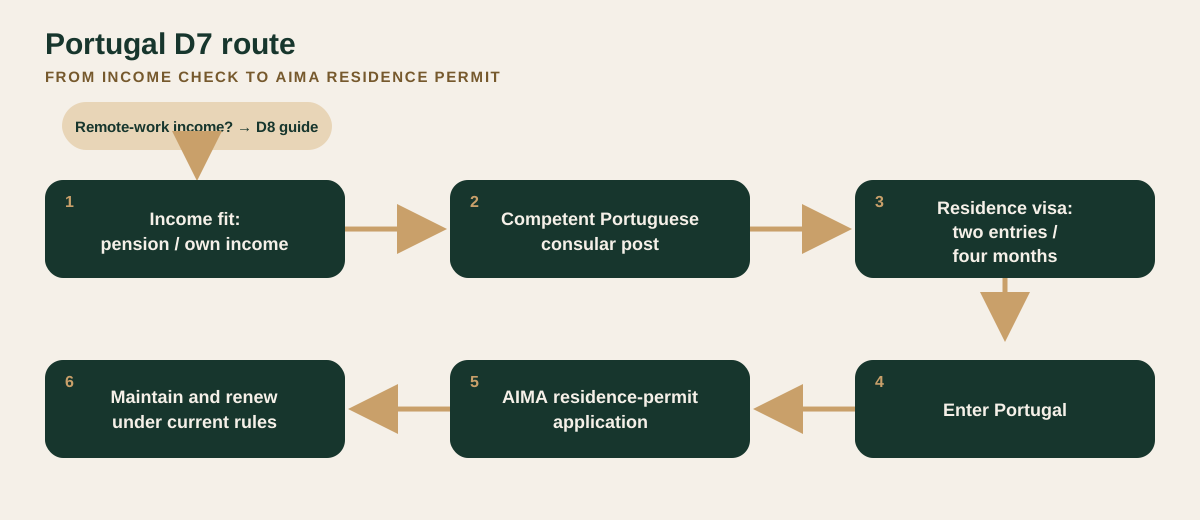
- Identify the competent post. Check which Portuguese consular post has jurisdiction based on nationality and lawful residence, or whether it uses an authorised service provider.
- Download the current national-visa form. Use the form and instructions published by the competent official channel.
- Build the post-specific dossier. Combine the national baseline documents with D7 income evidence and any extra items required locally.
- Submit the application. Follow the post or provider’s appointment, payment, and submission instructions. Do not assume the official process is completed entirely online.
- Receive the residence visa if approved. It is valid for two entries and four months; it is not the residence permit.
- Enter Portugal and apply to AIMA. Make the separate residence-permit application and complete the required identification and biometrics under AIMA’s current general requirements.
- Maintain and renew the permit. Follow the conditions, renewal procedure, and absence limits in force for your residence status.
Fees and timing can change. Check the current official D7 service information for the applicable fee and the MNE deadlines page for the statutory decision period. Appointment availability, external-provider charges, and requests for additional documents can change the actual calendar.
National document baseline
The MNE residence-visa checklist provides the national baseline. Prepare:
- the current national-visa application form;
- passport photographs meeting the stated specifications;
- a valid passport or other travel document;
- evidence of lawful residence in the country where you apply, when applicable;
- travel medical insurance covering necessary medical expenses, including urgent assistance and possible repatriation;
- the required criminal-record certificate, with apostille or legalisation when applicable;
- evidence of accommodation in Portugal;
- evidence of sufficient means of subsistence; and
- D7-specific evidence of a pension or other own income.
This is not a universal, exhaustive checklist for every jurisdiction. Confirm translations, legalisation, document validity, accommodation format, statement periods, and any extra evidence with your consular post or authorised provider.
Match proof to the income source
| Income source | Primary evidence | Continuity evidence | Consular-post check |
|---|---|---|---|
| Pension | Pension award and payment evidence | Regular pension receipts or account credits | Confirm periods, certification, and translation rules. |
| Rental income | Ownership, lease, and rent-receipt evidence | Payment history and current contractual term | Confirm which property and tax records are required. |
| Dividends, investments, or intellectual property | Statements, contracts, or ownership evidence | Distribution history, schedules, and expected continuity | Confirm acceptable institutions, periods, and certifications. |
| Mixed income | Evidence for every material source | Reconciliation of each source to bank inflows | Explain totals and avoid double-counting transfers. |
Savings can support the overall financial picture, but do not assume that a lump sum replaces the need to document the income basis of a D7 case.
NIF and Portuguese bank account
The national MNE baseline does not list a Portuguese NIF, a Portuguese bank account, six months of statements, a tax return, a separate private-health policy, or a 12-month lease as universal requirements for every applicant. A particular post or provider may nevertheless request some of these items or equivalent evidence. If they apply to your case, use our separate Portugal NIF guide and Portuguese bank account guide; these services are not official D7 filing routes.
Family members
Family members are not automatically included in the main applicant’s D7 application. Depending on timing and circumstances, the relevant route may be an accompanying-family visa or family reunification. Applicants must document the family relationship, economic dependency where required, accommodation, and sufficient means. Check the current AIMA family-reunification requirements and the competent consular post’s instructions.
Residence permit, absences, permanent residence, and citizenship
The residence visa is valid for four months; it is not a two-year permit. After entry, AIMA decides the separate residence-permit application. The general temporary-permit path has commonly involved an initial two-year permit followed by a three-year renewal, but applicants should verify the current rule and their permit details when AIMA issues or renews it.
A temporary residence permit can be affected by absence from Portugal. Before extended travel, check the current grounds and absence limits in Article 85 of the Foreigners Law and seek case-specific advice where necessary.
Permanent residence and Portuguese nationality are separate applications. AIMA’s Article 80 page lists the current permanent-residence conditions and documents. Under the nationality rules effective from 19 May 2026, the general residence period for naturalisation is seven years for nationals of Portuguese-speaking countries and EU citizens and ten years for other nationals, alongside additional conditions. Procedures already pending on that date have a transitional rule. A D7 visa therefore does not create an automatic or universal five-year route to citizenship.
Frequently asked questions
What is the Portugal D7 visa and who is it for?
D7 is the common name for Portugal’s residence-visa route for retired people, religious persons, and people who live from their own stable income. Approval depends on the complete application and the competent consular post’s assessment; savings alone do not guarantee eligibility.
What is the difference between Portugal’s D7 and D8 visas?
D7 is generally for applicants whose main documented means are a pension or stable own income. D8 is for remote employment or independent professional activity performed for clients or organisations outside Portugal. Read the Portugal D8 visa guide and confirm the correct route with the competent Portuguese consular post.
How much income do I need for a Portugal D7 visa?
Last verified in 2026, the official calculation uses the current Portuguese minimum monthly wage: 100% for the first adult, 50% for each additional adult, and 30% for each child or dependent adult child. With the 2026 base of €920, the 12-month reference for one applicant is €11,040. This is an indicative baseline, not an approval guarantee, and it must be rechecked before applying.
Do I need a Portuguese NIF and bank account before applying for D7?
The national MNE baseline does not list a Portuguese NIF or bank account as a universal document for every applicant. A specific consular post or its authorised provider may request them or equivalent financial evidence. See the Portugal NIF guide and Portuguese bank account guide for those separate steps.
Where do I apply for D7, and what happens after approval?
Apply through the competent Portuguese consular post or its designated service provider. If approved, the residence visa allows two entries and is valid for four months. You then enter Portugal and make a separate residence-permit application to AIMA, including the required identification and biometrics.
Does a D7 visa lead to permanent residence or Portuguese citizenship?
The D7 residence visa is not permanent residence and does not automatically grant citizenship. Permanent residence is a separate AIMA application under Article 80. For nationality applications under the rules effective from 19 May 2026, the general residence period is seven years for nationals of Portuguese-speaking countries and EU citizens, and ten years for other nationals, with additional conditions. Nationality procedures already pending on that date are subject to a transitional rule.