


















How to Get Citizenship in Portugal
In this article
Portuguese nationality can be acquired through different legal routes, including birth or family connection, marriage or de facto partnership, adoption, and naturalisation after the applicable period of residence. The route, evidence, fee and submission method depend on your facts and on the law applicable when you apply. Use this guide to identify the likely route, then verify the current official profile before preparing documents.
Current rules: what changed in 2026
Checked 7 September 2026. Organic Law no. 1/2026 took effect on 19 May 2026. For new general naturalisation applications based on legal residence, the official Justice update states seven years for nationals of Portuguese-speaking countries or EU Member States and ten years for nationals of other states. Applications already pending on 19 May 2026 remain subject to the previous version of the law.
Justiça also marks parts of its nationality guidance as being updated. Confirm the consolidated Nationality Law, the matching official profile and the implementing rules in force when you file. A residence period is only one condition; it is not an eligibility decision or a promise of approval.
Which Portuguese citizenship route should you check?
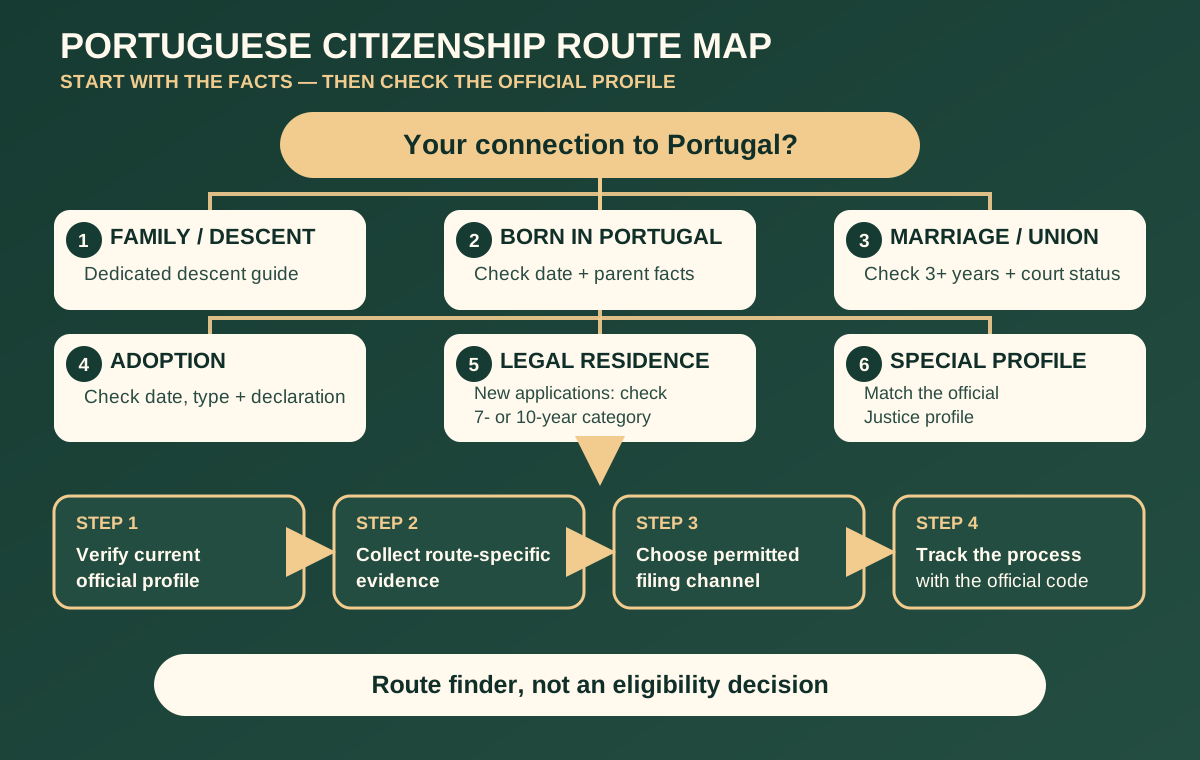
| Starting point | Likely route | What to verify | Next destination |
|---|---|---|---|
| Portuguese family connection | Nationality through family or descent | The exact relationship, dates, civil records and current statutory conditions | Dedicated Portuguese citizenship by descent guide and the matching Justiça profile |
| Born in Portugal | Birth-based profile | Date of birth, age, and each parent’s residence status and period at the relevant time | Official nationality route guide |
| Marriage or court-recognised de facto partnership | Acquisition through marriage or partnership | Duration of the relationship, court recognition for a de facto union, and any evidence of connection required in the case | Official marriage and de facto union profile |
| Adoption before age 18 | Acquisition through adoption | Date and type of adoption and the declaration requirement applicable under the current law | Official nationality route guide |
| Qualifying legal residence | Residence-based naturalisation | Whether the seven- or ten-year category applies and every other current condition | Official residence profile and the 2026 Justice update |
| Exceptional or special circumstances | The specific statutory profile, if any | The exact legal ground and the evidence required for it | Official nationality route guide |
This table is a route finder, not an eligibility decision.
On a small screen, scroll horizontally to view every route.
Requirements depend on the legal basis
There is no general checklist that applies in the same way to every nationality application. Age, Portuguese-language knowledge, residence, connection to the Portuguese community, criminal-law restrictions and supporting records differ by legal basis and sometimes by the relevant dates.
The 2026 reform also changed substantive conditions. Those restrictions should not be reduced to a universal “clean criminal record” test. Open the official profile for the route that fits your facts and check every condition there before ordering, legalising or translating records.
The main routes, in context
Portuguese family connection or descent
If your route is based on a Portuguese parent, grandparent or another qualifying ancestor, read our dedicated Portuguese citizenship by descent guide and verify the current Justiça profile. This general guide does not replace the route-specific rules or evidence needed to prove the family connection.
Birth in Portugal
Being born in Portugal does not produce the same result in every case. The applicable profile can depend on the date of birth, the applicant’s age and facts about a parent’s birth, legal residence or period of residence. Use the official route guide rather than an old “before or after 2018” shortcut.
Naturalisation after legal residence
For new general residence-based applications filed after 19 May 2026, the official framework uses a seven-year category for nationals of Portuguese-speaking countries and EU Member States, and a ten-year category for nationals of other states. Pending applications keep the previous wording of the law. The applicant must still satisfy the other current conditions; time in Portugal alone does not establish eligibility.
If you are an EU citizen who first needs to document residence in Portugal, see the CRUE registration route for EU citizens. Residence registration and a later nationality application are separate processes.
Marriage or de facto partnership
The official profile covers a person who, on the application date, has been married to a Portuguese national or in a de facto partnership with one for more than three years. A de facto partnership must be recognised by a court, nationality is not automatic, and evidence of a connection to the Portuguese community may be required depending on the circumstances.
Adoption
The 2026 law changed acquisition through adoption from an automatic effect to a declaration-based regime. The route finder refers to adoption before age 18, but the date and legal type of adoption matter. Check the current official profile and declaration requirement before acting.
Exceptional or special profiles
The Nationality Law contains specific profiles beyond the common routes summarised here. Do not assume that professional, cultural, scientific or other achievements create a general entitlement. Select the matching profile in the official guide and verify its statutory conditions.
Golden Visa is residence, not citizenship
Portugal’s Golden Visa, formally the Autorização de Residência para Investimento (ARI), is a residence authorisation. It does not grant nationality or create an automatic passport route. An ARI holder may later request naturalisation only through a separate application and only if all requirements of the Nationality Law then in force are met.
This article does not reproduce an investment menu. In particular, it does not present direct real-estate purchases or the former general capital-transfer option as current qualifying ARI investments. Check AIMA’s current page for the residence programme and Justiça for nationality.
How to prepare and submit an application
1. Choose the legal basis
Start with the fact that connects you to Portugal: birth, family, marriage or recognised partnership, adoption, legal residence, or a specific statutory situation. Do not combine requirements from several profiles into one application checklist.
2. Open the matching official profile
Use the Justiça nationality route guide. It is marked as being updated, so also check the consolidated law and the page for your exact profile immediately before filing.
3. Prepare only the route-specific evidence
A profile may ask for birth and identity records, evidence of family connection, marriage or residence, criminal records, proof of Portuguese knowledge, or other case-specific material. Legalisation, an apostille and certified translation apply only where the official instructions for the document and its country of issue require them. A generic list cannot determine what your case needs.
4. Choose a permitted filing channel
The general online nationality-submission service is exclusively for lawyers and Portuguese solicitadores acting as representatives, and online filing is mandatory for those professionals. An applicant without a representative can deliver the request at a Balcão da Nacionalidade or use the postal application service. Some separate services have their own rules, so follow the exact profile and form.
5. Keep the consultation code and answer IRN requests
For a postal filing, IRN states that the applicant receives a consultation code after the case is entered in the system. Keep the code, copies of the filed material and proof of delivery. Monitor the case and respond through the official route if IRN asks for information or documents.
Language and civic-knowledge requirements
Portuguese-language knowledge is not a universal requirement stated identically for every route. The current residence-based profile requires sufficient knowledge of Portuguese and lists accepted evidence and exceptions. Family, birth and other profiles can apply different conditions, so use the relevant official page instead of assuming that every applicant must present the same A2 certificate.
For general naturalisation, the 2026 reform also added requirements concerning Portuguese culture, national history and symbols, fundamental rights and duties, the political organisation of the Portuguese state, and a declaration of adherence to the democratic rule of law. The practical format and accepted evidence must be checked against the regulation and official profile in force when the application is filed.
Fees and processing time vary by case
There is no reliable universal fee or processing-time range for all nationality applications. The state fee depends on the type of request and filing method; verify the amount in the matching application form and the IRN fee regulation. Actual elapsed time can depend on the legal route, submission channel, completeness of the case, requests for further evidence and IRN’s workload.
Do not treat a statutory step or an old article’s estimate as a promise of total elapsed time. After filing, use the official consultation code to follow the recorded case.
Is a NIF required for citizenship?
A Portuguese tax identification number may be needed for residence, investment or tax activity, but it is not a universal document for every nationality application. Check the document list for the exact route.
Need to get your NIF?
Obtaining a Portuguese Tax Identification Number (NIF) is the essential first step in fulfilling your tax obligations in Portugal.
This number is mandatory for property owners, business directors, and all employees, as it is required for any financial and legal transactions within the country.
Dual nationality and EU citizenship
Portuguese law allows a Portuguese national to hold other nationalities and does not itself require a person to give up another nationality. Another country’s law may produce a different result, so check that country’s rules separately before applying.
A Portuguese national is also a citizen of the European Union. This status does not create a universal answer about tax, military, consular, healthcare or education consequences; those questions depend on the relevant country, residence and personal circumstances.
Official sources
Checked 7 September 2026. The general Justiça route guide was marked “em atualização” (being updated) on the check date.
- Consolidated Portuguese Nationality Law — Diário da República
- Justice update on Organic Law no. 1/2026 and the rules effective 19 May 2026
- Justiça guide to nationality profiles — being updated at the check date
- Justiça residence-based nationality profile
- Justiça marriage and de facto union profile
- Justiça online submission service
- Justiça postal application service
- IRN service costs and fee regulation
- AIMA investment residence authorisation (ARI)
Frequently asked questions
What are the main ways to obtain Portuguese citizenship?
The main routes include birth or a Portuguese family connection, marriage or a court-recognised de facto partnership, adoption, residence-based naturalisation, and specific special grounds. This overview helps you find a route; it does not confirm eligibility.
How long do I need to live in Portugal before applying for citizenship?
For new general residence-based applications filed after 19 May 2026, the official framework states seven years for nationals of Portuguese-speaking countries or EU Member States and ten years for nationals of other states. Cases already pending on 19 May 2026 remain under the previous wording of the law. Check the current official profile and implementing rules when you file; meeting a residence period alone does not confirm eligibility.
Does a Portugal Golden Visa give me citizenship automatically?
No. The ARI, commonly called the Golden Visa, is a residence authorisation. Any later naturalisation request is a separate application and must meet the residence period and all other nationality-law requirements in force at that time.
Can I submit a Portuguese citizenship application online myself?
The general Justice online submission channel is exclusively for lawyers and Portuguese solicitadores representing an applicant, and its use is mandatory for those representatives. Without a representative, the applicant can submit in person or by post. Separate services, such as registration for some newborns, have their own rules.
Which documents are required for a Portuguese citizenship application?
There is no universal document list. Depending on the legal route, the official profile may require birth and identity records, evidence of family connection, marriage or residence, criminal records, language evidence, and legalisation or an apostille and certified translation where specified. Use only the list for your exact route.
Does Portugal allow dual citizenship?
Portuguese law allows a Portuguese national to hold other nationalities and does not itself require renouncing another nationality. The law of the other country may restrict multiple citizenship, so check that country’s rules separately.