


















Becoming Autónomo in Spain: Your Practical Registration Guide Without Bureaucracy
In this article
You’ve landed a freelance client in Spain, but what do you need before invoicing them? Start by separating Tax Agency census registration from Social Security registration, and checking which requirements apply to your activity. Getting professional support turns this bureaucratic nightmare into a straightforward online process handled in days, not weeks. Here’s what to prepare, how the two registrations work, and which ongoing obligations to plan for.
Introduction: Why Autónomo Registration Matters
RETA generally covers habitual, personal and direct self-employed economic or professional activity carried out for profit. TGSS states that registration is required for personal, habitual activity regardless of the income it generates. A single invoice amount does not, by itself, settle whether RETA registration is required. Tax Agency census registration is a separate obligation; check both requirements before starting, together with any necessary work authorisation.
Designers, consultants and digital nomads may all need to consider these procedures. The relevant questions are how and where you carry out the activity, not simply where your client is based.
Before starting, establish your registration and filing obligations rather than relying on the amount of your first invoice. Healthcare entitlement, cash benefits and tax deductions each have their own conditions, explained below.
The practical starting point is to check the filing details for AEAT and RETA separately from immigration requirements and any local or activity-specific licences. Gather the information for each procedure before you submit it.
What Does Being Autónomo Actually Mean?
Autónomo is Spain’s legal classification for self-employed workers and freelancers. When you register as autónomo, you’re declaring yourself as an independent professional responsible for your own taxes, social security contributions, and business operations.
The status differs from traditional employment. As an employee, your employer handles payroll withholding and employment contributions. As an autónomo, you manage your own filing and contribution obligations; the returns and filing frequency depend on your activity and tax regime.
Registration involves declaring your economic activity to the Tax Agency, choosing the appropriate activity classification and arranging RETA registration where required. Your tax filings depend on your activity and tax regime; check whether modelo 130, VAT returns and annual income-tax filing apply.
Self-employed workers affiliated and registered with Social Security, or in an equivalent status, are among those eligible for publicly funded healthcare. Check recognition of your entitlement with INSS. Cash benefits, including a future contributory pension, are subject to their own eligibility conditions; registration alone does not guarantee every benefit. Contribution arrears may affect entitlement to cash benefits: check your individual position with Social Security. See INSS healthcare eligibility guidance. Business expenses may also be deductible, subject to the applicable income-tax deduction rules.
Self-employment can suit writers, developers, designers, consultants, coaches, photographers and translators. Before choosing this structure, check any professional or activity-specific requirements that apply to your work.
Who Needs to Register as Autónomo in Spain?
The TGSS registration service identifies personal, habitual economic activity as requiring registration regardless of income. Examples of work to assess against that rule include:
- Freelance professionals providing services to Spanish companies
- Consultants working with EU or international clients while based in Spain
- Digital nomads earning income through online platforms
- Creative professionals like designers, writers, or photographers
- Technical specialists such as developers, engineers, or IT consultants
- Coaches, trainers, and educators offering paid services
- Other independent professional activities
Both EU and non-EU applicants should check the tax and Social Security requirements for their activity. If you are from outside the EU, also check that your immigration status authorises the self-employment you plan to carry out. Registration does not replace that authorisation.
A low invoice amount is not a safe exemption from registration, but the amount of a single invoice does not by itself establish a RETA obligation either. Assess the nature and habitual character of the activity, and check the separate Tax Agency census obligation before starting.
If you combine employment with freelance work or work across borders, assess each activity separately. Do not assume that a foreign client, a company abroad or a short stay in Spain removes your Spanish obligations.
If your situation is unclear, get advice on the applicable registrations before you start.
Essential Requirements and Documents for Registration
Prepare the information for each registration separately. The RETA checklist below is not a universal document list for tax, immigration or licensing procedures.
Information to Prepare
For Tax Agency procedures you need a tax identification number (NIF). For foreign individuals this is generally the NIE. If you do not yet have a NIE, check the Tax Agency’s identification rules and the separate requirements for Social Security registration. See the Tax Agency’s NIF rules.
For RETA registration, prepare your DNI or NIE, Social Security number (NUSS/NAF), activity start date and address, contact details, IAE and CNAE activity codes, expected net income and bank details. During the application, you select a contribution base, any applicable contribution relief and the collaborating mutual insurer (mutua). TGSS may request further information or supporting documents for your circumstances. Check any required residence and work authorisation separately.
Use the TGSS guide’s registration checklist to prepare those details. Provide supporting evidence when requested for your case; do not treat a passport, padrón, rental contract or utility bill as a universal RETA attachment list.
Provide an IBAN for contribution direct debits through a bank or financial institution collaborating with Social Security. Check that your account is accepted before registering. If the account is not in your name, you need the account holder’s identification details and authorisation.
Additional Requirements for Non-EU Citizens
If you are from outside the EU, check that your immigration status authorises your planned self-employment. Review the specific conditions that apply to you, including if your stay is connected with study; do not infer permission or a prohibition from the visa label alone.
If you are unsure about your right to work, check your authorisation documents with the immigration authorities or a qualified adviser before proceeding.
Keep Registration and Other Permissions Separate
Check the filing details for AEAT and RETA separately from immigration requirements and any local or activity-specific licences. A registration checklist does not settle the requirements of those other procedures.
| Procedure or detail | What to prepare or check |
|---|---|
| Tax Agency identification | NIF; generally NIE for foreign individuals. Check AEAT identification rules for your case |
| RETA identity | DNI or NIE and NUSS/NAF |
| RETA activity | Start date, activity address, contact details, IAE and CNAE codes |
| RETA contributions | Expected net income, contribution base, applicable relief and collaborating mutua |
| RETA bank details | Accepted IBAN through a collaborating financial institution; account-holder authorisation if needed |
| Immigration and licences | Check separately for your status and planned activity |
Step-by-Step Registration Process Explained
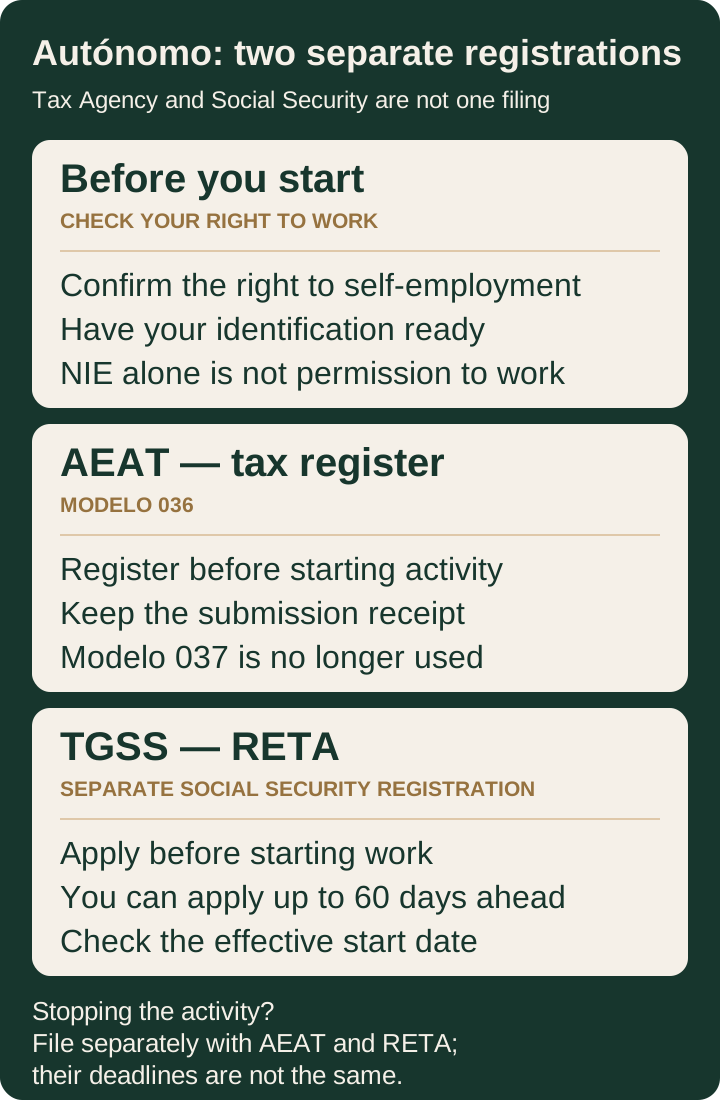
Tax Agency census registration and Social Security registration are separate procedures. Arrange both before starting your activity.
Step 1: Register with Spanish Tax Agency (Agencia Tributaria)
Use modelo 036 to register in the Tax Agency’s census of businesses, professionals and withholding agents before starting your activity. Modelo 037 was abolished on 3 February 2025; simplified assistance is now available through modelo 036 itself. See the Tax Agency’s current modelo 036 guidance.
The form requires the IAE classification that corresponds to your work. Use the Tax Agency’s activity finder to check the classification and tax obligations for your specific activity. If you provide different kinds of services, check whether you need to declare more than one activity. See the Tax Agency’s activity classification guidance.
Check the current filing and identification options in the Tax Agency’s modelo 036 guidance. If you use a professional service, confirm the authorisation it needs to submit on your behalf.
Keep your filing confirmation. Submitting modelo 036 does not enrol you in Social Security: you must handle RETA registration separately.
Step 2: Social Security Registration (Seguridad Social)
Apply separately for RETA, the special Social Security regime for self-employed workers, through Importass: registration for self-employed work. Submit the application before starting your activity; you can do so up to 60 days in advance. During the application, you declare your estimated annual net income and select a contribution base and any applicable benefits.
Eligible new or returning self-employed workers may apply for a reduced contribution (cuota reducida); it is not automatic. Request the initial reduction when applying for registration. Any extension depends on the applicable income and other conditions. Check the TGSS contribution guidance before applying.
Provide an accepted IBAN through a bank or financial institution collaborating with Social Security for contribution direct debits. If the account belongs to someone else, provide the holder’s identification details and authorisation.
Step 3: Start Operating Legally
Keep confirmation of both registrations and check their effective dates before starting. Make sure any immigration or activity-specific permissions are also in place. Your invoices must meet the applicable invoicing requirements.
Set up a basic accounting system from day one. Even simple spreadsheets tracking income and expenses help enormously when quarterly tax time arrives. Many autónomos hire a gestor (tax advisor) to handle ongoing compliance, but you can manage independently if you’re comfortable with tax procedures.
Common Registration Mistakes to Avoid:
- Not checking the separate AEAT and RETA identification requirements
- Choosing wrong activity code and needing to amend later
- Assuming a reduced contribution is automatic instead of checking eligibility and applying at registration
- Not checking that the direct-debit account is accepted by Social Security
- Assuming registration gives residency rights (it doesn’t)
Understanding Your Tax and Social Security Obligations
Registration is just the beginning. Understanding ongoing obligations helps you avoid surprises and stay compliant.
Under the general system, Social Security contributions depend on a contribution base selected within the band corresponding to your estimated average monthly net income. Provisional contributions are later reconciled against income reported by the tax authorities. Eligible new or returning self-employed workers may apply for a reduced contribution (cuota reducida); it is not automatic. An extension beyond the initial period depends on meeting the applicable income and other conditions. Check the current TGSS rules and contribution calculator for your circumstances. See the TGSS guide to contributions and regularisation.
Not every autónomo has to file modelo 130. For professional activities, no instalment return is required for that activity if at least 70% of the previous calendar year’s income was subject to withholding or payment on account; when starting the activity, the test uses the quarter concerned. Where modelo 130 applies to a professional activity in direct estimation, calculate income and deductible expenses cumulatively from the beginning of the calendar year to the end of the quarter, and apply the Tax Agency’s instructions for previous instalments, withholdings and other adjustments. These payments are advances against annual income tax. See the Tax Agency’s modelo 130 instructions.
Annual income-tax filing follows the Tax Agency’s campaign calendar for the relevant tax year. Check the filing dates and any separate direct-debit deadline. Where modelo 100 applies, it brings together your income, payments on account, deductions and final tax liability. Tracking expenses throughout the year makes this easier. See the income-tax campaign calendar.
VAT obligations depend on your activity, the transaction and the applicable regime. Check whether you must file modelo 303, the filing frequency, and whether modelo 390 is required or a filing exception applies. For services to clients outside Spain, check the place-of-supply rules and who must account for VAT. A transaction outside the scope of Spanish VAT, a VAT exemption and reverse charge are not the same. Use the Tax Agency’s VAT tools to check your transaction. See the guidance on VAT returns and cross-border services.
Business expenses may be deductible for income-tax purposes when they meet the applicable requirements: they must relate to the activity, be properly supported and be recorded in the required accounts or books. Do not assume that equipment, mixed-use phone or internet costs, travel or home-office expenses are fully deductible. Check the deductible share and any depreciation or specific home-expense rules. Keep supporting invoices and records. See the requirements for deductible expenses and specific rules for utilities.
Non-residents working as autónomos face different tax rules depending on their residency status. The Spanish Tax Agency provides specific guidance for these situations, which can involve different filing requirements and tax rates.
| Period | Obligation | Form | Due Date |
|---|---|---|---|
| Monthly | Social Security | Direct debit | Last working day of the month |
| Quarterly, if required | Income-tax payment on account | Modelo 130 | Check the current Tax Agency calendar and any direct-debit deadline |
| Quarterly or monthly, as applicable | VAT, if required | Modelo 303 | Check the current Tax Agency calendar and any direct-debit deadline |
| Annually, as applicable | Income-tax return | Modelo 100 | Check the campaign calendar for the relevant tax year |
| Annually, if required | VAT summary | Modelo 390 | Check the current Tax Agency calendar |
Check the Tax Agency’s current tax calendar for the relevant return and year. Direct-debit deadlines can differ from filing deadlines.
How E-Residence Simplifies Your Autónomo Registration
You can handle registration yourself, but it helps to prepare for each system. Check the current filing route, accepted identification method and language support for the procedure. If you need in-person assistance, check appointment availability rather than assuming an office visit is always required.
One expat described their experience dealing with Spanish administrative systems:
“Spanish bureaucracy will break you before it makes you… You need an appointment to get the number, but you also need the number to do most of the things you need the appointment for. The booking system opens at random, fills up in about 30 seconds, and many links don’t work.”
These barriers don’t prevent registration, but they certainly slow it down and increase stress levels.
Professional registration support eliminates these pain points. Services like e-residence handle document preparation, authority communication, and ensure everything files correctly the first time. You submit your information online through an English-language interface. The team prepares all forms, translates documents where needed, and manages submissions directly with Tax and Social Security authorities.
The process becomes: upload your documents → receive confirmation of verification → wait a few business days → get your registration numbers and documentation. No appointments, no Spanish language requirements, no dealing with rejection notices due to minor form errors.
Thousands of freelancers and digital nomads have used this approach to establish legal working status in Spain without the typical bureaucratic headaches. The time saved and stress avoided often justify the service cost, especially when you’re trying to focus on actually starting your business rather than wrestling with administrative procedures.
Most clients report the entire process taking 5-7 business days from initial submission to receiving final confirmation documents. Compare this to 3-4 weeks of independent attempts involving multiple office visits and form resubmissions.
What Happens After Registration?
Registration marks the beginning, not the end. Several immediate actions ensure you start correctly.
First, prepare your invoicing system. Check the identification details, invoice numbering and tax treatment required for your transactions. Before choosing software, confirm that its current version and settings meet the Spanish invoicing requirements that apply to your activity; a product name alone is not a compliance guarantee.
Consider a digital certificate if you plan to handle government procedures directly, and check which identification method each service accepts. FNMT issues digital certificates; check the identity-verification routes and document requirements for the certificate you request. An in-person visit is not required for every route, but the available route depends on your documents and eligibility. For example, FNMT’s video-identification route has its own document requirements; do not assume it is available with a NIE alone.
Consider finding a gestor or accountant. These professionals specialise in Spanish tax compliance and handle quarterly filings, annual returns, and provide advice on deductions and structure. Costs typically run €50-150 monthly depending on complexity and service level. Many autónomos start without a gestor, managing basic compliance themselves, and add professional support as their business grows.
Mark your calendar with the filing deadlines that apply to you. Late filing can have consequences even if no tax is payable. Check your circumstances and how to regularise the filing instead of assuming that the same penalty always applies. The General Tax Law distinguishes different late-filing situations.
Check whether you must file modelo 130 for the quarter in which you start; do not assume that starting mid-quarter removes a filing obligation. Follow the applicable instructions for the calculation and filing deadline.
Plan ahead for annual obligations. Check which income-tax campaign covers your first earnings and when to file modelo 100. Do not count the deadline as a fixed number of months from registration. Tracking expenses from day one will make the return easier.
If you stop all your self-employed activities, deal with both the Tax Agency census deregistration using modelo 036 and the separate RETA deregistration with Social Security. Stopping work alone does not complete either procedure. The final FAQ below explains the separate filing requirements and why you should check the effective RETA end date.
Your First 90 Days Checklist:
- Confirm your contribution direct-debit IBAN is accepted through a collaborating financial institution
- Create invoicing system with proper Spanish format
- Establish expense tracking method
- Mark the deadlines for the returns that apply to you
- Decide whether to hire gestor or manage independently
- Consider professional liability insurance
- Update LinkedIn and professional profiles with legal business status
Key Takeaways
RETA generally covers habitual, personal and direct self-employed activity for profit. Low income is not a blanket exemption, and a single invoice amount does not settle the question. Check the separate Tax Agency census requirements before starting.
There are two separate registrations: AEAT census registration and RETA registration with Social Security. For AEAT you need a NIF, generally the NIE for foreign individuals; for RETA, prepare DNI or NIE and NUSS/NAF. Healthcare recognition and cash benefits have their own conditions.
Prepare your activity details, IAE and CNAE codes, expected net income and an accepted direct-debit IBAN through a collaborating institution. Check AEAT and RETA filing details separately from immigration permissions and local or activity-specific licences; the registration checklist does not replace those checks.
Under the general contribution system, your base is linked to an estimated net-income band and provisional contributions are later regularised. A reduced contribution requires eligibility and an application; there is no automatic fee ladder for every new autónomo. Tax payments and filing duties depend on your activity and tax regime.
Professional support services eliminate language barriers and bureaucratic confusion, condensing a weeks-long process into several business days of online submission and processing.
Ongoing compliance means keeping track of the returns and deadlines that apply to you, monthly Social Security contributions and any annual filing obligations. Record expenses from day one and retain supporting documents.
FAQ
Can I register as autónomo without speaking Spanish?
Yes. If you handle the process yourself, check the language support, instructions and accepted filing routes for each service. Translation tools or bilingual assistance can help you understand the forms, but you should still check the information you submit and plan how to handle later correspondence and returns.
Professional registration services solve this problem by handling all Spanish-language communication and document preparation. You interact in English while they manage authority procedures in Spanish. This approach works well for people who want legal status without learning bureaucratic Spanish terminology. Some autónomos register independently then hire Spanish-speaking gestors to handle ongoing compliance.
How long does the registration process actually take?
Timeline depends on your approach. Independent registration typically takes 2-4 weeks from starting the process to receiving final confirmation from both Tax Agency and Social Security. This assumes you already have NIE and all required documents. Delays usually come from form errors requiring resubmission, appointment availability at Social Security offices, or processing backlogs during busy periods.
Professional services condense this to 5-7 business days in most cases. They prepare everything correctly the first time and use established channels for faster processing. The main variable becomes NIE acquisition if you don’t have one yet — that can add 1-3 weeks depending on your location and nationality.
Plan for at least one full month if you’re starting from scratch without NIE. EU citizens typically move faster than non-EU citizens due to simpler documentation requirements.
Do I need to pay social security from day one of registration?
Yes. Contributions depend on the effective date of your RETA registration, not on when you receive your first income. Registering mid-month does not always mean paying for the full month. According to the TGSS guide, you can choose the effective registration date up to three times a year if you apply on time; in those cases, you contribute from the day of registration. Further registrations that year take effect from the first day of the month in which you start work, and contributions cover the full month. If you apply after starting your activity, the full month’s contribution also applies. Check the effective date recorded for your registration.
A reduced contribution is available only if you meet the conditions and apply for it. Contribution arrears may affect cash benefits; check your individual position with Social Security. The TGSS guide states that contributions are debited on the last working day of the month through a collaborating bank or financial institution. Confirm that your account is accepted.
You can’t pause contributions during slow months unless you formally deregister. Many autónomos maintain registration year-round even during vacation periods or temporary work slowdowns because the deregistration and re-registration process is cumbersome.
Can I work as autónomo while also employed by a company?
Absolutely. Spanish law allows combining employed work with autónomo activity. Many people maintain salaried positions while freelancing on the side. You’ll pay social security contributions for both statuses — your employer handles employment contributions while you pay autónomo contributions separately.
Where modelo 100 applies, it brings together income from employment and self-employment, with the deductions that apply to your activity. Where required, modelo 130 payments relate to your self-employed activity, not your employment salary; check the professional-activity withholding exception described above.
Some employment contracts include non-compete clauses that restrict freelancing in the same industry. Review your contract before registering as autónomo to avoid conflicts. Also check whether your role is subject to specific incompatibility rules.
What happens if I stop working — do I need to deregister?
Yes. If you stop all your self-employed activities, submit a census deregistration (baja) using modelo 036 to the Tax Agency. For cessation of activity, the Tax Agency’s modelo 036 guidance gives a filing deadline of one month from cessation. This is a filing deadline, not a processing time or the date Social Security contributions stop.
Separately, request your RETA deregistration through Importass: deregistration from self-employed work when you finish all the self-employed activities you have reported. Check that service’s current filing deadline; the Tax Agency’s one-month deadline does not apply to RETA.
Do not assume contributions stop the month after you file. The effective RETA end date and final contribution depend on whether you file on time and on earlier registrations and deregistrations in the same calendar year. Check the TGSS guidance on repeated registrations and deregistrations and your own record. Before deregistering for a temporary break, also check the conditions for any contribution relief if you register again.