


















TIE Card Spain: The Real Guide (What to Expect and How to Avoid Delays)
In this article
Applying for your TIE card in Spain can feel like entering a labyrinth of forms, appointments, and waiting rooms. The process looks simple on paper — book a slot, bring documents, and collect your card — but in reality, it’s rarely that linear.
At e‑Residence, we’ve guided hundreds of foreigners through it. And while Spain’s system isn’t the fastest, there are clear ways to make it smoother. In this guide, we’ll skip the bureaucratic jargon and share what really matters when applying for your Tarjeta de Identidad de Extranjero — from timing tricks to insider advice on what to do when appointments disappear.
Understanding the TIE: Why It Matters
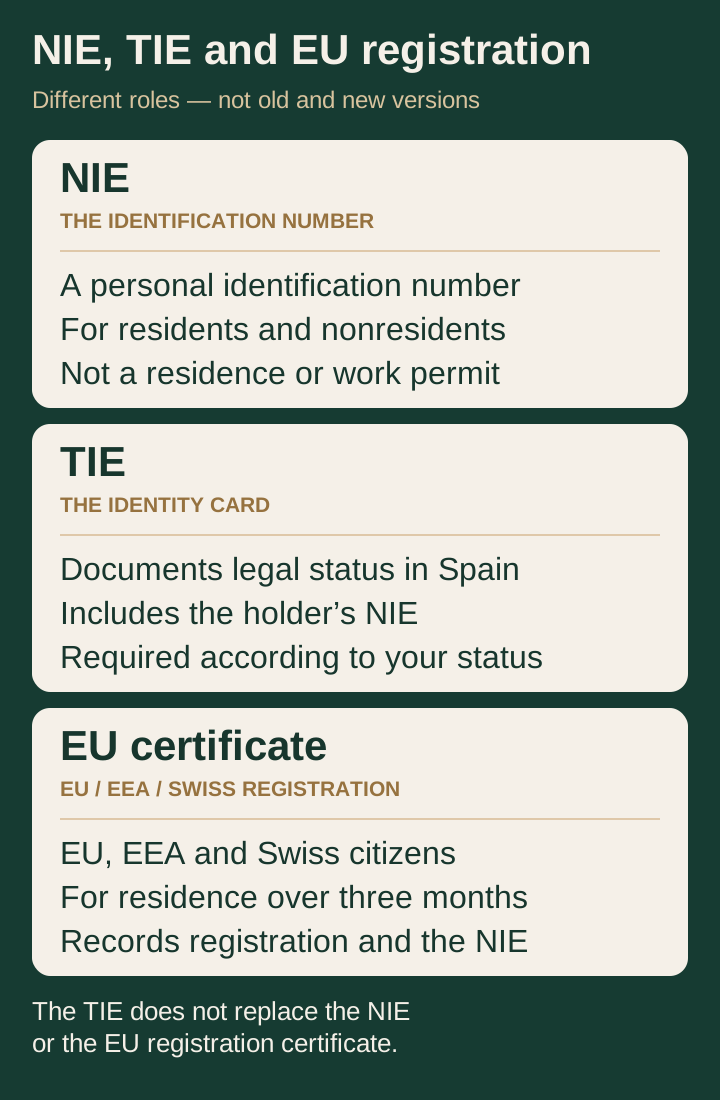
The TIE (Tarjeta de Identidad de Extranjero) is the physical identity card that documents a foreign national’s legal status in Spain. It records an existing authorisation or right to stay; it does not itself grant residence or permission to work.
Under the general immigration rules, a TIE is required when a visa or authorisation allows you to remain in Spain for more than six months; the law exempts holders of a seasonal residence and work visa from this obligation. EU, EEA, and Swiss citizens use the EU citizen registration certificate route for residence exceeding three months, rather than a TIE. Check the legal TIE requirement and the Police guidance on EU registration for your situation.
TIE vs. NIE — What’s the Difference?
Many newcomers confuse the two, so let’s clear it up. The NIE (Número de Identidad de Extranjero) is a personal, unique foreigner identification number, not a residence permit. It identifies you in dealings with Spanish authorities and can be assigned to residents and non-residents. The TIE is a separate physical document that shows your legal status and includes your NIE. The immigration regulation distinguishes the number from the card.
| Feature | NIE | TIE |
|---|---|---|
| What it is | Personal foreigner identification number | Physical foreigner identity card |
| Format | A number recorded on certificates and other documents | A card bearing the holder’s identification details |
| Used for | Identification in administrative dealings | Evidence of the holder’s legal status in Spain |
| Who gets it | Foreign nationals with relevant ties to Spain, including non-residents | Foreign nationals whose immigration route requires the card |
| Relationship | The number is not a residence permit | The card includes the NIE; it does not replace the number |
The TIE has not replaced the documents commonly called NIE Blanco and NIE Verde. “NIE Blanco” usually means the white certificate recording an assigned NIE; it does not grant residence. “NIE Verde” refers to the EU citizen registration certificate (certificado de registro de ciudadano de la Unión), which records registration in the Central Register of Foreign Nationals and includes the NIE. They are different documents for different purposes, not older versions of the TIE. For the full comparison in one place, see NIE vs TIE in Spain. The Police still provide separate procedures for NIE assignment, EU citizen registration, and TIE issuance.
The TIE Process: What Actually Happens
The steps below concern the physical card. Your residence or stay authorisation has its own application and renewal requirements.
Step 1: Booking the Appointment
⚠️ The general filing deadline is one month, not a universal 30 calendar days: it runs from entry into Spain or from the grant or effective date of the authorisation, depending on the case. Where the authorisation depends on Social Security registration, that affects when it takes effect. This is an application deadline, not a card-delivery time. See Article 209 of the immigration regulation. If you cannot obtain an appointment in time, contact the responsible office promptly; do not assume that you must restart your visa application.
Use the government’s appointment portal and select the Police card-issuance or fingerprint procedure that matches your authorisation. The procedure name and available offices depend on your route and province.
Pro tip from our team: check early mornings (between 7:30–9:00 AM) or mid‑week evenings. Refresh often — new slots open randomly. If you live in Madrid or Barcelona, consider smaller nearby towns. Sometimes a short train ride saves weeks of waiting. The booking logic is the same one we describe in our NIE appointment guide — same portal, same slot hunting.
Check the instructions for your specific appointment, including which office is competent and whether you need an empadronamiento certificate. Do not assume a lease or utility bill is an accepted substitute, or that the same address-document rules apply to every TIE procedure.
Step 2: Preparing the Paperwork
Use the Police TIE procedure and your appointment instructions to confirm the documents for your route. The following is a preparation guide, not a universal checklist:
- Your valid passport or travel document, with the copies requested
- The application form for your procedure: EX-17 for the general Police TIE procedure
- The authorisation decision or other evidence of your legal status required for your case
- A recent colour ID photo with a white background; confirm the specifications and quantity in your appointment instructions
- Payment receipt for fee form 790/012
- Address evidence, if required for your procedure
If your authorisation is conditional on Social Security registration, that registration must be in place before the card is issued; having a Spain Social Security Number is not the same as being registered. The Barcelona City Council TIE guide also distinguishes general applications from certain other routes with different forms and address requirements. If you are still getting the NIE number itself as a non-EU citizen, our document checklist for non-EU citizens covers that separate step.
📋 Checklist:
Organise your originals and the copies requested in your appointment instructions. Keep a copy of what you submit.
Step 3: Paying the Fee
Pay the applicable fee before your appointment and keep the receipt. Select the correct TIE category on the official 790/012 form rather than relying on a fixed fee range. The Police procedure lists banks, savings banks, and credit cooperatives as payment locations; you do not need an account there.
Step 4: The Appointment Itself
At the appointment, you submit the required documents and, where applicable, have your fingerprints taken. Keep the receipt (resguardo) and follow the office’s collection instructions.
Ask how to check when your card is ready; do not assume a fixed issue time.
Submission and collection are separate stages. Check whether your office requires a separate collection appointment.
Step 5: Collecting Your TIE
When you return, bring your passport and the resguardo, following the office’s instructions. Separate appointment availability from card production and collection rather than relying on a city-by-city estimate.
| Stage | What to check |
|---|---|
| Appointment | Availability for your procedure at the competent office |
| Card issuance | How the office tells you the card is ready |
| Collection | Location, documents, and whether a collection appointment is needed |
Common Mistakes (and How to Avoid Them)
- Wrong form: download the current form for your specific procedure from the official website.
- Appointment not confirmed: save the booking confirmation and check the date, office, and procedure.
- Address evidence: check whether your procedure requires empadronamiento and what issue date it accepts — the padrón guide explains certificado vs volante and the renewal rules.
- Missing copies: bring the copies specified in your appointment instructions.
- Confusing deadlines: distinguish the deadline for the TIE application from the expiry and renewal of your authorisation.
What No One Tells You About the TIE
- A visa is not the only basis for a TIE. The applicable documents depend on your authorisation and whether you are applying for an initial card, a renewal, or a replacement.
- Check the instructions for your procedure. Do not assume that advice about another office or immigration route applies to you.
- Don’t panic about language barriers. If you don’t speak Spanish, bring a friend or translator — most officers appreciate the effort.
- Appointment availability can change. Check the official booking system; there is no guaranteed booking time in this guide.
Renewing Your TIE (and Why You Shouldn’t Wait)
Renewing a residence or stay authorisation and obtaining a new physical TIE are different steps. Check the filing window for your authorisation rather than applying a universal 60-day rule. For a residence-authorisation renewal, the Police guidance says to request the TIE once the favourable decision has been notified.
A pending renewal is not a guarantee that an expired card can be used for international travel. Before leaving Spain, check whether you need an autorización de regreso; it is subject to conditions and is valid for entry through authorised Spanish border crossings, not as a general travel document for other countries.
Obligations After Receiving Your TIE
Getting your card isn’t the end — it’s the beginning of your administrative life in Spain. Once you have it:
- Check your healthcare entitlement before registering with a local health centre.
- Update your address whenever you move.
- Keep digital copies of your TIE and visa.
- Keep your identity and immigration documents valid and safe.
Real‑World Advice from e‑Residence
After helping hundreds of clients through this process, here’s what we’ve learned:
- Arrive early, be polite, and bring your documents in order — it genuinely speeds things up.
- Don’t assume all advice on expat forums applies to your case. Spain’s bureaucracy is local — what works in Valencia might fail in Madrid.
- Make digital backups of every document you submit.
- Most delays happen because applicants overlook one small detail — signatures, copies, or expired proofs.
Frequently asked questions
Do I need a TIE card in Spain?
Under the general immigration rules, a TIE is required for a visa or authorisation allowing a stay of more than six months, with an exception for seasonal residence and work visas. EU, EEA, and Swiss citizens follow the EU citizen registration certificate route for residence exceeding three months. Having an NIE alone does not grant residence or permission to work.
TIE requirements and exceptions
What is the difference between the NIE and the TIE?
The NIE is a personal, unique foreigner identification number, not a residence permit. The TIE is a physical identity card documenting your legal status in Spain and includes your NIE. It has not replaced the NIE assignment certificate often called NIE Blanco or the EU citizen registration certificate commonly called NIE Verde.
NIE and TIE in the immigration regulation · Barcelona City Council explains NIE Blanco, NIE Verde, and TIE
If a form additionally asks for the “soporte number”, do not look for it in the NIE: the soporte number guide for the TIE, the green certificate and the NIE shows where that datum sits on each document and how to enter it in the official format. And if you need to read or verify the number itself, the NIE format guide breaks down the string letter by letter.
What documents do I need for a TIE in Spain?
Check the instructions for your specific procedure. The general Police TIE procedure uses EX-17 and proof of payment of fee 790/012. You must also check the identity, authorisation, photo, and any address documents required for your case; do not treat two photos or an empadronamiento certificate less than three months old as universal requirements.
How do I renew my TIE card in Spain?
Distinguish renewal of your authorisation from issuance of a new card. Check the deadline for your authorisation; for a residence-authorisation renewal, the Police say to request the TIE after notification of the favourable decision. Do not assume a pending renewal makes an expired card valid for travel: check whether you need an autorización de regreso before leaving Spain.
Police guidance on autorización de regreso
What photo do I need for the TIE appointment?
Check the photo format and quantity in your appointment instructions. Barcelona City Council’s TIE guide lists one recent colour ID photo with a white background. Do not treat two photos as a nationwide requirement.
Barcelona City Council TIE guide
Final Thoughts
The TIE process isn’t impossible — it’s just Spanish. It rewards patience, preparation, and good timing. Having the right documents helps with daily administration, but a TIE is not a universal prerequisite for every service.
At e‑Residence, we’re here to make that process easier — not just by explaining the rules, but by sharing what actually works. Because when it comes to Spanish bureaucracy, a little insider knowledge can save you weeks of waiting.