


















NIE vs TIE in Spain: Which One Do You Actually Need?
In this article
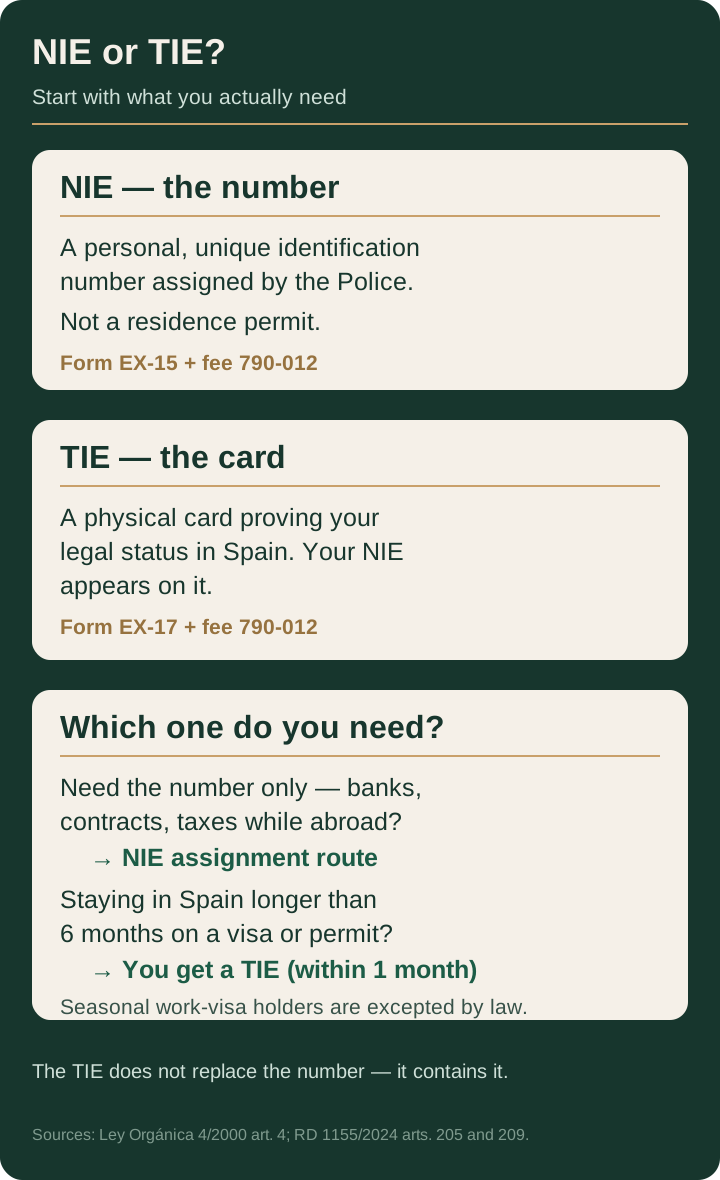
Short answer. The NIE is a number: your personal, unique foreigner identification number. The TIE is a card: the physical document that proves your legal status in Spain, and your NIE appears on it. You apply for the number with EX-15; you obtain the card with EX-17 when your visa or authorization covers more than six months in Spain. They are different documents for different jobs — and many people legitimately need both.
For the service picture around the number — applying, costs, fast-tracking — see NIE in Spain. This article stays on the difference between the two documents.
What the NIE is — a number, not a permit
The NIE (Número de Identidad de Extranjero) is defined in the immigration regulation as a personal, unique and sequential number given to foreigners who start a Spanish procedure, have an administrative file opened under the immigration rules, or relate to Spain for economic, professional, social or other interests. It is the foreigner’s identifier: it appears on documents issued to you and on passport stamps, except visas. The regulation states this in Article 205 of RD 1155/2024.
Two things follow from that definition, and both cause everyday confusion:
- The NIE is not a residence permit. Having a number does not authorize you to live or work in Spain. It identifies you.
- The number is for life. Cards and certificates around it expire and get reissued; the number itself stays.
If your question is “how do I get this number”, our NIE application guide covers the routes, and the appointment guide explains the official booking entry points.
What the TIE is — the card that documents your status
The TIE (Tarjeta de Identidad de Extranjero) is the physical identity card for foreigners. Under Article 4.2 of Organic Law 4/2000, every foreigner issued a visa or an authorization to stay in Spain for more than six months has both the right and the duty to obtain the TIE, requesting it personally within one month of entering Spain or of the authorization being granted or taking effect (which depends, where applicable, on Social Security registration). Holders of a seasonal residence and work visa are excepted from that obligation.
Three consequences worth stating plainly:
- The TIE documents your status. Article 209.2 of the regulation describes it as the document that identifies the foreigner for the purpose of proving their legal situation in Spain.
- The TIE expires with your authorization. It carries the same validity period as the authorization or right that justifies it, and it loses validity when that ends (Article 209.7).
- Your visa stops being your document once the TIE exists. A valid visa accredits your situation until you obtain the corresponding TIE (Article 208).
If you are dealing with the card itself — appointments, fingerprints, collection — the TIE card guide is the dedicated walkthrough. This article stays on the difference, not the card process.
Side-by-side: number vs card
| Feature | NIE | TIE |
|---|---|---|
| What it is | Personal, unique foreigner identification number | Physical card documenting your legal status |
| Legal basis | RD 1155/2024, Art. 205 | Organic Law 4/2000, Art. 4.2; RD 1155/2024, Art. 209 |
| Who needs it | Foreigners with Spanish procedures or interests (including non-residents) | Holders of a visa or authorization for more than six months (seasonal work-visa holders excepted) |
| Official form | EX-15 (assignment and certificates) | EX-17 (initial card or renewal) |
| Fee | Modelo 790 Código 012 | Modelo 790 Código 012 (TIE category) |
| Does it expire | The number does not expire | Same validity as the underlying authorization |
| Relationship | The identifier itself | Contains the NIE; does not replace it |
The comparison table above is the practical core of this article: one identifier, one document. Where guides mix them up, the mistake is usually treating “NIE” as if it were a card — or assuming a card is needed to get the number.
How the two procedures differ
Both procedures are run by the National Police (Dirección General de la Policía), and both use the same fee form (Modelo 790 Código 012), but the forms, appointments and purposes are separate:
- NIE assignment (“Asignación de NIE a instancia de interesado”): for foreigners who relate to Spain for economic, professional or social reasons. The police procedure page lists form EX-15, the 790-012 payment receipt, and the requirement to state your reason. The procedure must be resolved within five days; if you apply from outside Spain, you go through the Spanish consular offices. Non-residents regularly hold only this number.
- TIE issuance (“Tarjeta inicial o renovación residencia o residencia y trabajo”): for residents who already hold the authorization. The police procedure page lists form EX-17 and the same fee receipt. The card is requested after your visa or authorization exists — not instead of it.
Because the two procedures share the fee form, people assume they share the appointment type. They do not: an EX-15 number-assignment appointment does not produce a card, and an EX-17 card appointment does not assign a bare number. Check which procedure your appointment names before you travel.
Want a second pair of eyes on your route? E-Residence works with NIE requests and can review which procedure fits your situation. Start an NIE enquiry — a private service, not a government booking.
Which one do you actually need?
Use the three scenarios below as orientation. They follow from the legal definitions above; your own authorization or consular instructions remain the decisive reference.
You only need the number. Opening a bank account, signing a contract, paying taxes from abroad, buying property — these identification needs are met by the NIE itself. If you are not moving to Spain, a card is not part of the picture: the NIE can be assigned to non-residents through the assignment procedure, or from abroad through a consulate.
You are moving to Spain on a long-stay visa or residence authorization. Once your visa or authorization covers more than six months, the TIE is both your right and your obligation, requested within one month on the terms of Article 209. In that situation the question is not “NIE or TIE” — your number will have been assigned in the process, and the card documents your status. A visa in your passport accredits your situation only until the TIE is obtained.
You are an EU, EEA or Swiss citizen. The TIE is not your route: residence over three months goes through the EU citizen registration certificate (the “green certificate”), a separate procedure with its own card or folio format. See the registration certificate guide and the NIE Verde page for that branch. If a form asks for the “soporte number” of your document, the soporte number guide explains the E+8 and C+8 formats.
Common confusions, cleared up
- “The TIE replaced the NIE.” No. The number and the card are different documents; the card includes the number. The police keep separate procedures for assignment and card issuance, which is the clearest proof that neither substitutes the other.
- “I have a visa, so I already have a NIE.” Visas are expressly excluded from the list of documents where the NIE appears: the number is recorded on documents issued to you and on passport diligencias, but not on the visa itself (Article 205.2). For long-stay visas the number is assigned ex officio as part of the procedure — check your own resolution before assuming.
- “A TIE alone is enough for everything.” The card documents your status; where a form asks for the NIE, you provide the number that appears on it. One identifies the person, the other the card — the soporte guide shows how the two sit side by side on the same documents, and the NIE format guide explains the number itself.
- “One month means the card arrives in a month.” The one-month rule in Article 209.1 is a requesting deadline for the card, not a delivery time. Follow your office’s instructions on collection.
Frequently asked questions
Is the NIE the same as the TIE?
No. The NIE is a personal, unique identification number for foreigners; the TIE is the physical card that documents your legal status in Spain and includes your NIE. The immigration regulation treats them as different documents with different procedures.
Do I need a TIE if I already have a NIE?
Not automatically. A TIE is required when a visa or authorization allows you to stay in Spain for more than six months; seasonal work-visa holders are excepted. A NIE alone identifies you but does not prove residence.
How long do I have to apply for the TIE?
You must request it personally within one month of entering Spain, or from the date the authorization is granted or takes effect, depending on your Social Security registration. See Article 209 of RD 1155/2024 and your own authorization’s instructions.
Which form is used for the NIE and which for the TIE?
The National Police lists EX-15 for NIE assignment and certificates, and EX-17 for the TIE. Both use the Modelo 790 Código 012 fee receipt, but the forms and appointments are not interchangeable.
Does the TIE replace the NIE?
No. The TIE contains the NIE and documents your legal status; it does not replace the number. EU, EEA and Swiss citizens follow the separate registration-certificate route.
Can I get a NIE without becoming a resident?
Yes. Non-residents who relate to Spain for economic, professional or social reasons can request the number from the Dirección General de la Policía, stating their reason; applicants outside Spain apply through Spanish consular offices.
Does the TIE expire?
The TIE carries the same validity as the authorization or right that justifies it and loses validity when that authorization ends. The NIE number itself does not expire.
Official sources
- Organic Law 4/2000, Article 4 — right to documentation, TIE obligation over six months, seasonal-visa exception
- RD 1155/2024 (immigration regulation), Article 205 — the NIE
- RD 1155/2024, Articles 208–209 — visa validity and the TIE
- National Police — NIE assignment procedure (EX-15)
- National Police — TIE initial card or renewal procedure (EX-17)
Editorial note. Deadlines, forms and fee categories change. Re-check the linked official pages on the day you act; this article does not decide individual cases.