


















Buying Property in Spain: Complete Guide for Expats (2026)
In this article

Author: Content Team, E-Residence
Expert Review: María González Ruiz, Spanish Property Lawyer, Colegio de Abogados de Madrid
Reading Time: 15 minutes
Legal Disclaimer
This guide provides general educational information about Spanish property purchase procedures. It is not legal, tax, or financial advice and should not be relied upon as such.
Spanish property law, tax regulations, and residency requirements are complex, vary significantly by autonomous region (comunidad autónoma), and change frequently through new legislation. Every property transaction has unique circumstances requiring individual professional assessment.
You must:
- Consult a licensed Spanish lawyer (abogado colegiado) registered with a Spanish Bar Association (Colegio de Abogados)
- Engage an independent tax advisor familiar with Spanish and international tax law
- Verify all information with official Spanish government sources
- Confirm current regulations at time of your purchase
Financial Risk Warning: Property purchase involves substantial financial commitment and risk. Prices can fall as well as rise. Currency exchange rate fluctuations can significantly affect costs for foreign buyers. You may lose money on your investment.
Can Foreigners Buy Property in Spain?
Yes, without any restrictions. Spanish law explicitly permits foreign nationals from any country to purchase property freely, as established under Article 33 of the Spanish Constitution and regulated by Law 29/1994 on Urban Leases (BOE-A-1994-26003).
The process requires obtaining a NIE (Número de Identidad de Extranjero) tax identification number, opening a Spanish bank account, and paying between 10-15% of the property value in taxes and professional fees beyond the purchase price. Foreign buyers completed 64,247 property transactions in 2025, representing 13.2% of all Spanish property purchases—a 6.8% increase from 2024, according to the Spanish Property Registrars Association (Colegio de Registradores) (Source: Estadística Registral Inmobiliaria, December 2025).
National property prices increased an average of 7.3% in 2025 according to Spain’s National Statistics Institute (INE), with significant regional variations: coastal areas saw 11-15% growth while inland regions averaged 4-6% (INE Property Price Index Q4 2025).
What makes this process different from other countries: Spain uses a civil law system with mandatory notarial deeds (escrituras públicas), comprehensive property registry requirements, and self-assessed taxation where buyers must calculate and pay their own taxes within strict deadlines. The typical transaction takes 8-12 weeks from initial offer to completed ownership registration.
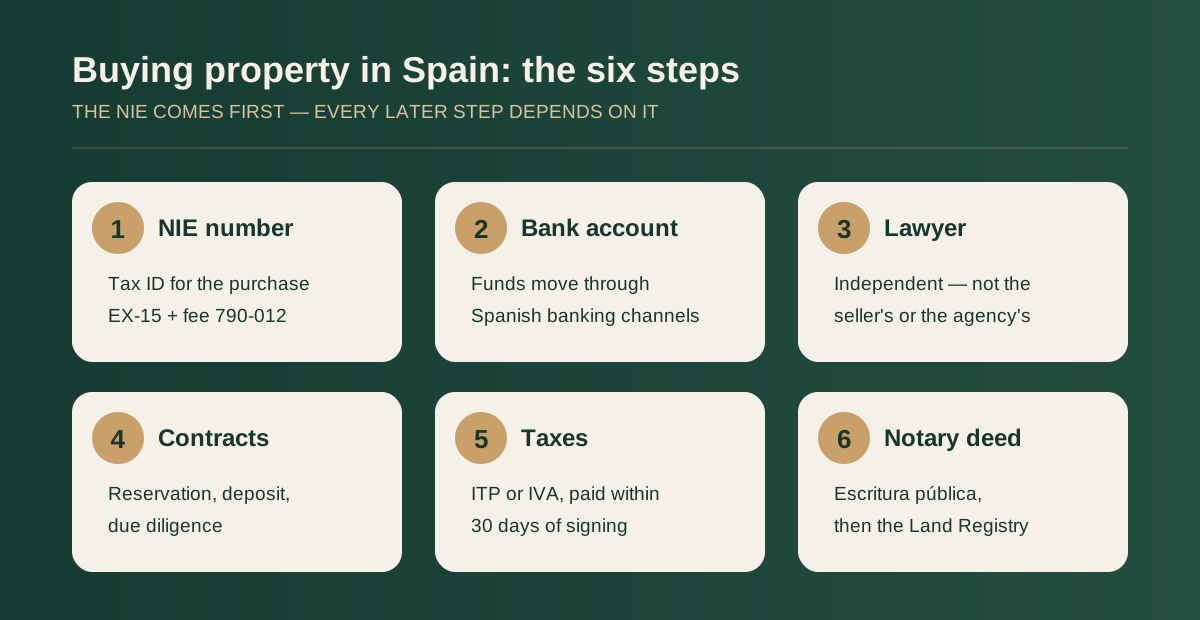
Step 1: Get Your NIE Number
The NIE is your Spanish tax identification number, mandatory for all significant financial transactions including property purchases, opening bank accounts, and signing contracts. It’s regulated by Organic Law 4/2000 on Rights and Freedoms of Foreigners (BOE-A-2000-544).
Critical distinction: A NIE for property purchase is NOT a residence permit. You’re applying for tax identification only, which doesn’t grant any right to reside in Spain beyond standard tourist allowances (90 days per 180-day period for non-EU nationals under Schengen rules).
NIE Application Methods and Realistic Timelines
Four official routes (as of February 2026):
| Method | Processing Time | Cost | Application Form | Best For |
|---|---|---|---|---|
| Spanish Consulate (abroad) | 15-30 business days | €10.71 | EX-15 | Planning 2+ months ahead |
| Immigration Office in Spain | 5-10 business days | €10.71 | EX-15 | Already visiting Spain |
| Authorised Representative (Power of Attorney) | 10-15 business days | €10.71 + representative fees (€200-€400) | EX-15 + notarised POA | Remote purchase |
| Police Station (some provinces) | Same-day to 5 days | €10.71 | EX-15 | Limited availability |
Source: Spanish Immigration Office, Ministry of Inclusion and Social Security, updated January 2026
Required Documentation
Per Immigration Regulations (Article 205, Royal Decree 557/2011):
- Valid passport (original plus 2 photocopies of identity pages)
- Completed Form EX-15 (download official form)
- Justification letter explaining reason for NIE request (property purchase contract qualifies, or simple letter stating intention to buy property)
- Modelo 790 Código 012 payment receipt (€10.71 fee payment proof)
- If applying via representative: Notarised Power of Attorney (poder notarial) with apostille if signed outside Spain For the non-EU document checklist with the official sources, see our guide: Spanish NIE requirements for non-EU citizens.
Real Client Experience: “An American client applied for his NIE through the Spanish Consulate in Los Angeles on November 15, 2025. He received it on December 18—exactly 33 days, longer than the stated 15-30 days due to Thanksgiving holiday closures in both US and Spain. Always factor in holiday periods when planning your timeline.” — E-Residence Client Services Team, January 2026
Pro Tip: If applying from the US, UK, or Canada, consulate processing times vary dramatically by location. Houston, Edinburgh, and Toronto consistently process faster than New York, London, or Los Angeles due to lower application volumes. Call ahead to ask current processing times.
The NIE number itself remains valid indefinitely once issued. However, if you don’t proceed with your property purchase within 3-6 months, some banks and notaries may request updated documentation confirming the NIE remains active and you haven’t been denied residency or had legal issues in Spain.
Step 2: Open a Spanish Bank Account
For the full non-resident banking walkthrough — documents, banks that work without an NIE, and timelines — see our guide to opening a bank account in Spain as a non-resident.
Spanish banking regulations (Law 10/2010 on Prevention of Money Laundering) require property purchase funds to transfer through Spanish banking channels. Foreign transfers directly to sellers aren’t accepted by notaries for property transactions due to anti-money laundering compliance.
Non-Resident Accounts (Cuenta No Residente)
Spanish banks offer specialised accounts for foreign property buyers who don’t have Spanish tax residency. These accounts function identically to resident accounts for property transactions but may have different fee structures and require less documentation for opening.
Major Banks with Strong Expat Support (2026 Assessment):
| Bank | English-Language Service | Online Banking | Mortgage Availability | Typical Monthly Fee |
|---|---|---|---|---|
| Banco Sabadell | Excellent (dedicated expat units in coastal areas) | Yes, full English interface | Yes (non-resident terms) | €0-€10 |
| BBVA | Good (major cities, limited in rural areas) | Yes, multilingual app | Yes | €0-€8 |
| Santander | Good (international network advantage) | Yes | Yes | €0-€12 |
| CaixaBank | Moderate (largest branch network) | Yes (limited English) | Yes | €0-€10 |
Account Opening Requirements

Under Bank of Spain regulations (Circular 2/2014):
- Valid passport (original for in-person verification)
- NIE certificate (original or certified copy—banks won’t accept photocopies)
- Proof of address in home country (utility bill, bank statement, or government document dated within 90 days)
- Proof of occupation or income source (employment letter, business registration, or pension documentation for anti-money laundering compliance)
- Initial deposit: €100-€500 depending on bank and account type
- Spanish mobile phone number (some banks provide temporary numbers for account setup)
Anti-Money Laundering Compliance: Banks will ask detailed questions about source of funds for your property purchase. Prepare documentation showing fund accumulation—savings history, sale of previous property, inheritance documentation, investment liquidation statements, etc. This is standard procedure, not suspicion of wrongdoing.
Processing Timeline:
- In-branch appointment: 30-45 minutes
- Document verification: 1-3 business days
- Account activation: 5-10 business days total
- Online banking access: 24-48 hours after activation
- Physical debit card arrival: 7-10 business days by mail
The account must be fully operational before you sign the final property deed, as notaries require verified proof of fund availability and won’t proceed without confirmation funds are in a Spanish account under your control.
Step 3: Hire Your Independent Spanish Lawyer (Most Critical Step)
This is your most important protection. Your abogado (lawyer) is the only professional in the transaction who represents your interests exclusively. Real estate agents represent sellers, notaries are impartial officials, developers’ lawyers protect developers—only YOUR lawyer protects YOU.
What Your Lawyer Must Verify
According to best practices from the Spanish Bar Association (Abogacía Española), comprehensive due diligence includes:
1. Property Registry Search (Nota Simple)
Your lawyer orders an official extract from the Property Registry showing:
- Current registered owner(s) with full identification
- Exact property boundaries and registered surface area
- Any mortgages (hipotecas) registered against the property
- Easements (servidumbres) such as rights of way
- Restrictions on use or sale
- Court orders or legal proceedings affecting the property
Cost: €9 per online search via Colegio de Registradores
Processing: Instant for online requests
2. City Hall Search (Ayuntamiento)
Verifies at the local municipal government:
- Property has valid occupancy licence (cédula de habitabilidad)
- All construction work has proper building permits (licencias de obra)
- No demolition orders (órdenes de demolición) exist
- No unpaid municipal taxes (IBI arrears)
- Property zoning classification allows your intended use
- No pending urban planning changes affecting the area
Cost: €50-€150 depending on municipality
Processing: 15-30 business days (varies significantly by municipality size and efficiency)
3. Community Verification (for apartments and urbanisations)
Your lawyer must obtain and review:
- Last 12 months of community meeting minutes (actas de la junta)
- Community statutes (estatutos) and internal rules (normas de régimen interior)
- Certificate of no debt (certificado de estar al corriente de pago) from community administrator
- Details of any approved but unpaid special assessments (derramas)
- Community budget and reserve fund status
Spanish Horizontal Property Law (Law 49/1960, updated by Law 8/2013, BOE-A-2013-3780) makes properties—not owners—liable for community debts. You inherit these obligations when you buy.
Expert Warning from the Field:
“We rejected 3 out of every 20 properties during due diligence in 2025. Most common issues: unpaid community fees inherited by new owner under Spanish law, illegal pool constructions without permits, and properties with extensions built without proper authorisation. One client almost bought a villa with a €47,000 community debt from unpaid special assessments going back four years. The nota simple showed zero debt because community debts don’t always appear in Property Registry records—you must request direct confirmation from the community administrator.” — Alberto Fernández Llorente, Property Lawyer, Málaga, 18 years experience
Legal Fee Structure (February 2026 Market Rates)
| Transaction Complexity | Fee Range | Typical Services Included |
|---|---|---|
| Standard apartment (no complications) | €1,200-€1,800 | All due diligence, deed review, signing attendance |
| Detached house/villa | €1,800-€2,500 | Above plus extensive urban planning verification |
| Rural property | €2,200-€3,500 | Above plus water rights, access rights, agricultural checks |
| New build from developer | €1,500-€2,200 | Contract review, bank guarantee verification, snagging |
| Bank repossession | €2,000-€3,000 | Title reconstruction, debt clearance verification |
How to Choose Your Lawyer:
- Must be colegiado (member of official Spanish Bar Association)
- Verify membership at Consejo General de la Abogacía Española
- Must carry professional indemnity insurance (seguro de responsabilidad civil profesional)
- Ask for references from other foreign buyers (not from agents)
- Confirm they have no commercial relationship with the seller, agent, or developer
Red Flag to Avoid: If an estate agent, developer, or seller “recommends” a lawyer with phrases like “our trusted lawyer who works very efficiently” or “the lawyer everyone uses,” politely decline. This creates an inherent conflict of interest. The lawyer’s efficiency serves their repeat client (the seller/agent), not you as the one-time buyer.
Step 4: The Contract Process
Spanish property purchases involve two contracts before the final deed:
Reservation Contract (Contrato de Reserva)
This preliminary agreement removes the property from the market for a specified period (typically 10-30 days) allowing time for due diligence.
Typical Deposit Amounts (2026 Market Practice):
| Property Value | Standard Reservation Deposit | Duration |
|---|---|---|
| Under €200,000 | €3,000-€6,000 | 10-15 days |
| €200,000-€500,000 | €6,000-€10,000 | 15-20 days |
| €500,000-€1,000,000 | €10,000-€20,000 | 20-30 days |
| Over €1,000,000 | €20,000+ or 1-2% of price | 30-45 days |
The reservation deposit should be refundable if:
- Property Registry search reveals undisclosed mortgages or restrictions;
- City Hall search shows lack of proper building permits or occupancy licence;
- Property fails structural survey (if survey clause included);
- Mortgage application denied (only if financing contingency clause included);
- Seller cannot provide clear title.
You lose the deposit if you simply change your mind without contractual justification, your mortgage is denied but you didn’t include financing contingency, or you fail to complete purchase within agreed timeline without valid reason.
Deposit Contract (Contrato de Arras)
After successful due diligence, you sign the contrato de arras—the legally binding private contract that commits both parties to complete the sale.
Spanish Civil Code (Articles 1452-1454) recognises three types, but 90% of transactions use arras penitenciales:
| Type | If Seller Backs Out | If Buyer Backs Out | Common Usage |
|---|---|---|---|
| Arras Penitenciales | Returns double your deposit | You lose deposit | 90% of deals |
| Arras Confirmatorias | Sue for damages | Sue for damages | Rare |
| Arras Penales | Penalty + damages | Penalty + damages | Very rare |
Standard deposit: 10% of total purchase price is market standard and accepted by notaries and courts as reasonable.
The contract must include: full identification of all parties, complete property description including cadastral reference (referencia catastral), total purchase price and payment breakdown, type of arras explicitly stated, completion date for final deed signing, and consequences of breach by each party.
Timeline: Final deed signing typically occurs 4-8 weeks after signing arras, allowing time for mortgage finalisation (if applicable), tax calculations and preparations, property insurance arrangement, and international fund transfers.
Step 5: Understanding Spanish Property Taxes
This is where many foreign buyers face surprises. Spanish property purchase involves self-assessed taxation—you must calculate, declare, and pay your own taxes within strict deadlines. The tax authority won’t send you a bill.
ITP vs IVA: Which Tax Applies to Your Purchase?
Your primary purchase tax depends on whether you’re buying resale or new construction:
Resale Properties (buying from individual owner) pay ITP (Impuesto sobre Transmisiones Patrimoniales – Property Transfer Tax):
| Autonomous Community | ITP Rate 2026 | Type | Notes |
|---|---|---|---|
| Madrid | 6% | Flat | Lowest rate in Spain |
| Valencia | 10% | Partially progressive | 8% for properties under €150,000 |
| Andalusia | 8-10% | Progressive | 8% up to €400k, 9% to €700k, 10% above |
| Catalonia | 10-11% | Progressive | 11% over €1M, 5% for buyers under 32 |
| Balearic Islands | 8-11.5% | Progressive | Highest rates in Spain |
| Canary Islands | 6.5% (IGIC) | Flat | Special tax regime |
Source: Regional tax agencies; Valencia: Generalitat Valenciana, Andalusia: Junta de Andalucía
New Properties (buying from developer) pay IVA (VAT) at 10% PLUS AJD (Actos Jurídicos Documentados – Stamp Duty) at 1-1.5%, totalling 11-11.5%. Legal basis: Law 37/1992 on VAT (BOE-A-1992-28740).
Tax Payment Timeline and Penalties

Critical deadline: 30 calendar days from signing the escritura (notarial deed)
Late payment penalties under General Tax Law (Law 58/2003, Article 27, BOE-A-2003-23186):
- 1-3 months late: 5% surcharge + daily interest
- 3-6 months late: 10% surcharge + daily interest
- 6-12 months late: 15% surcharge + daily interest
- Over 12 months: 20% surcharge + daily interest
- Interest rate: 3.75% annually (2026)
Plus: Tax authorities can impose additional fines of 50-150% if they determine avoidance was intentional.
Real Case Study:
“A British couple bought a €380,000 villa in Marbella in September 2024. They thought their lawyer would automatically pay the ITP tax. The lawyer assumed they’d handle it themselves. Neither paid within 30 days. The tax demand arrived 8 months later: €30,400 original tax + €4,256 in penalties and interest = €34,656 total. They paid €4,256 extra (14% more) due to a communication failure. Always confirm IN WRITING who will file and pay taxes.” — E-Residence Case Files, November 2025
Step 6: Sign the Final Deed (Escritura Pública)
The escritura is the official notarial deed that transfers property ownership. This is the legally binding moment of sale under Spanish law (Civil Code Article 609).
The Notary’s Role and Fees
Spanish notaries are appointed by the Ministry of Justice after passing extremely competitive state examinations (historically, fewer than 3% of applicants succeed). They serve as impartial public officials, not as advocates for either party.
The notary verifies identities, confirms legal capacity to contract, reads the entire deed aloud in Spanish, explains key clauses, verifies payment occurred, ensures compliance with Spanish law, and issues official stamped copies.
Notary fees are government-regulated by Royal Decree 1426/1989 (BOE-A-1989-26019):
| Property Value | Notary Fee Range |
|---|---|
| €100,000 | €600-€850 |
| €200,000 | €750-€1,000 |
| €300,000 | €800-€1,200 |
| €500,000 | €1,000-€1,400 |
| €1,000,000+ | €1,500-€2,200 |
What Happens at the Signing Ceremony
The entire process takes 45-90 minutes:
- Identity verification (5-10 min): All parties present passports/ID
- Deed reading (30-45 min): Notary reads entire escritura aloud in Spanish (legally required)
- Questions (5-15 min): Parties can request clarifications
- Payment confirmation (5-10 min): Buyer provides bank transfer proof
- Signing (5-10 min): All parties sign multiple copies
- Key handover: If not already transferred
You must bring:
- Valid passport and NIE certificate (originals)
- Bank transfer proof showing payment to seller’s account
- Your lawyer (highly recommended)
- Interpreter if you don’t speak Spanish fluently
Property ownership transfers immediately when all parties sign the escritura. You legally own the property from that second, though Property Registry registration takes an additional 4-8 weeks to complete.
Notary Perspective: “I’ve conducted over 3,000 property signings in 22 years. The smoothest transactions involve buyers who: bring their lawyer, have read a translated deed beforehand, have funds already confirmed in their Spanish account, and have arranged tax payments in advance. The most problematic involve buyers who arrive alone, don’t speak Spanish, haven’t read anything, and expect to understand a 15-page legal document in 45 minutes.” — Fernando Ruiz Gómez, Notary, Alicante
Complete Transaction Cost Breakdown
Understanding exact costs prevents surprises. Here’s a detailed breakdown for a typical purchase:
Example: €300,000 Resale Apartment in Valencia
| Item | Cost | % of Price | Legal Basis |
|---|---|---|---|
| Purchase Price | €300,000 | 100% | Agreed |
| ITP Transfer Tax (10%) | €30,000 | 10.0% | Valencian Law 13/1997 |
| Notary Fee | €1,000 | 0.3% | RD 1426/1989 (regulated) |
| Property Registry | €500 | 0.2% | RD 1427/1989 (regulated) |
| Lawyer Fee | €2,000 | 0.7% | Market rate |
| Gestor (Admin) | €400 | 0.1% | Market rate |
| Energy Certificate | €180 | 0.1% | Market rate |
| Bank Transfer Fees | €65 | 0.0% | Bank charges |
| TOTAL ACQUISITION | €334,145 | 111.4% |
First Year Ongoing Costs:
- IBI Property Tax: €750
- Community Fees: €1,800 (€150/month)
- Non-Resident Income Tax: €650
- Buildings Insurance: €400
- Utilities (part-time use): €1,000
- Total Year 1 Ongoing: €4,600 (1.5% of property value)
Regional Comparison: Where to Buy in Spain
Different regions suit different priorities. Here’s data-driven comparison:
| Region | Avg €/m² | Growth 2025 | Foreign Buyers % | Best For | Climate | ITP Tax |
|---|---|---|---|---|---|---|
| Costa del Sol | €2,800-€4,200 | 11% | 43% | Year-round living, expat services | 320 sunny days | 8-10% |
| Valencia | €1,900-€3,200 | 9% | 25% | Beach+city, culture, affordability | 300 sunny days | 10% |
| Costa Blanca | €1,600-€2,800 | 7% | 52% | British community, retirement | Driest in Spain | 10% |
| Barcelona | €4,500-€7,500 | 6% | 20% | Urban sophistication, culture | Mild winters | 10-11% |
| Balearics | €3,500-€9,000 | 10% | 38% | Luxury, tourism income potential | Mediterranean | 8-11.5% |
| Canaries | €1,800-€3,500 | 8% | 35% | Year-round sun, tax benefits | Subtropical | 6.5% |
| Madrid | €3,800-€6,200 | 6% | 15% | Capital city, strong rentals | Continental | 6% |
Source: Idealista Property Portal Q4 2025 Market Report, regional property registrar data
Costa del Sol (Málaga Province) leads in expat purchases with established infrastructure, international schools, private hospitals, and comprehensive English-speaking services. Málaga city offers urban sophistication with beach proximity. However, overtourism is increasing, and water restrictions are becoming more common.
Valencia emerged as the top destination for younger expats and remote workers in 2025. The city offers authentic Spanish culture, excellent beaches, lower living costs than Barcelona or Madrid, and rapidly improving infrastructure. Property prices in Valencia city centre increased 12.3% during 2025.
Canary Islands provide year-round warm weather and special tax status through the ZEC (Zona Especial Canaria), offering 4% corporate tax rates for qualifying businesses. However, distance from mainland Europe affects accessibility.
Critical Rental Regulation Update: Tourist rentals are heavily restricted or effectively banned in Barcelona city, Madrid city centre, most of Mallorca, and increasingly in Valencia. Always verify rental legality directly with City Hall (Ayuntamiento) before purchasing property with rental income plans.
Mortgages for Foreign Buyers
Spanish banks offer non-resident mortgages with significantly stricter terms than resident financing.
Non-Resident vs Resident Comparison
| Factor | Non-Residents | Residents | Impact |
|---|---|---|---|
| Maximum LTV | 60-70% | 80% | Need 30-40% deposit vs 20% |
| Interest Rate | 3.5-5.5% | 2.5-4.0% | Pay €150-300/month more per €100k borrowed |
| Maximum Term | 20-25 years | 30 years | Higher monthly payments |
| Age Limit | Loan ends by age 70-75 | Loan ends by age 75-80 | Affects older buyers significantly |
| Processing Time | 4-8 weeks | 3-6 weeks | Must factor into timeline |
| Income Scrutiny | Extensive | Standard | Self-employed face 10-20% haircuts |
Current Interest Rates (February 2026)
Fixed Rate Mortgages:
- 10 years fixed: 4.5-5.5% (non-resident) vs 3.2-4.0% (resident)
- 15 years fixed: 4.8-5.8% vs 3.5-4.3%
- 20 years fixed: 5.0-6.0% vs 3.8-4.6%
Variable Rate Mortgages:
- Euribor (currently 3.18% Feb 2026) + 1.5-2.5% margin = ~4.7-5.7% current rate
Source: Bank of Spain mortgage statistics, January 2026; individual bank rate surveys
Required Documentation
Spanish mortgage applications require extensive financial disclosure:
For Employed Borrowers:
- Last 3 years’ tax returns
- Last 6 months’ payslips
- Employment contract
- Last 12 months’ bank statements (all accounts)
- Proof of deposit source
For Self-Employed:
- Last 3 years’ business tax returns
- Last 3 years’ personal tax returns
- Business accounts (profit & loss, balance sheet)
- VAT returns (if applicable)
- Proof of business ownership
Property Documents:
- Signed contrato de arras (deposit contract)
- Property nota simple (registry extract)
- Bank-commissioned valuation (tasación): €300-€500, takes 7-10 days
- Energy certificate
Banks lend based on the lower of purchase price or valuation. If property values at €280,000 but you’re paying €300,000, bank only lends on €280,000 (at 70% LTV = €196,000 max loan, not the €210,000 you expected). You need additional €14,000 deposit.
Mandatory Insurance and Costs
Spanish mortgages require:
- Life insurance: €30-€150/month (coverage equals outstanding loan balance)
- Home insurance: €300-€600/year minimum
- Combined adds 0.5-1.0% to effective annual cost
Early repayment penalties (Law 5/2019):
- First 10 years: Maximum 2% of amount repaid
- After 10 years: Maximum 0.5% of amount repaid
Golden Visa: Ended for New Applicants in April 2025
Spain’s Golden Visa — residency for non-EU nationals investing €500,000+ in real estate (formerly Law 14/2013) — was abolished by Organic Law 1/2025 (BOE-A-2025-76), published on 3 January 2025. New applications closed on 3 April 2025.
What this means for buyers now:
- Buying property in Spain is still fully legal for foreigners — it just no longer grants residency by itself.
- Applications filed before 3 April 2025 continue to be processed, and existing holders keep their renewal rights under the original conditions.
- Residency now requires a separate route based on work, income or business (for example the Digital Nomad Visa, the Non-Lucrative Visa or an entrepreneur permit) — not the size of the purchase.
The tax warning still stands: spending 183+ days a year in Spain makes you a Spanish tax resident regardless of your visa type, with worldwide income to declare. Track your days carefully — property ownership does not change this rule.
Common Mistakes Foreign Buyers Make
1. Using Agent-Recommended or Developer’s Lawyer
Frequency: ~30% of foreign buyers initially consider this
Cost of mistake: €5,000-€50,000 in hidden problems
Estate agents and developers have ongoing commercial relationships with certain lawyers who prioritise closing deals, not protecting your interests. Their repeat client is the agent/developer, not you.
Real Case: “British couple buying €420k Barcelona apartment used developer’s lawyer (€800, seemed cheap). Lawyer didn’t check community minutes. Post-purchase, they discovered €15,000 special assessment for facade renovation approved before their purchase. Independent lawyer would have flagged this and negotiated. Total unnecessary cost: €15,000.” — E-Residence Case File #2024-287
Solution: Find independent lawyer through Spanish Bar Association directory, verify no relationship with seller/agent.
2. Ignoring Community Debt Liability
Frequency: 25% don’t request community debt certificate
Cost of mistake: €2,000-€50,000 in inherited debt
Spanish Horizontal Property Law makes properties (not owners) liable for community debts. When you buy, you inherit unpaid fees.
Solution: ALWAYS request certificado de estar al corriente de pago (zero-debt certificate) from community administrator, dated within 5 days of signing final deed.
3. Assuming Property Ownership = Residency Rights
Buying property does not itself grant permission to live in Spain. Spain’s investor visa and residence route closed to new applications on 3 April 2025; a property purchase made now does not qualify you for a new Golden Visa. Check the immigration requirements that apply to your citizenship and plans.
Applications submitted before the closure, permits already valid at that point and renewal requests are subject to the law’s transitional rules for investors. Those provisions are not a new route for someone buying a property now.
4. Overestimating Rental Income Potential
Frequency: 60% of “investment” buyers overestimate viability
Tourist rentals are banned/restricted in Barcelona, Madrid centre, most of Mallorca, and tightening elsewhere. Long-term rentals offer 4-6% gross yields but Spanish tenancy law heavily protects tenants—evicting non-paying tenant takes 12-18 months average.
Realistic return calculation for €300k property:
- Gross rent: €14,400/year
- Minus costs (IBI, fees, insurance, management, repairs): -€9,810
- Minus income tax: -€872
- Net: €3,718 = 1.24% yield
If you live outside the EU/EEA: this example assumes an owner resident in the EU/EEA, taxed at 19% after deductible costs. Residents of other countries, including the UK and the US, pay 24% of the gross rent with no deductions: €3,456 here instead of €872, leaving €1,134 net (0.38% yield).
Local Perspective: Reddit discussions about ethical foreign property purchase highlight Spanish frustration that foreign investment drives prices beyond local wages. Some regions considered 100% non-resident property purchase taxes in 2025.
5. Missing Tax Payment Deadlines
Frequency: 20% of first-time buyers delay tax payments
Cost of mistake: 5-25% penalties
Spain’s self-assessed tax system means YOU must calculate and pay within 30 days. Tax office doesn’t send bills. Confirm in writing who handles this (your lawyer or you), and request written proof when completed.
Annual Property Ownership Obligations
Tax Calendar for Non-Residents
| Obligation | Deadline | Form | What You Declare | Penalty |
|---|---|---|---|---|
| IBI Property Tax | Sept-Nov (varies) | Municipal billing | Automatic billing | 5-20% surcharge |
| Non-Resident Income Tax (non-rented) | Dec 31 | Form 210 | Deemed income (1.1-2% cadastral value) | 5-20% + interest |
| Non-Resident Income Tax (rented) | April 1–20 (following year) | Form 210 | Rental income minus expenses (EU/EEA residents); gross rent, no deductions (all others) | 5-20% + interest |
| Wealth Tax (if assets >threshold) | June 30 | Form 714 | Worldwide assets >€700k-€3M | 5-20% + interest |
| Capital Gains (on sale) | Months 2–4 after the sale | Form 210 | Sale profit | 5-20% + interest |
Form 210 Example (non-rented property):
- Cadastral value: €180,000
- Deemed income: €180,000 × 1.1% = €1,980
- Tax due: €1,980 × 19% (EU/EEA rate) = €376 annually
- Outside the EU/EEA (e.g. UK, US): €1,980 × 24% = €475 annually
You pay this even though property generates zero income—it’s tax on personal use benefit.
Community Fees and Special Assessments
Monthly fees vary dramatically:
- Basic apartment: €40-€100/month
- Mid-range complex: €100-€200/month
- Luxury development: €200-€400/month
- Resort complex: €300-€800/month
Special assessments (derramas) for major repairs:
- Roof replacement: €3,000-€15,000 per owner
- Elevator modernisation: €1,500-€5,000
- Facade restoration: €5,000-€20,000
These are mandatory. Communities can sue, obtain court orders, place liens on your property if unpaid.
Essential Property Purchase Checklist
Before Making Offer
- NIE obtained (allow 2-4 weeks)
- Spanish bank account opened (allow 1-2 weeks)
- Independent lawyer hired (not agent-recommended)
- Property viewed multiple times (different days/times)
- Rental legality verified with City Hall if planning rentals
- Mortgage pre-approval obtained if financing
During Due Diligence (Your Lawyer Verifies)
- Property Registry confirms seller ownership, no hidden debts
- City Hall confirms building permits, occupancy licence
- Community debt certificate shows zero balance
- Physical property matches cadastral records
- No demolition orders or urban planning violations
- Energy certificate provided
Before Signing Final Deed
- All due diligence completed satisfactorily
- Funds transferred to Spanish bank account
- Buildings insurance arranged (effective from signing date)
- Tax payment process confirmed in writing
- Lawyer will attend notary signing with you
- Utility transfer process arranged
Within 30 Days of Signing
- Pay property transfer tax (ITP or IVA)
- File tax declaration (Form 600/610)
- Transfer electricity, water, gas to your name
- Set up IBI direct debit
- Set up community fee direct debit
- Change door locks (previous owners have copies)
Frequently Asked Questions
Can I buy property in Spain without an NIE?
For foreign individuals, the Spanish tax identification number is normally the NIE. If you do not yet have one, ask the notary and Tax Agency which identification and documents are required before proceeding. The NIE does not grant residence. See the Tax Agency’s identification guidance and our NIE document checklist.
Can foreigners buy property in Spain?
Yes, but buying a property does not itself give you permission to live in Spain. The investor route closed to new applications on 3 April 2025; transitional rules apply to earlier applications and existing authorisations. Your residence route depends on your citizenship and circumstances, not the property’s price. Check the official rules separately from the purchase.
How long does the complete purchase process take?
8-12 weeks from initial offer to ownership: Reservation + due diligence (2-3 weeks), deposit contract to final signing (4-6 weeks), Property Registry registration (4-8 weeks, overlaps with ownership). Cash purchases can complete faster (6-8 weeks). Mortgage-financed purchases take full 12 weeks or more.
Can I buy property remotely without visiting Spain?
Legally yes, using a power of attorney. In practice, it’s risky. Photos hide condition issues, you can’t assess neighbourhood noise or traffic, and it’s easy to miss red flags. If absolutely necessary, hire an independent surveyor (€400-€800) for a detailed inspection before committing.
What happens if I exceed 90 days in Spain?
Owning property does not extend your permitted stay. If Schengen short-stay rules apply to you, the usual maximum is 90 days in any 180-day period; your visa may authorise fewer days. Overstaying can have legal consequences. Check your permission and the Commission’s short-stay calculator before planning your stay.
Do I need Spanish income to get a mortgage?
No. Spanish banks assess worldwide income. However, foreign income requires more documentation (translated, often notarised). Some banks prefer applicants with Spanish tax returns, but it’s not mandatory. Self-employed foreign income faces the heaviest scrutiny.
Is now a good time to buy Spanish property?
If buying for personal use with a 7-10 year horizon, timing matters less than finding the right property in the right location. If buying purely for investment returns, Spanish property offers modest net yields compared to alternatives. Market timing is impossible — focus on thorough due diligence.
Final Takeaways: Keys to Success
- Hire independent lawyer (€1,500-€2,500) – your only protection against €5k-€50k+ hidden problems
- Budget realistically – 10-15% beyond purchase price for taxes and fees
- Pay taxes within 30 days or face 5-20% automatic penalties
- Property ≠ residency – the investor route closed to new applications on 3 April 2025; check the immigration rules for your citizenship and circumstances separately from the purchase
- Track days in Spain – 183+ days triggers worldwide income taxation
- Verify rental legality directly with City Hall before buying for investment
- Request community debt certificate – you inherit unpaid fees under Spanish law
- Annual costs = 1.5-2.5% of property value (taxes, fees, insurance, maintenance)
Bottom Line: Spanish property purchase is straightforward for foreign buyers who follow proper procedures, work with qualified independent professionals, and conduct thorough due diligence before signing anything. Thousands of foreigners successfully buy Spanish property annually. The difference between smooth transactions and costly disasters is almost always: proper legal representation and complete due diligence.