


















Padrón in Spain: the expat guide to empadronamiento (certificate, documents, renewal)
In this article
Short answer. The padrón municipal is the municipal register of residents — the official list of everyone who lives in a Spanish municipality. Registering (empadronarse) is a legal duty for everyone living in Spain, including foreigners, and it is the document behind most everyday procedures: residence applications, public healthcare, school enrolment. It does not prove legal residence and it does not register you with the tax agency.
What the padrón is — and who has to register
The padrón municipal is the administrative register of a municipality’s residents. The national law is explicit about its force: its data constitute proof of residence in the municipality and of habitual domicile, and the certificates issued from it are a public, reliable document for all administrative purposes (Law 7/1985, art. 16.1).
The duty to register is status-neutral:
“Toda persona que viva en España está obligada a inscribirse en el Padrón del municipio en el que resida habitualmente.” — Law 7/1985, art. 15.
Everyone living in Spain must register in the municipality of habitual residence; if you live in several municipalities, you register only where you spend more time per year. The register is kept by each town hall, which sends the data to the National Statistics Institute (INE) for coordination between all municipalities (art. 17).
Two limits matter for expats:
- Registration is not a residence permit. The law states that the inscription of foreigners in the padrón “no constituirá prueba de su residencia legal en España” and grants no rights beyond what immigration law already gives you (art. 18.2).
- Since February 2024, all municipal registers must be electronic and interconnected with the INE (Royal Decree 141/2024, amending RD 1690/1986) — the paper-era idea of a register that only your town hall can see is gone.
Why expats need it
The padrón certificate is the standard supporting document across Spanish administration. Municipal examples show the pattern: Barcelona lists access to public healthcare and school enrolment for minors, and describes empadronamiento as a requirement for most procedures under the immigration law (family reunification, arraigo social and similar). Zaragoza lists extranjería procedures (arraigo social, residence and work permits) among the ones where an empadronamiento document is expected.
It connects directly to the workflows we cover elsewhere:
- EU citizens registering for the green certificate: empadronamiento is step 1 of the EU citizen registration file.
- Non-EU residents managing a TIE card: some TIE-related procedures ask for an empadronamiento document — check what your specific procedure accepts.
- Autónomo registration: the autónomo guide lists padrón among documents you may be asked for — case by case, not a universal list.
What the padrón does not do: it does not prove legal residence, does not by itself create healthcare or schooling rights, and does not change your tax registration.
What you can register without a NIE
A frequent blocker for newcomers: “I haven’t got my NIE yet — can I still register?” Yes. Article 16.2 of Law 7/1985 fixes the mandatory data for the register entry, and for foreigners it is either the NIE from your Spanish-issued document or — in its absence — the number of your valid passport. A NIE is not a legal prerequisite for empadronamiento; your passport number is enough to open the entry. (Other mandatory fields: name, sex, habitual domicile with cadastral reference where available, nationality, place and date of birth.)
This matters because the sequences overlap: many people register on the padrón before they hold a NIE or a TIE, and then use the certificate as a supporting document in later procedures.
The documents town halls typically ask for
Spain’s national rules set the frame; the document list is where municipal practice varies. The INE’s technical instructions (2020), which bind how town halls run the register, describe the typical evidence that you occupy the home:
- Property title: deed, purchase contract or a registry note; or
- a valid rental contract for the home as habitual residence, with the latest rent receipt.
The instructions add two important flexibilities:
- The town hall may accept other documents (utility bills, for example) after the checks it considers appropriate — and its staff may verify residence by other means (a local police report, an inspection) and register you if you really live there.
- If other people are already registered at the address, the instruction is to ask for written authorisation from an adult already registered there (who holds title to the home) instead of demanding a housing document from you.
In the extremes, the system is designed not to leave people out: the same instructions require town halls to accept infraviviendas (substandard housing, caravans, caves) as valid addresses and to register homeless residents through a “domicilio ficticio” based on a social services report — Barcelona implements this through its ICR (informe de conocimiento de residencia).
The practical reading: there is no universal document list. Your ayuntamiento defines the exact combinations it accepts, and it has lawful ways to register you even when your paperwork is imperfect.
Certificado vs volante: which document do you need?
Two documents come out of the padrón:
- The certificación de empadronamiento — the formal certificate, signed by the town hall secretary (or issued electronically), which “acredita fehacientemente” — reliably proves — the fact of registration (RD 1690/1986, art. 61; INE instructions, section 8.1.1).
- The volante de empadronamiento — a purely informative document, no official signature needed.
The national rules let town halls verify the authenticity of both for at least three months after issue — which is why the volante is sufficient for many procedures. But which document a given procedure accepts is decided by the body running it, and municipal practice differs: Madrid states its certificate is valid in every administrative procedure whether the target body asks for a certificate or a volante; Zaragoza describes the volante as valid “para la mayoría de los trámites” (listing extranjería procedures among them); Oviedo keeps the certificate for specific cases and the volante for most. One rule holds everywhere: wherever a volante is accepted, a certificate is accepted too.
Do not assume a “3-month validity” rule. The “three months” that appears in the national texts refers to how long town halls must be able to verify a document’s authenticity, and to the maximum processing time of the registration procedure itself (see below) — not to a certificate’s shelf life. What matters is what the office asking for the document accepts.
How long the registration itself lasts — renewal and the two-year rule
The register is not static, and there are two different “clocks”:
1. Your duty to keep data current. Residents must inform the town hall of any change in the personal data that must appear in the register — including a change of address (RD 1690/1986, art. 68). Moving house without updating the padrón is how registrations quietly go stale.
2. The two-year renewal rule — for a specific group. For foreigners without long-term residence authorisation who are not EU, EEA or Swiss nationals, the law requires periodic renewal every two years (Law 7/1985, art. 16.1; RD 1690/1986, art. 54 bis, introduced by RD 141/2024). If such a registration is not renewed, the town hall can declare it expired without a prior hearing.
This is the most common misunderstanding in expat blogs: the two-year rule does not apply to everyone. EU/EEA/Swiss citizens and non-EU holders of long-term authorisation are outside it.
For context on procedure timing: when a town hall needs to run checks, the maximum processing period is the general three months of Law 39/2015 — and if no resolution is notified within that period, positive silence applies and you are considered registered from the date of your application (INE instructions, 2020). Again: this is a different “three months” from the certificate question above.
How to register: the procedure varies by town hall
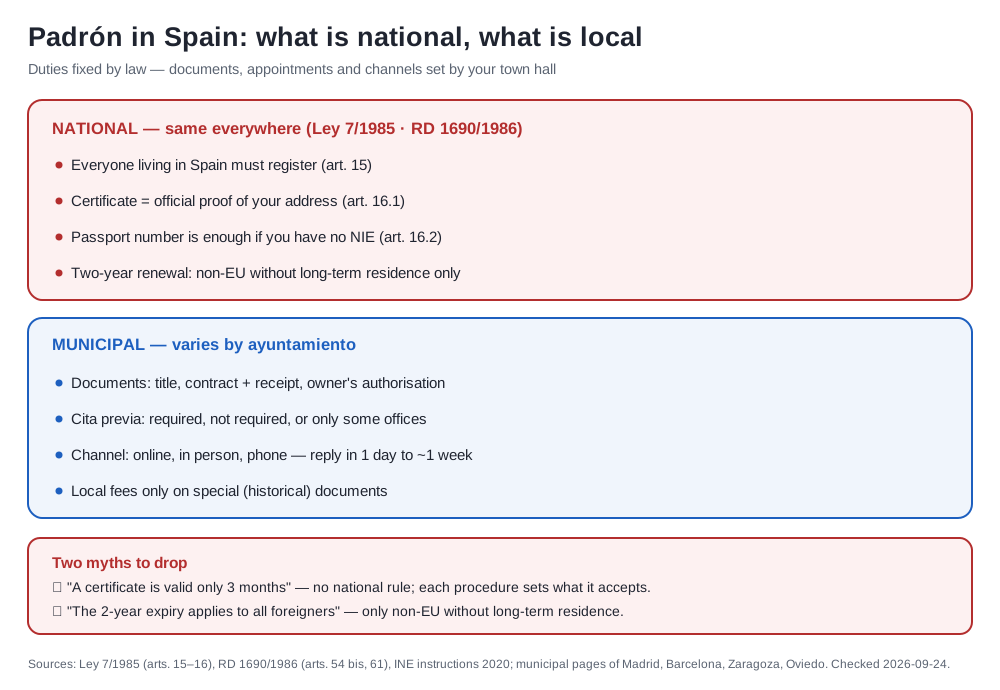
The national law obliges you to register; the how is municipal. Official municipal pages show the real spread:
- Madrid: certificates issued in person at citizen offices — at most of them without an appointment (three specific offices excluded); historical certificates by phone, delivered by post within about 15 days.
- Barcelona: online submission with electronic signature, confirmation email in about 7 working days if documents are correct; cita previa by web or the 010 line as the practical channel.
- Oviedo: current registration documents standard; historical certificates carry a local fee.
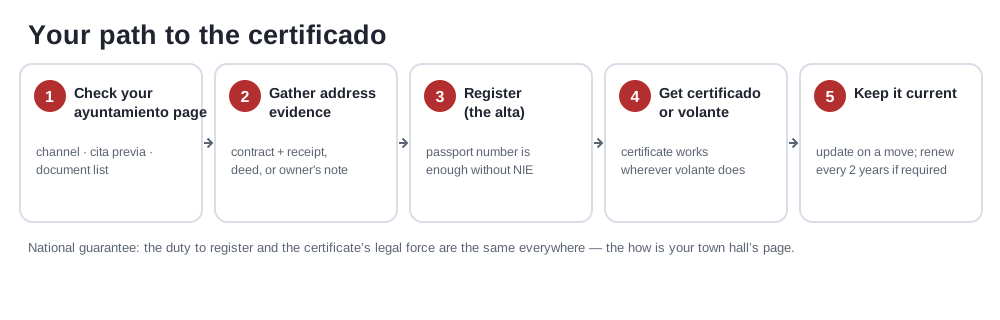
So the honest answer to “how do I register?” is: check your ayuntamiento’s empadronamiento page first — it is the only source that can tell you the channel, the appointment rule and the document combinations it accepts. What the national layer guarantees is that the duty to register, the register’s probative force, the certificado/volante framework and the two-year rule are the same everywhere.
Does the padrón affect your taxes?
Directly — no. The padrón’s coordination role is statistical: town halls send register data to the INE, not to the tax agency, and the INE itself warns that its padronal data may lag up to about two months behind your town hall’s and “no sirven de base para la expedición de certificaciones o volantes” — they cannot be used to issue certificates. The law limits the transfer of padronal data to matters where residence or domicile is a relevant data point (art. 16.3).
Registering on the padrón therefore does not make you a tax resident, does not enrol you with Hacienda, and does not update your tax address. Tax residence follows its own rules (the 183-day and tax status guide covers that), and your address for the tax agency is communicated in separate procedures. What the padrón does give you is the residence proof that tax and residency procedures often ask you to attach.
The takeaway
- Everyone living in Spain must register — the duty is nationality- and status-neutral, and you can do it with a passport number alone.
- The certificate is the key that opens procedures — residencia, healthcare, school, extranjería files — but it proves address, not legality.
- Documents, appointments and channels are municipal: your ayuntamiento’s page beats any blog, including this one.
- Renew on schedule: keep data current when you move, and if you are a non-EU holder without long-term authorisation, diary the two-year renewal — a lapsed registration can be struck off without a hearing.
Frequently asked questions
Do I need a NIE to register on the padrón?
No. The national register entry for a foreigner is filled either with the NIE from your Spanish-issued document or — if you do not have one — the number of your valid passport (Article 16.2 of Law 7/1985). The exact paperwork still depends on your town hall.
Is empadronamiento free?
Registering and getting a standard certificate is free in the large cities that document this — Madrid states that issuing empadronamiento certificates is free of charge. Some town halls charge a local fee for special documents, such as historical certificates in Oviedo. Check your own ayuntamiento’s ordinances.
How long does a padrón certificate last?
There is no national expiry date for the certificate itself. What matters is what the body asking for the document accepts: many procedures expect a recently issued document, but that requirement belongs to the specific procedure — the law does not set a universal “3 months” shelf life. The register itself has its own renewal clock (below).
Do I need a cita previa to register?
It depends on the town hall. In Madrid, certificates are issued in person at most citizen offices without an appointment (three offices excluded); Barcelona runs an online channel and a cita previa by web or the 010 line. Treat cita previa as a common but not universal step.
What if I don’t have a rental contract in my name?
If other people are already registered at the address, the national instructions say the town hall should ask for written authorisation from an adult already registered there, instead of demanding a housing document from you. Town halls may also accept utility bills and verify residence by other means, such as a local police report.
What is the difference between the certificado and the volante?
The certification is the formal document, signed by the town hall secretary, that reliably proves empadronamiento. The volante is a purely informative document without those formalities. Which one a procedure accepts is decided by that procedure’s own rules — but a certificate is valid wherever a volante is accepted.
Does registering on the padrón make me a tax resident?
No. The register feeds the INE for statistical coordination, and the law states that registering does not prove legal residence or grant rights (Article 18.2). Your address for the tax agency is handled in separate procedures — updating your padrón does not update your Hacienda records.
Does the padrón expire after two years for everyone?
No. The two-year periodic renewal applies to foreigners without long-term residence authorisation who are not EU, EEA or Swiss nationals (and equivalents). EU/EEA/Swiss citizens and non-EU holders of long-term authorisation are outside the rule. For those inside it, an unrenewed registration can be declared expired without a prior hearing.
Fuentes oficiales
- Ley 7/1985, de 2 de abril, Reguladora de las Bases del Régimen Local — arts. 15, 16, 17, 18.2 (BOE consolidated text)
- Real Decreto 1690/1986, Reglamento de Población y Demarcación Territorial — arts. 54 bis, 57, 61, 68
- Real Decreto 141/2024 — electronic, INE-interconnected registers
- Instrucciones técnicas del Padrón Municipal (INE, 2020) — housing documents, authorisation, volante/certificado
- INE — Datos de Padrón (sede electrónica)
- Ayuntamiento de Madrid — Certificado de empadronamiento
- Ajuntament de Barcelona — Trámite de empadronamiento (alta y modificación)
- Ajuntament de Barcelona — Nueva Ciudadanía: empadronamiento
- Ayuntamiento de Zaragoza — Volante de empadronamiento
- Ayuntamiento de Oviedo — Certificado de empadronamiento