

















NIE Number Format Explained: Example, Check Letter, and How to Verify Your Number
In this article
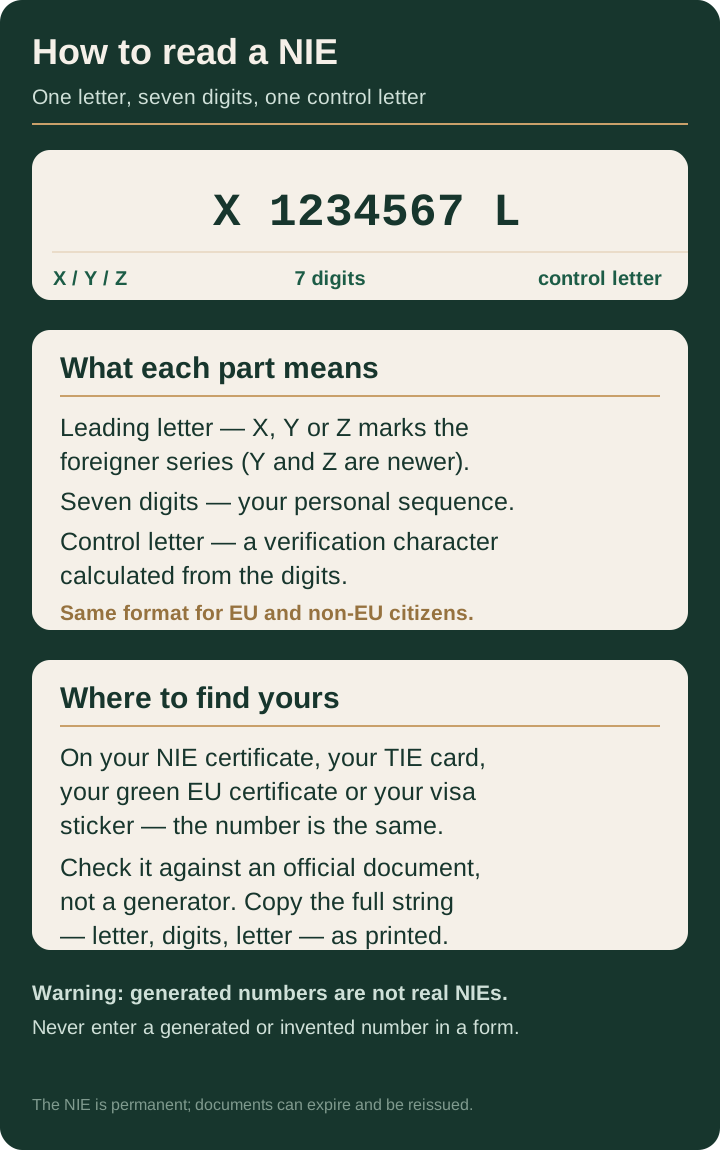
Short answer. An NIE looks like X1234567L: one leading letter — X, Y or Z — then seven digits, then a control letter. Certificates often print it with dashes (X-1234567-L). The same format applies to everyone, EU or non-EU. Your number is printed on the documents Spain issues you; check it against those documents, and never use a “generator” — a generated number is not a real NIE.
For the full service picture — applying for the number, costs and timing — start with NIE in Spain. This article focuses on the format itself.
What each part of the NIE means
Spain defines the NIE in Article 205 of the immigration regulation (RD 1155/2024) as a personal, unique, sequential number for foreigners. The regulation describes what the number is for; the format you see on every certificate is the practical shape of that identifier:
- The leading letter — X, Y or Z — marks the foreigner series. Older certificates carry X; as the series advanced, Y and then Z came into use. The letter is part of the number, not decoration: leaving it off makes the string incomplete.
- The seven digits — your personal sequence within the series. Two people never share the same letter-plus-digits combination.
- The control letter — a verification character calculated from the digits. It is the last letter of the string, and official e-office forms check the format as you type.
You will see the same number written in slightly different ways: X1234567L, X-1234567-L or X - 1234567 - L. All of them are the same number; keep the separators exactly as the form you are filling in shows them.
Want to see the real thing? The example of the NIE document shows a certificate as it arrives. For what “NIE” means as a document and a concept, the What is an NIE guide covers the wider picture — this article stays on the format itself.
Where to find your NIE
The number is assigned once and then appears everywhere. Look for it on:
- Your NIE certificate — the white A4 certificate many non-residents hold (“NIE blanco”), stamped by the National Police.
- Your TIE card — the red foreigner identity card, which carries the number among its details.
- Your green EU registration certificate — for EU, EEA and Swiss citizens, in card or old folio format.
- Other Spanish paperwork — resolutions, certificates and tax documents issued to you.
One number, several documents. That is also why a question like “is my NIE on my visa” has a specific answer: Article 205.2 requires the number on documents issued or processed for you and on passport stamps — except visas. A long-stay procedure assigns the number ex officio; check your own resolution or certificate rather than the visa sticker.
And keep the number distinct from the soporte number on your card or certificate: the soporte guide explains the E+8 (TIE) and C+8 (EU certificate) formats, and why a form asking for “soporte” will reject an NIE. If you are untangling the number from the card itself, NIE vs TIE explained sorts out which document does which job.
How to check a NIE number — and why generators fail
The safe order of operations when a form, bank or employer asks for your NIE:
- Copy it from an official document, not from memory: letter, seven digits, control letter, exactly as printed.
- Match the document to the request. Some forms accept the certificate; others want the card’s details or a soporte number. When in doubt, ask the requesting body which document they need.
- Enter it without inventing characters. If an e-office form rejects your number, check that you have not swapped the control letter with the soporte letter or dropped the leading letter.
- Re-request the certificate if it is lost. The number does not change: a replacement certificate shows the same string. See what to do if your NIE is lost or stolen, and the application guide for the request routes.
About “NIE generators”: search results are full of tools that produce plausible-looking strings. They are not official, the numbers they produce are not assigned to anyone, and using one in a form is the fastest route to a rejection — or worse, to supplying a number that belongs to someone else. Official e-office forms validate the format as you type; that is the only “checking” that matters in a procedure. If you need to confirm your own number, the check is against your documents and the issuing authority — there is no public register to query a NIE against.
Common format mistakes in forms
- Dropping the leading letter. “1234567L” is not an NIE; the leading letter is part of the identifier.
- Mixing up the NIE with the soporte number. E+8 and C+8 strings are document numbers, not your NIE — the soporte guide disambiguates them.
- Assuming the certificate expires with the card. Cards and certificates can expire and be reissued; the number itself does not. Enter the same string from whatever current document you hold.
- Copying from a photo at an angle. B/8, 0/O and 1/I confusions are the classic transcription errors in Spanish paperwork; compare your copy against the printed character shapes, not a memory of them.
- Treating a “generated” NIE as valid. It is not assigned, it is not yours, and any official check will fail it.
Need the number itself, or help with the paperwork around it? E-Residence assists with NIE requests and document questions. Start an NIE enquiry — a private service, not a government body.
Frequently asked questions
What does a NIE number look like?
An NIE has three parts: a leading letter (X, Y or Z), seven digits, and a final control letter — for example X1234567L. Certificates often print it with separators, such as X-1234567-L. The format is the same for EU and non-EU citizens.
What does NIE stand for?
NIE stands for Número de Identidad de Extranjero — the personal, unique identification number Spain assigns to foreigners under Article 205 of the immigration regulation (RD 1155/2024).
How can I check that a NIE number is correct?
Check it against an official document — your NIE certificate, TIE, green certificate or visa paperwork — and with the body that issued or requested it. Official e-office forms validate the format when you enter it. Do not rely on online “generators”.
Is there an official NIE generator?
No. Only the Dirección General de la Policía assigns numbers, and a generated number is not a real NIE — it will fail in any official procedure and may belong to someone else. Treat any generator as, at best, a format illustration.
Where do I find my NIE number?
On your NIE certificate (the white certificate for non-residents), your TIE card if you have one, your green EU registration certificate, and other Spanish documents issued to you. The number is the same on all of them.
Do X, Y and Z mean anything?
The leading letter marks the foreigner series: X on earlier numbers, Y and Z as the series continued. The letter plus the seven digits form your personal sequence; the final letter is a verification character calculated from the digits.
What is the difference between the NIE and the soporte number?
The NIE identifies you as a person; the soporte number identifies a physical document (E + 8 digits on a TIE, C + 8 on an EU certificate card). When a form asks for a soporte number, the NIE is not the answer.
Does the NIE format ever change?
Your number does not change once assigned, and the NIE does not expire. What changes is the document that displays it: certificates and cards are reissued, the number stays.
Official sources
- RD 1155/2024 (immigration regulation), Article 205 — the NIE as personal, unique, sequential identifier
- National Police — NIE assignment procedure (EX-15)
- Spanish Tax Agency (AEAT) — Cl@ve help: how to enter the soporte number (why the NIE is not a soporte number)
Editorial note. Spain does not publish the NIE check-letter algorithm as a consumer-facing specification. This article describes the format as it appears on official documents and deliberately avoids reproducing generator logic. Verify against your own documents and official channels.