


















Are NIE and NIF the Same? Your Straightforward Guide
There’s a moment every foreigner in Spain encounters sooner or later — someone asks for “your NIF”, even though you’re holding a freshly issued NIE in your hands. The terms seem interchangeable, and sometimes locals use them as if they were. But they’re not the same, not in the legal sense. And yet… for most people, one number ends up doing double duty. A small paradox of Spanish bureaucracy.
Below is a grounded, human explanation of how it all really works. No stiff official tone, no over‑simplifications — just a clear, practical guide you can actually read without losing the thread.
At a Glance
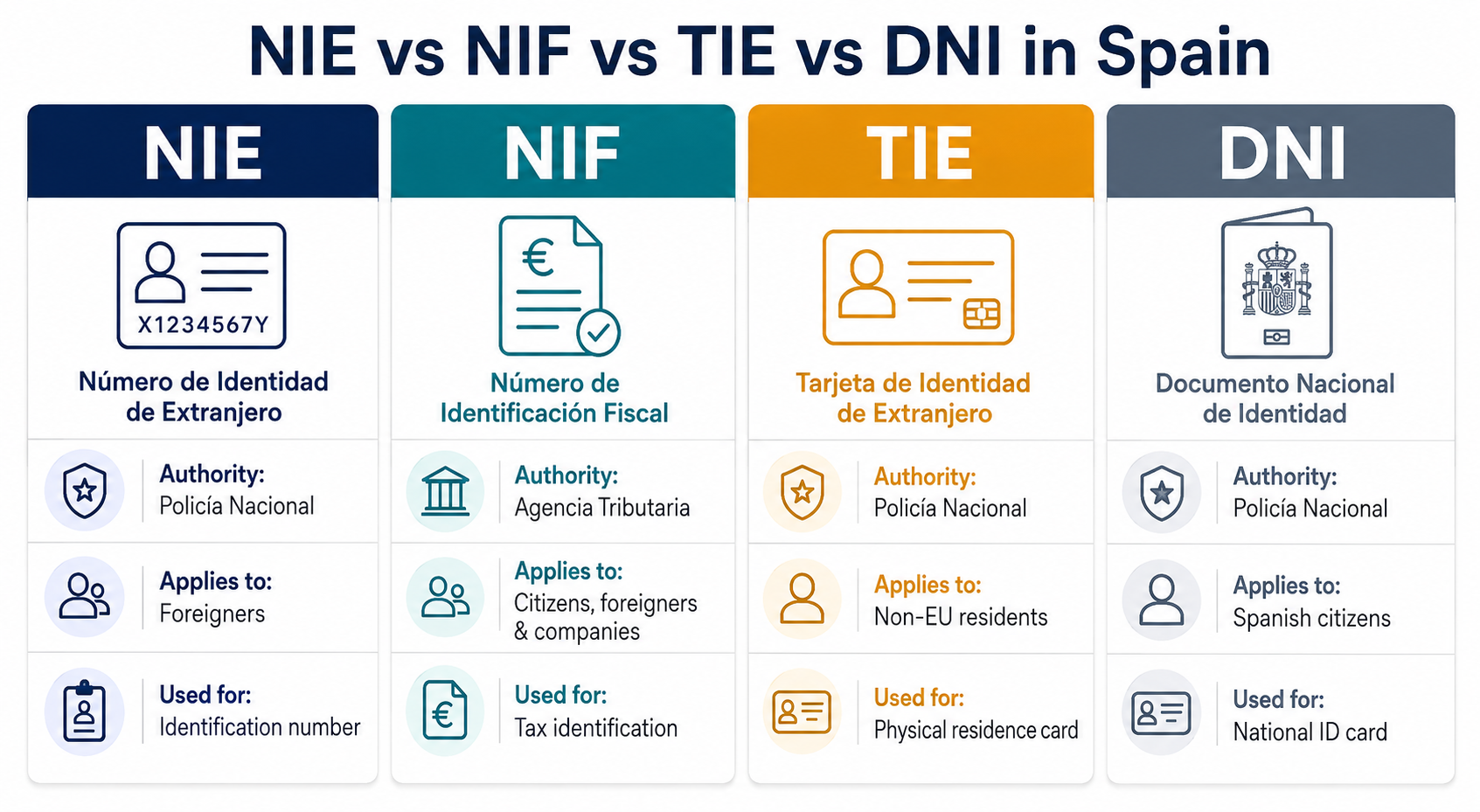
Quick answer
No — NIE and NIF are not the same, although the same number often ends up serving both purposes.
- NIE is your foreigner identification number. It’s issued by the Spanish National Police under the authority of the Ministry of the Interior. You’ll use it to identify yourself everywhere — banks, notaries, landlords, government offices. Full definition: what is an NIE in Spain.
- NIF is your tax identification number. It’s the number the Agencia Tributaria (Spanish Tax Agency) uses to link all your tax‑related information: income, invoices, declarations, and investments.
For foreigners, the process is straightforward: once your NIE is registered with the Tax Agency, the same number becomes your NIF. One number, two roles.
If you’d rather avoid appointments, queuing systems and language confusion, both NIE and NIF can be arranged remotely through accredited representatives. E‑Residence provides compliant online services for obtaining your NIE online and NIF online.
Ready to start? Get your NIE online with professional support — we confirm the right route and prepare the file for you.
Introduction
Spain’s identification system looks straightforward on the surface. A single number for citizens; another system for foreigners. That’s the theory.
But once you start opening a bank account, signing a rental contract, or preparing to buy property, the acronyms begin to blend together. “Put your DNI/NIE/NIF here”, says one form. A bank clerk asks for your NIF even though you only have an NIE. People around you seem to use both terms as if they mean exactly the same thing.
They don’t. Not officially.
NIE identifies you as a foreigner inside the Spanish administrative structure. NIF ties you into the fiscal system. And although these two categories overlap, they don’t merge automatically. A small piece of bureaucracy — usually a registration with the Tax Agency — connects them.
This guide walks you through that connection. What each number is for. When you’ll need one, the other, or both. And how to navigate the system without drowning in forms.
What is NIE?
A simple definition
NIE — Número de Identidad de Extranjero — is the number Spain assigns to non‑Spanish nationals who need to interact with local authorities. Think of it as your administrative identity inside the country. For the technical definition, see what is an NIE in Spain.
It’s:
- just a number (not a card),
- issued and managed by police and immigration offices under the Ministry of the Interior,
- the reference used by all other institutions — tax, social security, healthcare.
Once you have it, you keep it for life. Even if you leave Spain. Even if your residence status changes.
Who needs it?
Most foreigners do. You’ll need an NIE if you’re planning to:
- stay longer than a standard tourist visit,
- buy a home, invest, or sign a reservation contract,
- open a Spanish bank account,
- start a job or freelance activity,
- register with social security,
- appear on official documents or notarial acts.
In real terms, the NIE is your “entry ticket” to Spanish bureaucracy.
Format
X / Y / Z + 7 digits + 1 control letter
Example: X1234567A
The starting letter depends on historical issuance rules — not something you need to worry about. To see what the actual certificate looks like, check the example of the NIE document.
Why you will use it constantly
After obtaining it, your NIE becomes the number that:
- appears on bank papers, mortgage files, investments,
- goes into employment paperwork and payroll,
- links you to the healthcare system,
- shows up in residency procedures,
- eventually becomes the base for your NIF.
Without it, almost nothing moves.
What is NIF?
What the number really does
NIF — Número de Identificación Fiscal — is your tax number. The one the Agencia Tributaria (Spanish Tax Agency) uses to identify you in every fiscal context.
This includes:
- income tax returns,
- VAT or withholding obligations,
- property‑related taxes,
- investment reporting,
- communication with employers or clients.
Who uses it?
- Spanish citizens: their DNI number doubles as their NIF.
- Foreign individuals: their NIE becomes their NIF once registered with the Tax Agency.
- Companies: receive their own dedicated NIF starting with a letter.
Formats
- Citizens: 8 digits + letter (12345678A)
- Foreigners: same structure as NIE (X1234567A)
- Companies: letter + digits + letter (B1234567R)
Why NIF matters
Your NIF is needed for:
- invoices you issue,
- income declarations,
- payroll integration,
- company creation,
- investment accounts,
- property taxation,
- rental income reporting.
If something is fiscal, it requires a NIF. How the NIE/NIF interacts with residency and tax obligations is covered in the NIE and Spanish tax status guide.
NIE vs NIF: key differences
Although the same number may eventually serve both functions, NIE and NIF are legally different.
| Aspect | NIE | NIF |
|---|---|---|
| Purpose | Identification of foreigners | Tax identification |
| Authority | Ministry of the Interior / Police | Tax Agency (Agencia Tributaria) |
| Applies to | Foreign individuals | Citizens, foreigners, companies |
| Format | X/Y/Z + digits + letter | DNI format, NIE format, company format |
| Used for | Banking, immigration, property, residency | Taxes, invoices, payroll, fiscal records |
| Validity | Permanent | Permanent |
The key idea: NIE identifies you; NIF taxes you.
How NIE becomes your NIF
This is the part that confuses everyone.
A foreigner gets an NIE. Feels done. Files a tax form — suddenly, people start calling the number a NIF. What happened?
The mechanism, without the jargon
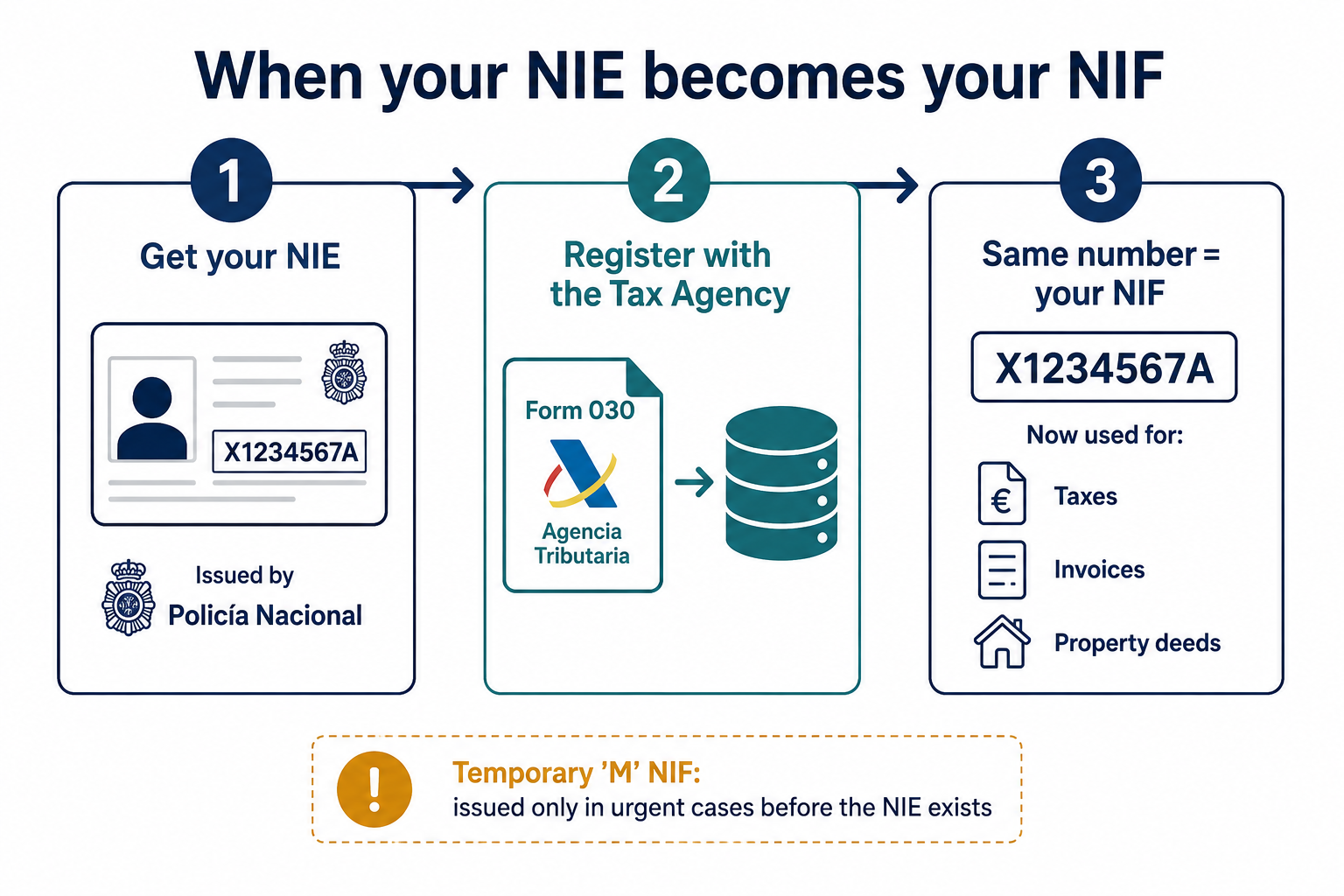
- You obtain an NIE. At this stage, it’s only an identification number.
- At some point — through employment, property purchase, or a simple Form 030 — the Tax Agency registers that NIE.
- The moment it’s in their system, that NIE becomes your NIF for all fiscal purposes.
Same number, expanded function.
Real‑life example
Ivan, a non‑EU investor, gets NIE X9876543Z to buy an apartment. His lawyer files Form 030. The Tax Agency enters Ivan into the system.
From that point on, the same number — X9876543Z — is used:
- on his deed,
- in non‑resident income tax,
- in future financial operations.
Temporary “M” NIF
In rare situations, someone needs a tax number urgently before their NIE is issued. Then the Tax Agency may assign a temporary NIF beginning with M. Later, it’s replaced by the permanent NIE‑based NIF.
Want both numbers sorted without appointments and forms? Get your NIE online and the e-residence team will handle the Spain-side process for you.
When you’ll be asked for each number
You’ll need an NIE when you:
- open a bank account,
- sign a rental contract,
- buy property,
- apply for residency,
- register with social security,
- work for a Spanish employer,
- handle notarial processes that involve money.
You’ll need a NIF when you:
- file tax returns (resident or non‑resident),
- issue invoices as a freelancer (autónomo),
- report rental income,
- create or manage a company,
- sign financial agreements,
- handle any fiscal matter.
Often, you will need both — but it is one and the same number doing both jobs.
How to obtain NIE and activate it as NIF
Step 1: Obtain your NIE
Three possible paths:
- In Spain, in person at a police or immigration office. You’ll need your passport or EU ID, Form EX‑15, justification, and an appointment.
- Through a Spanish consulate if you’re still abroad. Timelines vary — sometimes days, sometimes months.
- Through a legal representative, using a power of attorney. This is the simplest option for most people who aren’t yet in Spain or don’t speak Spanish.
Full breakdown of all three routes: how to apply for an NIE number in Spain and the NIE Spain online pillar.
Step 2: Register it with the Tax Agency
This is usually done via Form 030. The form links your NIE to the fiscal system and defines whether you’re resident or non‑resident for tax purposes — see the NIE and Spanish tax status guide.
Registration can happen:
- in person,
- or online through a representative.
Step 3: Corporate NIF
If you open a company, the entity receives its own separate NIF through Form 036 and the commercial registry.
Official references
If you want to double‑check anything, these are the primary official sources:
Everything published in Spain eventually traces back to these three.
Related guides
- Pillar: NIE in Spain — apply online
- Application routes: How to apply for an NIE number
- Technical definition: What is an NIE in Spain?
- Fiscal side: NIE and Spanish tax status
- The document itself: Example of the NIE document
Conclusion
Spain’s system seems complicated when you first meet it — partly because terms blur together in everyday speech. But once you understand the architecture, it starts making sense.
NIE identifies you. NIF connects you to the fiscal world. One number can do both, once it’s in the right database.
If you’re planning a move, an investment, or long‑term work in Spain, taking care of NIE/NIF early saves you time and spares you avoidable mistakes. And if you prefer not to wrestle with appointments and forms, get your NIE online — E‑Residence ties the whole process together smoothly, exactly the way the system was meant to work.
Start your case
Get Your NIE with Professional Support
Prefer not to manage the EX-15, Tasa 790-012, cita previa, and Tax Agency registration yourself? Share your case details and the e-residence team will confirm the right route and prepare the application file for you.
Get your NIE onlineFrequently asked questions about NIE and NIF in Spain
Do I need both numbers?
Not as separate numbers. You get an NIE — then the Tax Agency turns it into your NIF when needed. One number, two roles.
Can I use my NIE for taxes immediately?
Sometimes yes, but it's safer to assume you should register it first. Registration with the Agencia Tributaria is usually done via Form 030 and links your NIE to the fiscal system.
Does NIE expire?
The number — no. Residence permits may expire, but the NIE stays linked to you for life. See does the NIE number expire.
Is NIE the same as TIE?
No. TIE is a physical residence card for non-EU residents. NIE is just the number — the same number that is printed on the TIE card.
How long does issuance take?
Anywhere from a few days to a few months depending on where and how you apply. No provider can guarantee a fixed date. See the NIE processing timeline.
What is the main difference between an NIE and a NIF?
The NIE identifies you as a foreigner in the Spanish administrative system; the NIF identifies you in the tax system. The NIE is issued by the Policía Nacional, the NIF is managed by the Agencia Tributaria. See the key differences table.
When are the NIE and the NIF the same number?
For foreign individuals, almost always. Once your NIE is registered with the Agencia Tributaria — through employment, a property purchase, or Form 030 — the same number becomes your NIF for all fiscal purposes.
When are the NIE and the NIF different numbers?
In three situations: Spanish citizens use their DNI number as their NIF; companies receive their own dedicated NIF starting with a letter; and in urgent cases the Tax Agency may issue a temporary NIF starting with M before the NIE exists.
What does NIF stand for and what does it actually mean?
NIF stands for Número de Identificación Fiscal — tax identification number. It is the reference the Agencia Tributaria uses to link all your tax information: income, invoices, declarations, and investments. For citizens it equals the DNI number; for foreigners it equals the registered NIE.
What is the difference between NIE, NIF, TIE and DNI?
NIE is the foreigner ID number. NIF is the tax ID — a role, often filled by the NIE or DNI number. TIE is the physical residence card for non-EU residents. DNI is the national ID card for Spanish citizens. See the comparison above.
Which number do I put on a Spanish tax form — NIE or NIF?
The same number. Once your NIE is registered with the Tax Agency, you write that NIE in every NIF field on tax forms, invoices, and payroll documents. Until it is registered, register it first via Form 030.
Can you give a real example of an NIE also being a NIF?
A non-EU investor receives NIE X9876543Z to buy an apartment. The lawyer files Form 030, and the Agencia Tributaria registers the number. From then on, X9876543Z appears on the deed, in non-resident income tax, and in future financial operations — as both NIE and NIF.
In which scenarios do I need an NIE but not yet a NIF?
Purely administrative steps — opening a bank account, signing a rental contract, applying for residency — require the NIE only. The NIF role activates when a fiscal event occurs: filing taxes, issuing invoices, reporting rental income, or creating a company.
NIE vs NIF: Quick Reference
| Item | Fact |
|---|---|
| NIE — definition | Número de Identidad de Extranjero: personal ID number for foreigners, issued by the Policía Nacional under the Ministry of the Interior |
| NIF — definition | Número de Identificación Fiscal: tax ID used by the Agencia Tributaria for taxes, invoices, and payroll |
| When NIE and NIF coincide | For foreigners: once the NIE is registered with the Tax Agency (usually Form 030), the same number serves as the NIF |
| When they differ | Spanish citizens (DNI number = NIF), companies (own dedicated NIF), temporary M-NIF issued before an NIE exists |
| TIE | Physical residence card for non-EU residents — a document, not a number; it carries the holder’s NIE |
| DNI | National ID card for Spanish citizens; the DNI number doubles as the NIF |
| NIE format | X/Y/Z + 7 digits + control letter (e.g. X1234567A); permanent — never expires |
| Registration form | Form 030 links the NIE to the fiscal system and sets resident / non-resident status |
Reviewer and Sources
Reviewed by: E-Residence Team · License No. 62802L · Last updated:
Spanish identification and tax registration practices can vary by office, consulate, and applicant profile. Always check official sources and obtain case-specific advice before submitting documents.
Official sources
- Agencia Tributaria — NIF and census registration, Form 030 (sede.agenciatributaria.gob.es)
- Ministerio del Interior — NIE procedures (interior.gob.es)
- Dirección General de la Policía / Policía Nacional — NIE assignment (sede.policia.gob.es)
- BOE — Ley Orgánica 4/2000 (BOE-A-2000-544)
- BOE — Real Decreto 1155/2024 (BOE-A-2024-21999)