


















Portugal NHR Tax Regime: What It Was, Why It Ended, and What Replaced It
In this article

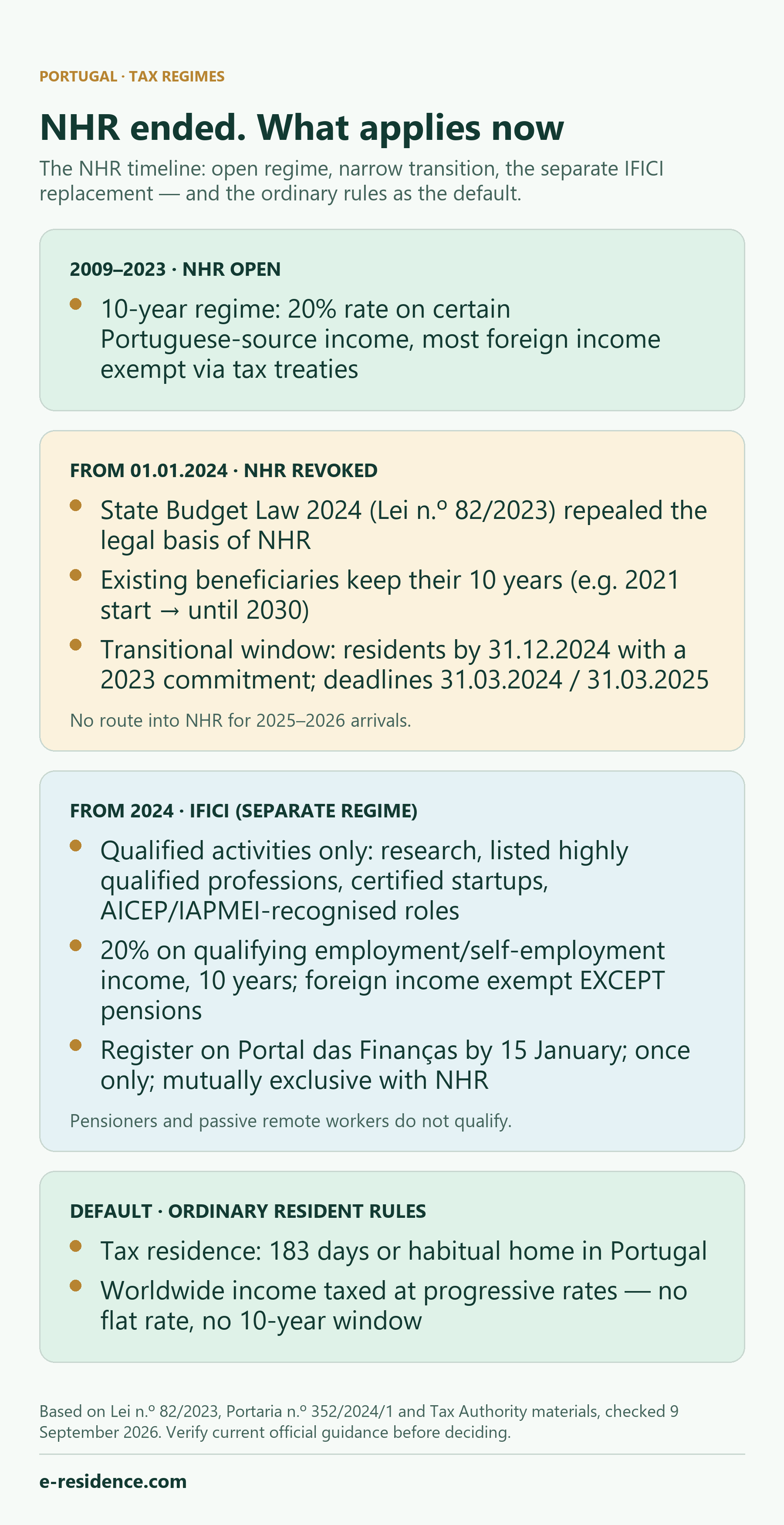
If you are researching the Portuguese NHR regime today, the most important fact is this: NHR has been closed to new applicants since 1 January 2024. Older guides — including the previous version of this article — that explain how to apply for NHR describe a procedure that no longer exists. This guide covers what the regime was, exactly how it ended, the narrow transitional cases, and what applies instead in 2026.
In short
- NHR was revoked from 1 January 2024 by the 2024 State Budget Law (Lei n.º 82/2023), which repealed the legal basis of the regime in the IRS Code.
- Existing beneficiaries keep their regime until the end of their 10-year period — for example, a 2021 start runs until 2030.
- Transitional applications were limited to qualifying people who became residents by 31 December 2024, including household members covered by Article 236.º(3)(d); deadlines applied, and late filings cover only the original years remaining.
- The replacement, IFICI, is much narrower: pension receipt, passive income, investment or remote-work status alone does not confer access. Eligibility requires a separate qualifying activity, and pension income remains under the ordinary rules.
What the NHR regime was
The Non-Habitual Resident (NHR) regime was introduced in 2009 to attract foreign professionals and pensioners to Portugal. For a 10-year period, it offered a special 20% rate on certain Portuguese-source employment and self-employment income from listed activities, and — in combination with Portugal’s double taxation agreements — exemptions on most foreign-source income. That combination made it one of Europe’s best-known tax incentives for new residents.
How NHR ended
The 2024 State Budget Law — Lei n.º 82/2023, de 29 de dezembro — repealed Article 16.º, paragraphs 8 to 12, of the IRS Code (CIRS), the legal basis of the NHR regime (Article 317.º, paragraph b), of that law). The law entered into force on 1 January 2024. From that date, the regime is closed to new applicants.
Transitional rules: who could still get NHR
The law (Article 236.º(3)) kept the revoked rules applicable, until the end of the 10-year period, to limited groups:
- taxpayers already registered as NHR with the Tax Authority on 1 January 2024;
- taxpayers who met the residence conditions on 31 December 2023;
- taxpayers who became tax residents by 31 December 2024 and declared, at registration, one of the qualifying 2023 commitments — for example an employment (promise) contract concluded by 31 December 2023, a lease or a property reservation/promissory contract signed by 10 October 2023, school enrolment of dependants completed by 10 October 2023, or a residence visa/permit valid (or a procedure initiated) by 31 December 2023;
- household members of the above.
The Tax Authority applied strict deadlines: registrations with effect from 2023 were accepted until 31 March 2024, and registrations under the qualifying-commitment route with effect from 2024 until 31 March 2025. For a qualifying person in the 2024-resident route—including a household member covered by Article 236.º(3)(d)—a later transitional application may still be possible, but, if accepted, it takes effect only from the application year and runs only for the period remaining until the end of 2033. This late-filing rule must not be extended to the separate 2023-resident category.
For anyone who becomes a Portuguese tax resident in 2025 or 2026, there is no route into NHR at all.
IFICI: the replacement is a different, narrower regime
The replacement is IFICI — the Tax Incentive for Scientific Research and Innovation, created by the same Lei n.º 82/2023 as Article 58.º-A of the Tax Benefits Statute (EBF) and regulated by Portaria n.º 352/2024/1. It is sometimes informally called “NHR 2.0”, but it is a separate regime with its own conditions — NHR treatment does not carry over.
Who qualifies. Individuals who become Portuguese tax residents without having been resident in any of the previous 5 years, and who exercise a qualifying activity: higher-education teaching and scientific research; qualified jobs and board positions linked to contractual tax benefits for productive investment; highly qualified professions listed in Annex I of Portaria 352/2024/1 (for example executive directors, specialist engineers and scientists, medical doctors, ICT specialists) exercised in companies with relevant investment or in exporting (≥50% of turnover) industrial or service companies with eligible CAE codes; roles in entities recognised by AICEP or IAPMEI as relevant to the national economy; R&D personnel under SIFIDE II; jobs and board positions in certified startups; and activities of tax residents in the Azores and Madeira under regional rules. For Annex I professions, qualification generally requires a PhD, or a bachelor’s/master’s degree plus at least 3 years of professional experience. Receiving pension income, making passive investments or working remotely does not by itself create eligibility. A person in any of these situations must qualify through a separate eligible activity, and pension income remains outside the IFICI benefit.
Benefits. A special 20% IRS rate on net Category A (employment) and Category B (self-employment) income from the qualifying activities, for 10 consecutive years from the year of registration as resident. Foreign-source income is generally exempt — except pensions (Category H), which are taxed under the general progressive rules; income from blacklisted jurisdictions is taxed at 35%.
Registration and limits. Registration is requested via the Portal das Finanças by 15 January of the year following the year of becoming resident, with validation by the competent entity for the activity (FCT, AICEP, AT, IAPMEI, ANI, Startup Portugal or the Autonomous Regions). Late registration takes effect only from the year it is made, for the remaining period. The regime can be used only once per taxpayer, and it is mutually exclusive with NHR: anyone who benefits or has ever benefited from NHR cannot receive IFICI.
For the operative eligibility and registration rules, use the Tax Authority’s current IFICI FAQ and consolidated Article 58.º-A EBF.
What a 2026 arrival gets by default
A person who moves to Portugal in 2026 and does not qualify for IFICI is taxed under the ordinary resident rules of the IRS Code. Tax residence is determined by Article 16.º(1)–(2) CIRS: staying in Portuguese territory for more than 183 days, consecutive or not, in any 12-month period beginning or ending in the relevant year; or staying for a shorter period while having a dwelling in conditions suggesting the intention to keep and occupy it as a habitual residence.
Ordinary residents are taxed on their worldwide income at progressive IRS rates — no flat rate, no 10-year window and no general foreign-income exemption. This makes an eligibility check before moving the single most valuable step: the difference between qualifying for IFICI and missing it is material, and the registration deadline arrives quickly after the move.
What this means in practice
- Treat any guide that still offers to “apply for NHR” — including paid services built around it — as outdated. The regime is closed for 2025–2026 arrivals.
- If you already hold NHR, your 10-year period continues; keep evidence of your registration year.
- If you are planning the move, check IFICI eligibility against the current official lists and your own activity before making tax decisions; start with the Tax Authority’s current IFICI FAQ.
- Tax residence, income structure and deadlines interact. For a personal assessment, our tax representation and IRS services cover exactly these questions.
What to check
- Your residence year and whether any transitional NHR rule could still apply to you.
- IFICI eligibility: the current official profession/CAE lists, your activity, and the 15 January registration deadline.
- The current Tax Authority guidance before relying on any article — including this one.
- Never rely on fixed promises, generic checklists or old NHR guides.
Official sources
- Lei n.º 82/2023, de 29 de dezembro (Diário da República) — revocation of NHR (Art. 317.º, b), transitional rules (Art. 236.º) and entry into force (Art. 320.º); full article texts via the PGDL legislation database
- Tax and Customs Authority — NHR registration leaflet (EN, May 2024)
- Tax and Customs Authority — Article 58.º-A EBF (IFICI), consolidated text
- Portaria n.º 352/2024/1, de 23 de dezembro (Diário da República) — IFICI procedures and profession/CAE lists
- Tax and Customs Authority — IFICI FAQ
Frequently asked questions
Can I still apply for the NHR regime in 2026?
No. NHR was revoked from 1 January 2024 by the 2024 State Budget Law (Lei n.º 82/2023). A person who becomes a Portuguese tax resident in 2025 or 2026 has no route into NHR. The remaining late applications are limited to people who became resident by 31 December 2024 and qualify under Article 236.º(3)(c), plus household members covered by Article 236.º(3)(d). If accepted, they cover only the original period remaining.
I already have NHR status. Do I lose it?
No. Taxpayers registered as NHR keep the regime until the end of their 10-year period counted from the year they became resident. For example, someone who started NHR in 2021 remains covered until 2030, under the transitional rule in Article 236.º of Lei n.º 82/2023.
What is IFICI and is it the same as NHR?
IFICI (Tax Incentive for Scientific Research and Innovation, Article 58.º-A of the Tax Benefits Statute) is a separate, narrower regime that requires a specific eligible activity and the other statutory conditions. Receiving a pension or passive income, investing, or working remotely does not by itself confer access. A pension recipient or remote worker can qualify only through a separate eligible activity; pension income remains taxed under the general rules.
Are foreign pensions tax-free under IFICI?
No. Under IFICI, foreign-source income is generally exempt except Category H (pensions): foreign pensions are taxed under the general progressive IRS rules. Income from blacklisted jurisdictions is taxed at 35%.
I became a tax resident in 2024 and had a lease signed in 2023. Can I still register as NHR?
Possibly, under the transitional rule — but the benefit then takes effect only from the year of application and runs only for the remaining period up to the end of the 10th consecutive year counted from your year of residence. Check the current Tax Authority guidance for your exact situation.
If I move to Portugal in 2026 without a special regime, how am I taxed?
Under the ordinary resident rules of the IRS Code: you become a tax resident if you stay more than 183 days in any 12-month period or keep a habitual home in Portugal, and residents are taxed on worldwide income at progressive rates. Without IFICI there is no flat rate, no 10-year window and no general foreign-income exemption.