


EX-15 Form Guide: Field by Field, the Form 790 Payment and Your NIE Appointment
The EX-15 is the application form for a Spanish NIE, and form 790 is the government fee that goes with it. If you ordered your NIE paperwork from us, you received both as PDF documents, completed from the details you gave us. This guide explains what each field of the EX-15 contains, how to pay the form 790 fee, and what to bring to your appointment at the police station.
Read this guide thoroughly and check your forms
Missing a step can complicate your application. If you entered your details on a mobile phone, autocorrect or input errors may have crept into names or other fields — if you notice an error or need a change, contact our team immediately. Some sections of the forms are left blank on purpose, because they are not relevant to your application or follow regional practice, so please do not modify the forms yourself.
Section 1: Datos del Extranjero (your personal data)
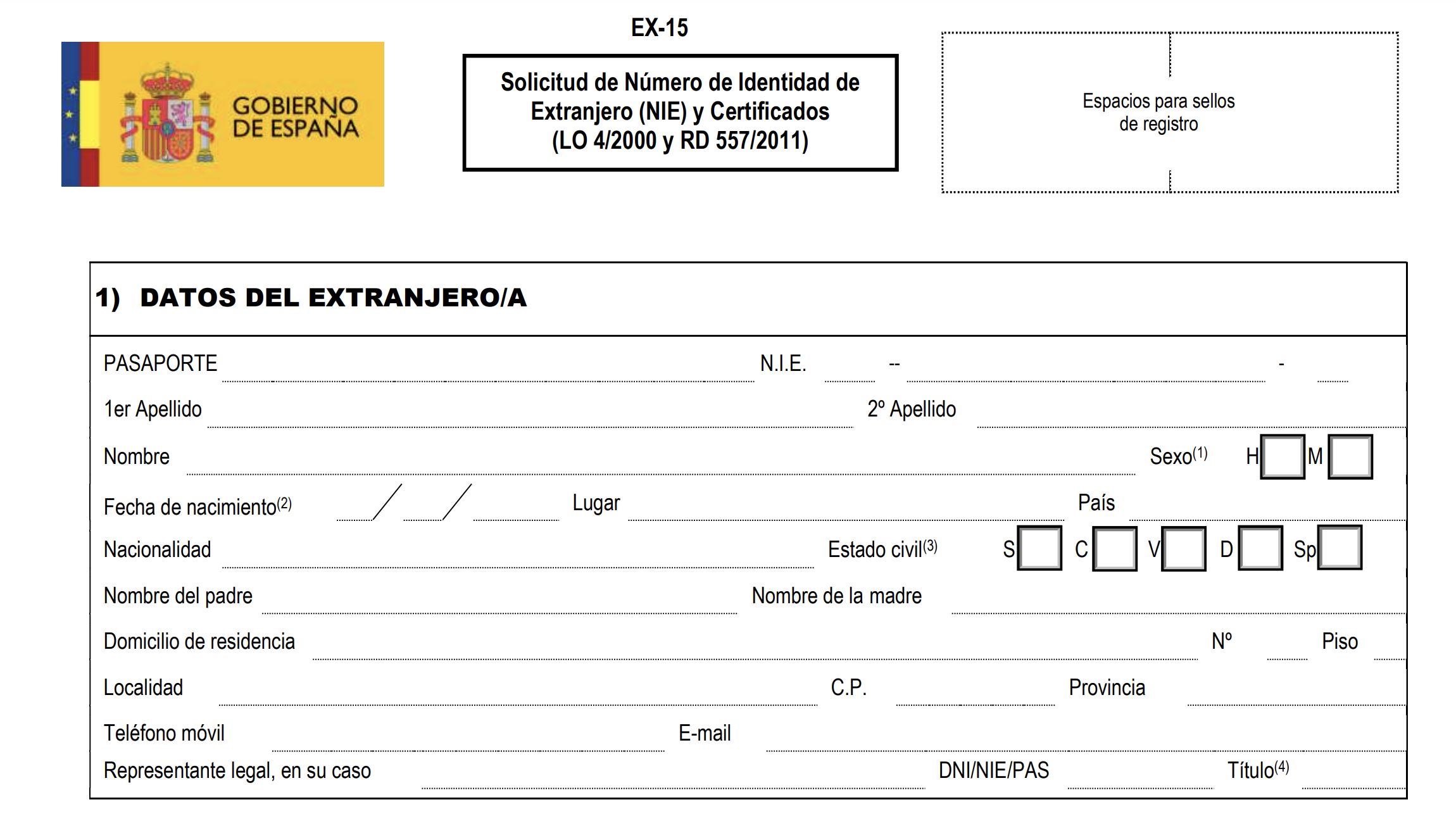
This is how each field of the first section is filled in:
| Field | What goes there |
|---|---|
| Pasaporte | Your valid passport or ID number |
| NIE | Left empty — this is the number you are applying for |
| 1er Apellido | Your family name |
| 2º Apellido | Your second family name, if applicable |
| Nombre | First name |
| Sexo | Tick the corresponding box: male (H) or female (M) |
| Fecha de nacimiento | Date of birth |
| Lugar | Place of birth |
| País | Country of birth |
| Nacionalidad | Nationality |
| Estado civil | Tick the corresponding box: single (S), married (C), widowed (V), divorced (D) or separated (Sp) |
| Nombre del padre | Your father's first name |
| Nombre de la madre | Your mother's first name |
| Domicilio de residencia | Your current address, in Spain or abroad |
| Nº | Street number |
| Piso | Flat number, if applicable |
| Localidad | City |
| C.P. | Postal code |
| Provincia | Province |
| Teléfono móvil | Phone number |
| Your email address |
Sections 2 and 3: representative and notification address
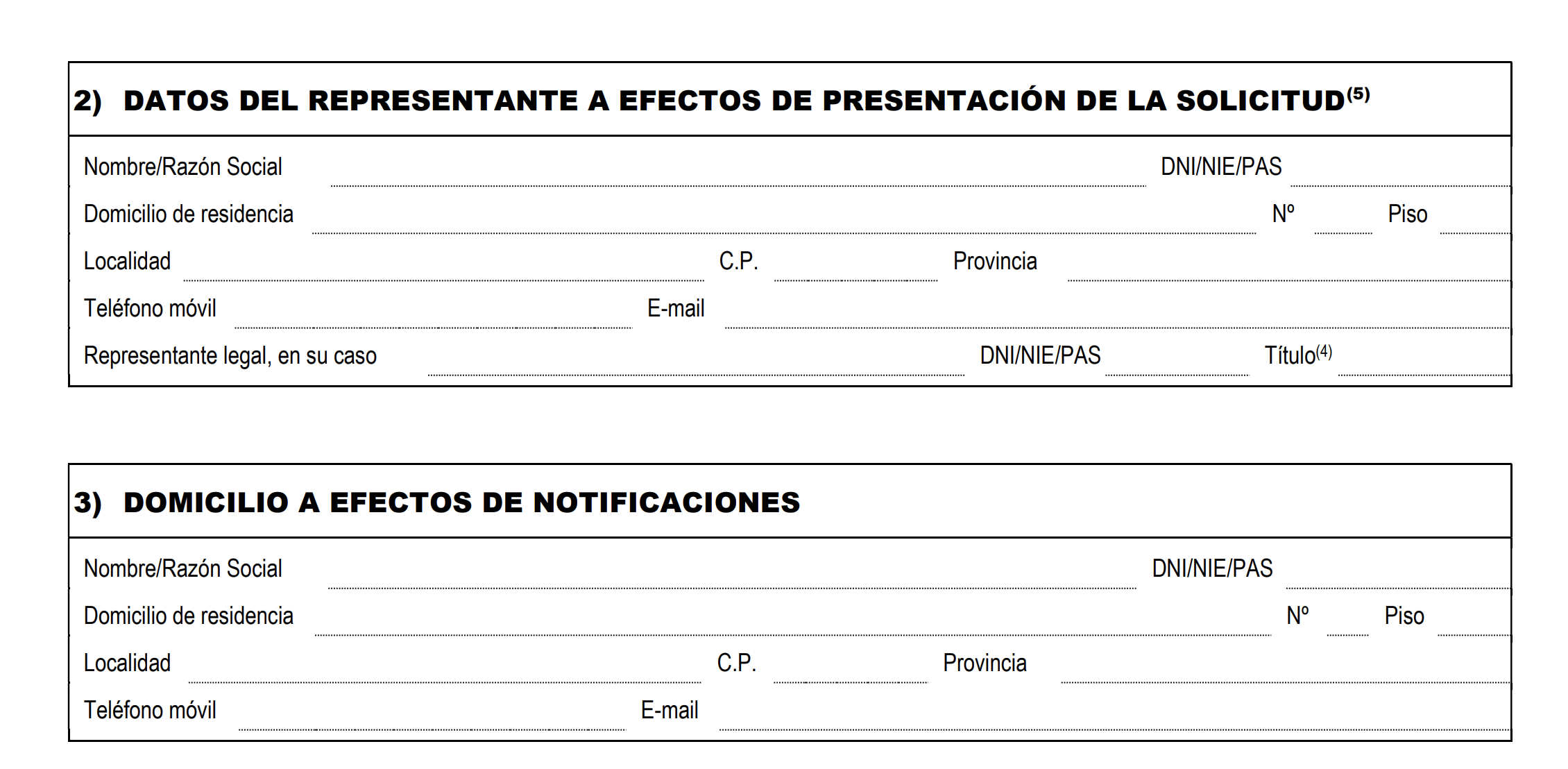
2) Datos del representante a efectos de la presentación de la solicitud. This part is completed only when the person submitting the application is not the applicant. In that case your representative fills it in on your behalf, like the rest of the form. If you submit the request yourself, the section stays blank.
3) Domicilio a efectos de notificaciones. Here you indicate the address where you want to receive any correspondence. It may or may not be the same as the address in section 1 — this section is particularly useful when you are represented by a third party.
Section 4: Datos relativos a la solicitud (the important part)
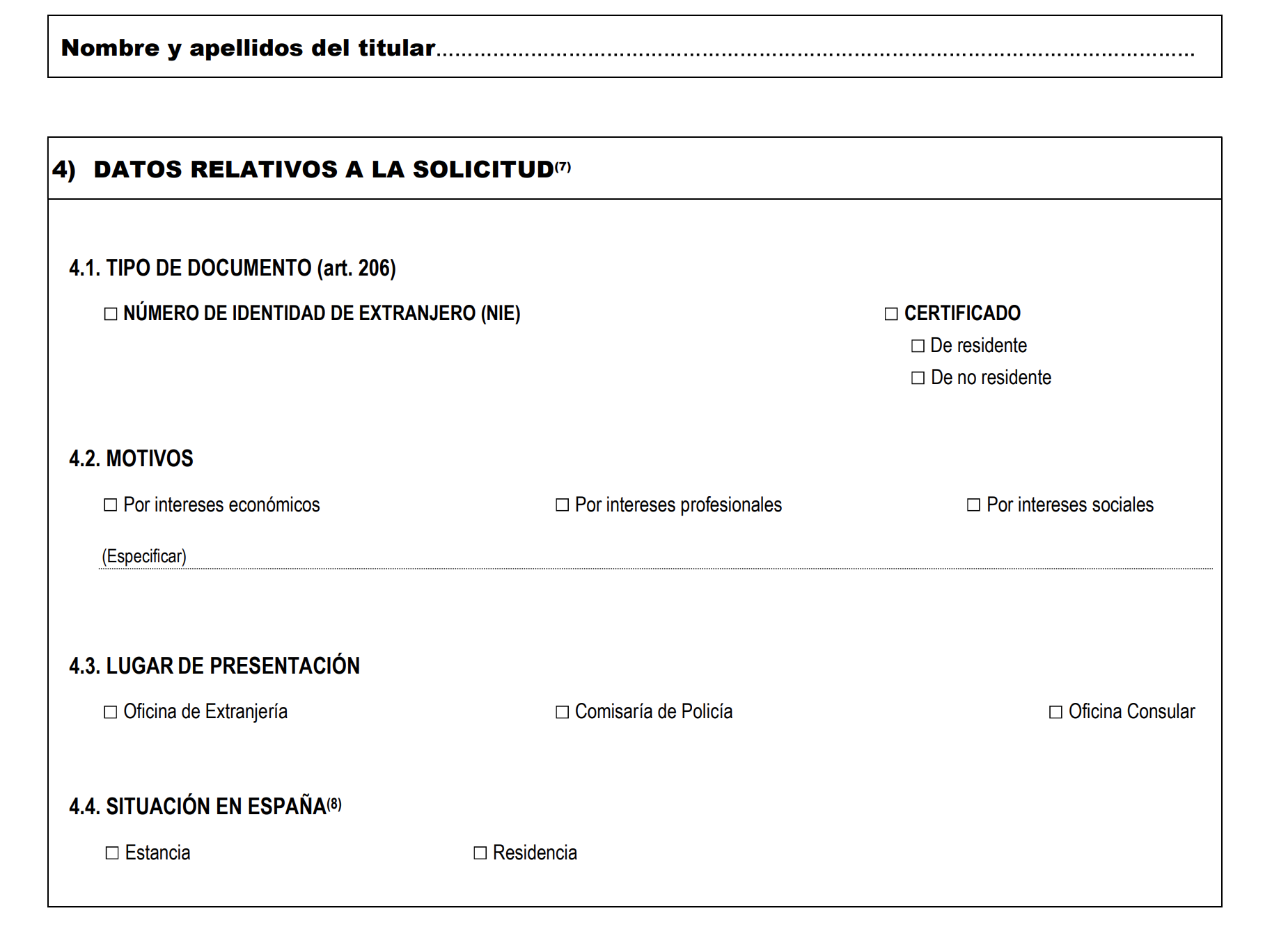
4.1 Tipo de documento. Select which document you are applying for: the NIE, or the resident or non-resident certificate. This certificate is not the same as the Certificado de Registro de Ciudadanos de la Unión Europea.
4.2 Motivos. Indicate why you want a NIE. The reasons are specific to each person and you choose between economic, professional and social reasons; in the “Especificar” field, describe your reason more precisely.
It falls on you to substantiate the need for a NIE to the police. How much proof is required varies a great deal between regions, and can even depend on the officer attending to you on the day. In many areas a verbal justification such as “I want to open a bank account” is enough, but not every region is that lenient. The main reason applications are denied is insufficient or incorrect proof of the need for a NIE, so bring every piece of corroborating evidence you can. The proof should match your reason:
- Buying a car — a letter from the seller or dealership confirming your intent to buy.
- Taking a job — a letter from the prospective employer indicating a job offer.
- Buying a house — a letter from your solicitor or estate agent confirming your intention to purchase a property.
- Retiring in Spain — tangible evidence of your financial status, such as bank statements or a letter from an accountant.
Without the corresponding letter or evidence, the application may be refused. These are translated reasons you can enter in the “Especificar” field:
| Reason | Spanish |
|---|---|
| I want to buy a car | Quiero comprar un coche. |
| I want to buy a property | Quiero comprar una propiedad. |
| I want to open a bank account | Quiero abrir una cuenta bancaria. |
| I have a job offer | Tengo una oferta de trabajo. |
| I want to retire in Spain | Quiero jubilarme en España. |
4.3 Lugar de presentación. Once you have your cita previa, select the place where the appointment will take place — usually the police station. If the request is made at a Spanish consulate, tick the corresponding box; note that a NIE issued this way is valid for only 3 months.
4.4 Situación en España. Indicate whether you reside in Spain or your stay is temporary.
Signature: Firma del solicitante
The last step is the signature. First specify the city and the date in the format “[City] a [day] de [month] de [year]”, then sign in the “Firma del solicitante” box. Do not sign the forms in advance — the police officer will ask you to sign on the day of the appointment.
If the police suggest the green NIE or the TIE instead
Some police stations have been advising applicants to apply directly for the EX-18 green NIE (the NIE Verde, also called residency or Cert EU). To be eligible for it you need either a job offer — normally unattainable without a NIE — or private health insurance and proof of funds in a Spanish bank account. If the police suggest the green NIE (Cert EU) or residency (TIE), make clear that you need the white non-resident NIE.
Which police station — and the address on your forms
Ideally you book the appointment at the police station closest to your home or workplace, but long waiting times may lead you to choose a neighboring town or even another city. If you are traveling to a different area for your NIE, the address we entered on your paperwork is a local, registered address within that police station’s jurisdiction; it serves as “your address” for the duration of the application only. It exists solely to match the station’s precinct, and it is not linked to or printed on your NIE certificate.
Be aware that the police will decline a NIE application if they learn you have traveled from another province — the Spanish police generally prefer not to take on work that belongs to another jurisdiction.
Paying the NIE fee: form 790
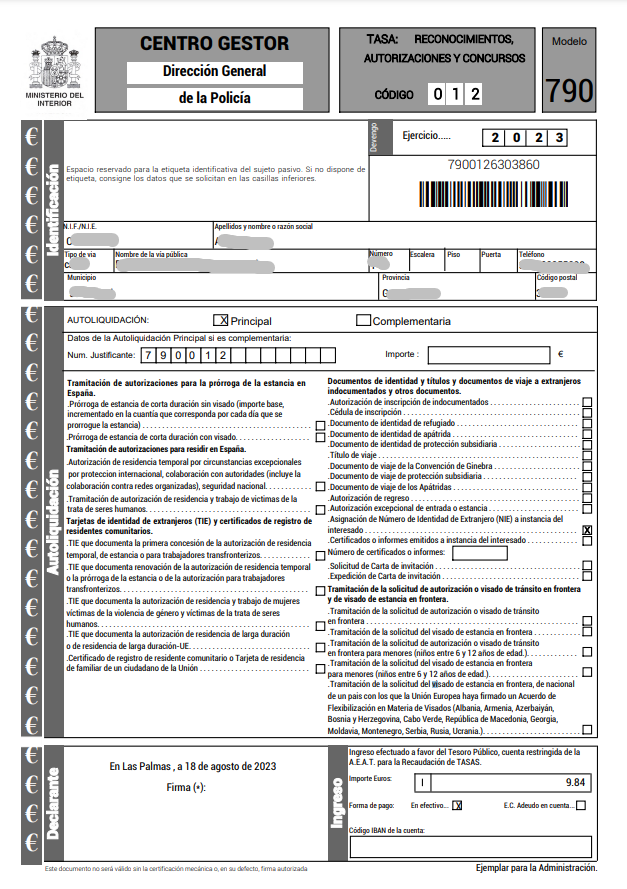
For every new or replacement NIE application a fee has to be paid to the Spanish government in advance. The exact amount is printed on the form 790 (the Tasa 790-012) we emailed you. Do not leave the payment to the last moment: settle it at least one day before your appointment, and if you have a short-notice appointment, make sure it is paid the day before. You can pay days in advance — you are not limited to the day of the appointment.
- Print the whole form. One copy of the three pages — two of them are identical, and all three are needed.
- Take it to a national bank. You may have to try more than one bank before you find one that processes NIE fee payments. Banc Sabadell (branch locator) and BBVA (branch locator) generally accept the form — ideally go to BBVA. Some banks only process the payment for their own account holders, but most national banks accept the form without an account. Because of the queues these payments create, some branches have set specific days of the week for them.
- Get a stamp. Make sure at least one of the pages you present is stamped — a manual ink stamp or a print directly onto the document are both acceptable. The bank may keep one page, leaving you two to present at the police station. If you pay at an ATM, the forms are not stamped, but you receive a receipt instead.
Arriving at the appointment without a stamped form or an ATM payment receipt means immediate rejection. Do not delay this step unless you have a fast-track or cancellation appointment.
What to bring to the appointment
- A black pen, in case any additional sections need to be filled in on the spot.
- Your original, up-to-date passport or EU citizen ID card, with the photocopies below.
- The EX-15 form (unsigned) and the stamped form 790 or the ATM receipt.
- Your supporting document for the reason given in section 4.2.
| EU passport or ID holders | Non-EU passport holders (UK included) |
|---|---|
| A photocopy of the first page of the passport, or a scan of both sides of the EU citizen ID card. | A photocopy of every page of the passport, blank pages included, plus a separate photocopy of the airport entry stamp showing your arrival in the Schengen area within the last 90 days. |
Photocopying blank pages may seem unusual, but it is a specific requirement set by the police.
Most NIE certificates are issued the same day, but this is not guaranteed — the timing is at the discretion of the police. You may be asked to return the following afternoon or, more rarely, a few days later to collect the certificate; if you are traveling to a particular station, factor in this possibility.
Punctuality is crucial. Aim to arrive at least an hour before your scheduled appointment, and if you are driving, scout parking near the police station the day before. The police have little tolerance for lateness, and arriving late can get your appointment canceled.
Plans changed?
You can cancel or change your appointment yourself on the official portal — see how to cancel a police cita in Spain. Once you have the certificate, you can confirm that your NIE is officially registered with its CSV code. And if you would rather not deal with the forms and the appointment at all, order your Spanish NIE online.
Reviewer and Sources
Reviewed by: E-Residence Team · Last updated:
This guide reflects the practice our clients have met at Spanish police stations. Requirements vary by region and by officer, and the police decide what proof they accept. The page is informational and not legal advice.
Official sources