


















Spanish NIE Requirements for Non-EU Citizens: Full Document Checklist
In this article

Short answer. For a non-EU citizen, the official NIE baseline is short: the EX-15 application form, the payment receipt for the Modelo 790 Código 012 fee, and a clearly stated reason for asking for the number. Everything else — the contract, the enrolment letter, the property papers — exists to prove that reason. Spain does not publish one universal checklist, so use this page as the solid core and confirm the details with your province or consulate before you submit.
Search for Spanish NIE requirements as a non-EU citizen and you will find lists that contradict each other. That is not because someone is lying. Spain simply does not publish a master checklist for every situation: the official procedure defines a small common core, and the rest depends on why you need the number and where you apply. This guide separates the two layers, so you know what everyone needs and what your case adds on top.
For the broader service context, see NIE in Spain. If your papers are ready and the next step is booking, see NIE Appointment in Spain.
Who this checklist is for
This page is for citizens of countries outside the EU, the EEA and Switzerland who need a Spanish NIE — the identity number for foreigners — for a concrete purpose: work, studies, buying property, opening a bank account or something similar.
EU citizens follow a different route with a different document set. If that is you, use the document requirements for the NIE Verde for EU citizens instead. Mixing the two checklists is one of the easiest ways to prepare the wrong papers.
One more boundary. This article covers the assignment of the NIE itself — not visas, residence permits or the TIE card. Those are separate procedures with their own requirements, and the number alone does not grant you the right to live or work in Spain.
The official baseline: what the National Police lists
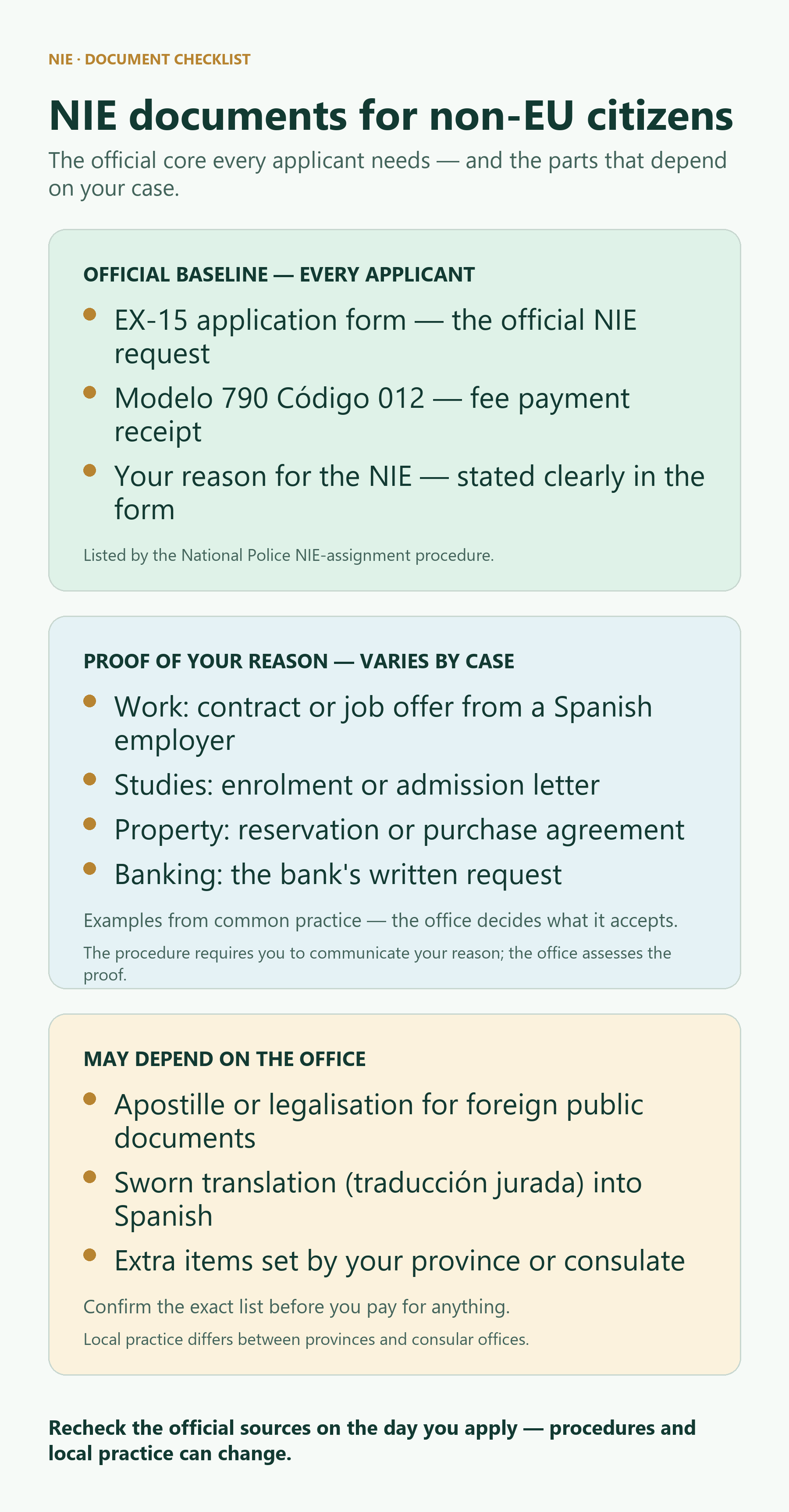
The National Police procedure for NIE assignment keeps the core list short. Every applicant, non-EU citizens included, starts from the same point:
| Item | What it is | Where it comes from |
|---|---|---|
| EX-15 application form | The official form for NIE assignment and certificates | Download from the Ministry of Inclusion’s official forms page |
| Modelo 790 Código 012 receipt | Proof that you paid the NIE assignment fee | Fill in and pay through the official 790-012 payment portal |
| Your reason for requesting the NIE | The procedure requires you to communicate why you need the number | Stated in the EX-15 and backed by your own documents |
Two conditions sit behind that list. You must not be in Spain in an irregular situation when you apply, and you must communicate the reasons for your request. The second point sounds like a formality. It is not — it decides which supporting documents you will need, as the next section shows.
A word about your passport. The EX-15 asks for your passport details, so bring the original and a photocopy. If your passport expires soon, renew it first: an identity document that runs out in the middle of the procedure creates problems you do not need.
Preparing an NIE application as a non-EU citizen? E-Residence can look at your situation and walk the paperwork route with you. Start an NIE enquiry — tell us your purpose in one sentence, and we will tell you what your case needs.
Preparing to apply in Alicante or Valencia? Check the local NIE offices and appointment information alongside your document instructions; an office address is not a universal checklist.
Documents that depend on your reason
This is the part most generic checklists get wrong. Spain does not ask every non-EU applicant for the same supporting papers. The police procedure requires you to state your reason; the office then expects documents that prove it.
| Your reason | Documents that typically prove it |
|---|---|
| A job or a job offer | Employment contract or offer letter from a Spanish employer |
| Studies | Enrolment or admission letter from a Spanish school or university |
| Buying property | Reservation agreement, purchase contract or notary appointment confirmation |
| Banking and financial matters | The bank’s written request or its account-opening requirements |
Read the right-hand column as examples from common practice, not as an official list. Two provinces can handle the same reason differently, and a consulate abroad may apply its own criteria. Before you pay for apostilles and translations, confirm the exact list with the office where you will apply.
Why this caution matters. A checklist copied from a forum can send you to the wrong counter with the wrong papers. Ten minutes with the official procedure — or one message to the office — is cheaper than a wasted visit.
Apostilles and sworn translations
If any of your supporting documents are foreign public documents — a criminal record certificate is the classic example — two extra steps may apply:
- Apostille or legalisation. Countries in the Hague Convention use the apostille; others go through consular legalisation. The goal is the same: the Spanish office can trust that the document is genuine.
- Sworn translation. Documents that are not in Spanish generally need a traducción jurada — a translation by a sworn translator, not a casual one.
Whether both steps apply depends on the document, the country that issued it and the office handling your case. There is no honest universal answer here. Check the requirement for each specific document before you pay for anything, and keep in mind that translations and apostilles take time — start with them, not with the easy papers.
Why applications get sent back
Offices rarely explain a returned application in detail, but the preparation errors behind most problems repeat themselves:
- an EX-15 with missing, inconsistent or unsigned fields;
- no Modelo 790 Código 012 payment receipt — or a receipt for the wrong fee code;
- a reason stated too vaguely to match any supporting document;
- photocopies without the originals to check them against;
- an expired passport, or one that expires within weeks.
These are not official statistics; they are the practical reading of the requirements above. Run through the list the day before your appointment, not in the queue.
And once the application succeeds, a new datum enters your life that many forms keep asking for: the soporte number of your document. The soporte number guide for the TIE, the green certificate and the NIE explains where it sits and how to write it in the official format; if you are unsure whether you need the number or the card, NIE vs TIE in Spain separates the two.
Want a second pair of eyes on your document set? Send your situation through a short NIE enquiry. We work with non-EU applications every week and can flag gaps before your appointment does.
Frequently asked questions
What documents do I need for an NIE in Spain as a non-EU citizen?
The official baseline is the EX-15 application form and the payment receipt for the Modelo 790 Código 012 fee. On top of that you need documents that prove your stated reason — for example a work contract, an enrolment letter or a property agreement. The exact supporting set depends on your purpose and on the office, so confirm it before your appointment.
Do I need an NIE number in Spain as a non-EU citizen?
You need an NIE if you have economic, professional or social interests connected with Spain. Typical triggers are work, studies, buying property or opening a bank account. If you never deal with Spanish institutions, you may never need one.
What is the EX-15 form?
The EX-15 is the official application form for NIE assignment and certificates. It asks for your identity details, your passport data and the reason for your request. Download it from the Ministry of Inclusion’s official forms page, linked in the baseline section of this guide.
How do I pay the NIE fee?
Through the Modelo 790 Código 012 form on the official National Police payment portal: fill it in, pay through the available channels and keep the receipt, because you submit it together with your application. The portal is linked in the baseline section.
Do my documents need an apostille or a sworn translation?
Foreign public documents may need an apostille or legalisation, and documents that are not in Spanish generally need a sworn translation (traducción jurada). Whether both apply depends on the document, the country that issued it and the office handling your case, so check each document before paying for anything.
Can I apply for an NIE from outside Spain?
Yes. The National Police routes applications from abroad through Spanish consular offices. Consulates follow the national procedure with local variations, so check the current instructions of your specific consular office before you act.
How long does NIE assignment take?
The National Police procedure states a maximum resolution period of five days from the date your application enters the registry. That is the administrative resolution window, not the total calendar time — getting an appointment or a consular slot can take longer.
Choose your next step
Check the official sources first. The National Police procedure page and the 790-012 payment portal linked above are current at the time of writing — recheck them on the day you act, because official pages change.
Prefer to prepare with E-Residence? Start an NIE enquiry and describe your purpose in one or two sentences. An enquiry does not replace the official procedure; it helps you arrive at it prepared.
For the full service picture, see NIE in Spain.
Editorial note: procedures, forms and local practice can change. Recheck the official links on the day you submit your application.