


Social Security for Recibos Verdes in Portugal: Contributions, Declarations and Exemptions
In this article
Recibos verdes is a tax term: the invoices you issue through Portal das Finanças. Segurança Social is a separate obligation with its own registration, declarations and payments — and it does not follow the same calendar or rules. This guide covers the self-employed (trabalhadores independentes) side: when contributions start, how they are calculated, the quarterly declaration and the exemptions.
If you are looking for how to issue the documents themselves, VAT or IRS withholding, see our recibos verdes issuing guide. For checking invoices issued to you, see the e-Fatura guide.
When the obligation starts
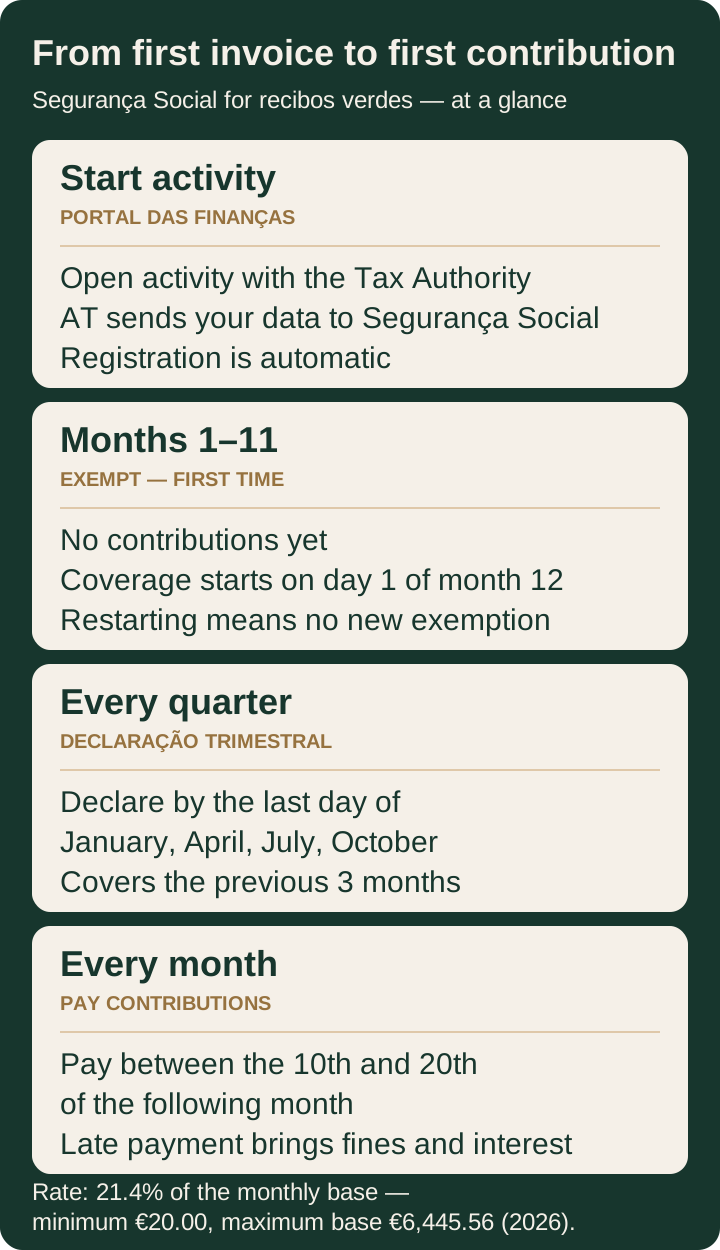
Registration is automatic: when you open activity with the Tax Authority, it sends your data, including your NIF, to Segurança Social, which enrols you in the self-employed regime and notifies you — see the ISS guide to the self-employed regime. Foreign nationals need a NISS; working for yourself (trabalhar por conta própria) is one of the official grounds for assigning one — see the ISS guide to requesting a NISS.
- First time self-employed: coverage (enquadramento) takes effect on the first day of the 12th month after the activity starts. The first eleven-plus months are exempt.
- Restarting an activity: coverage takes effect on the first day of the restart month — there is no new exemption period.
- Early coverage: you can opt in sooner through the quarterly declaration. All three rules come from the same ISS regime guide.
How the contribution is calculated
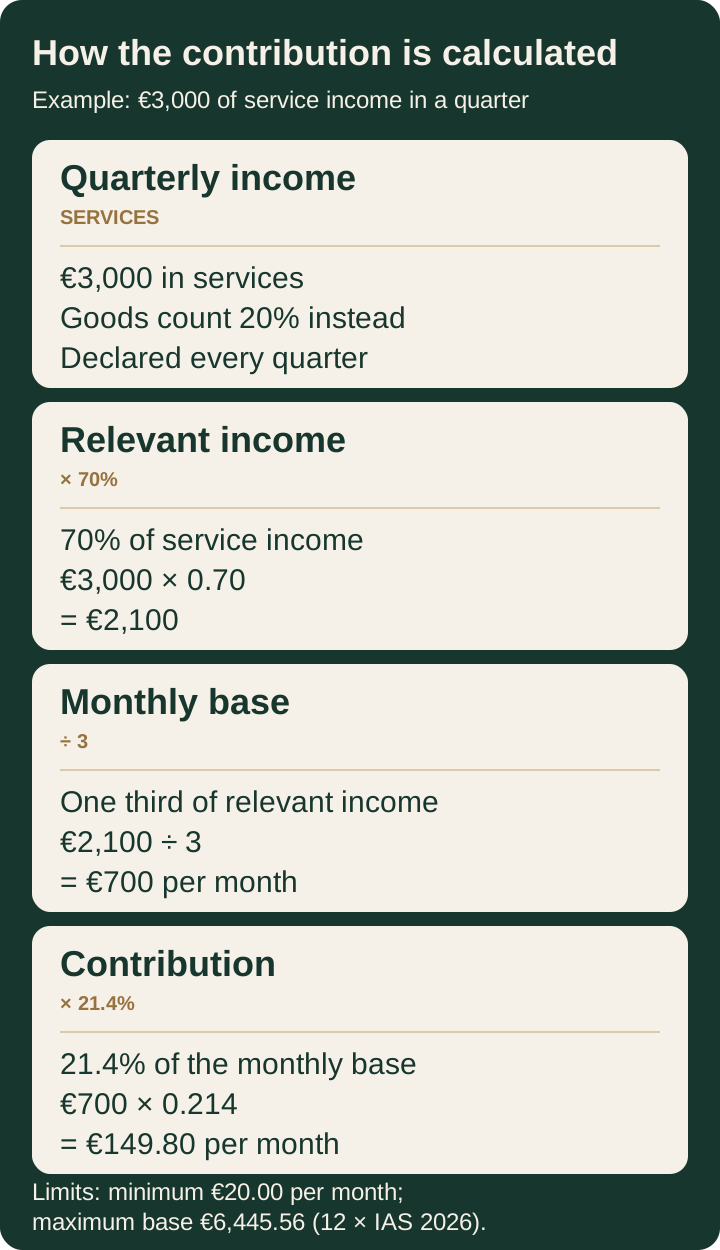
The contribution rate for self-employed workers is 21.4% (25.2% for empresários em nome individual and EIRL holders). It applies to a monthly base calculated from your relevant income:
- 70% of the total value of services provided;
- 20% of income from producing and selling goods (also 20% for hotel, restaurant and beverage activities when declared for IRS). Percentages are set out in the ISS regime guide.
The monthly base equals one third of the relevant income for the declaration period and stays in effect for three months. The limits, with the 2026 IAS value of €537.13 (fixed by Portaria n.º 480-A/2025/1, cited in the ISS guide):
- Minimum: if you have no income or the calculated contribution is below €20.00, the base is set so the contribution is €20.00 per month;
- Maximum: €6,445.56 (12 × IAS);
- Organised accounting: the base is the taxable profit divided by 12, with a minimum of €805.70 (1.5 × IAS), set each October for the following year.
When submitting the quarterly declaration, you may choose a relevant income up to 25% above or below the calculated value, in steps of 5%, within the same minimum and maximum limits (option rules in the ISS guide).
The quarterly declaration (declaração trimestral)
Every self-employed worker obliged to pay contributions must declare income by the last day of January, April, July and October. Workers with organised accounting do not submit it, because their base comes from taxable profit.
- Each declaration covers the previous three months — the January declaration covers October, November and December.
- You declare income from selling goods, providing services and other relevant income.
- Entries can be corrected up to 15 days after the deadline.
- Missing a mandatory declaration is a light infraction that can carry a fine under Article 233 of the Contributory Regimes Code. The guide does not state the fine amounts.
- Since 2026, the declaration can also be submitted online after the deadline, up to the last day of the month before the next declaration period; the January window also lets you confirm or correct annual values. All declaration rules above are from the ISS guide.
Paying each month
Contributions are paid between the 10th and the 20th of the following month (ISS payment guide). The 2026 guide also lists MB Way and an IBAN payment reference in the payment document.
Late payment is a light infraction during the first 30 days; after that it becomes a serious infraction with default interest — see the regime guide.
Exemptions that apply to recibos verdes workers
- First activity period. First-time self-employed are exempt until the 12th month of activity (see above). The count pauses if you close the activity and resumes if you restart within 12 months.
- Employment plus self-employment. Full exemption if all conditions hold: the two activities are for different employers not in the same corporate group; the employed work is covered by a regime protecting all the risks of the self-employed regime; the average monthly salary under the other regime is at least €537.13 (1 × IAS); and your average relevant self-employed income is below €2,148.52 (4 × IAS). Crossing that income in a quarter ends the exemption, and everything is declared in the next quarterly declaration.
- Pensioners. Receiving a national or foreign invalidity or old-age pension exempts you, provided the activity is compatible with the pension. The same applies to a work-accident or occupational-disease pension with a work incapacity of at least 70%.
- A year of minimum contributions. You can be exempt if, in January of the following year, it is confirmed that you paid only the €20.00 monthly minimum throughout the previous year.
- Justified pauses. A justified temporary stop of the activity, or temporary incapacity such as illness or parenthood, can remove the obligation for that period.
| Exemption | Key condition (2026) | Where to check |
|---|---|---|
| First activity period | Contributions start only from month 12 | ISS regime guide |
| Employment plus self-employment | Salary ≥ €537.13 and self-employed income < €2,148.52 | ISS regime guide |
| Pensioners | Invalidity or old-age pension compatible with work | ISS regime guide |
| Year of minimum contributions | Only €20.00/month paid all previous year | ISS regime guide |
All exemption conditions are set out in the ISS regime guide.
Closing your activity
Coverage ends when the self-employed activity ends, effective from the first day of the following month — automatically via the Tax Authority’s data or on request. Contributions stop from the same date, but settlements can still be charged after the annual review. Benefits already being paid — sickness, parenthood and family allowances — continue after closure. See the cessation rules in the ISS guide.
Proving your contribution status
Banks, clients and authorities often ask for proof that your contributions are in order. The declaração de situação contributiva is issued free of charge online (Trabalho → Remunerações e contribuições → Obter Declaração da situação contributiva), within 10 working days, and is valid for 4 months — see the ISS guide to the contributive-status declaration.
Common mistakes
- Treating recibos verdes and Segurança Social as one system. Issuing invoices correctly does not register you for contributions or declarations — the obligations are parallel.
- Assuming the first-year exemption renews. It applies once; a restart is covered from the restart month.
- Forgetting the quarterly declaration in a zero-income quarter. The obligation to declare does not depend on having income; missing it is still an infraction. The minimum contribution may apply instead.
- Using a salary below the IAS to claim the employment exemption. The combined-activity exemption needs the other regime’s average salary at or above €537.13 in 2026, plus the other conditions.
- Closing the activity only with the Tax Authority. Check that Segurança Social registered the closure, and expect possible settlements after the annual review.
All of the above follows from the ISS regime guide.
For a NISS, see the E-Residence NISS service. For annual tax filing support, see the Portugal annual tax return service.
Frequently asked questions
When do I start paying Segurança Social as a recibos verdes worker?
If this is your first time registering as self-employed, coverage starts on the first day of the 12th month after you begin the activity. If you restart an activity you had before, coverage starts on the first day of the restart month. You can opt into earlier coverage through the quarterly declaration. See the ISS regime guide.
How much is the monthly contribution?
The rate is 21.4% of your monthly contribution base. The base is one third of your relevant income for the declaration period — 70% of service income (20% for goods). If you have no income or the result is below €20.00, the minimum applies: €20.00 per month. The maximum base is €6,445.56 (12 × IAS). See the ISS guide to the self-employed regime.
When is the quarterly declaration due?
By the last day of January, April, July and October. Each declaration covers income from the previous three months — for example, the January declaration covers October, November and December. You can correct the entries up to 15 days after the deadline. See the ISS regime guide.
I have a job and freelance on the side — am I exempt?
Possibly. The exemption requires all conditions together: the two activities are for different employers not in the same corporate group, the employed work is covered by a protection regime covering all the risks of the self-employed regime, the average monthly salary under the other regime is at least €537.13 (1 × IAS in 2026), and your average relevant self-employed income is below €2,148.52 (4 × IAS). If you cross that income in a quarter, you lose the exemption. Conditions: ISS regime guide.
What happens if I miss the quarterly declaration?
Missing a mandatory declaration is a light infraction that can be fined under Article 233 of the Contributory Regimes Code. Since 2026 you can also submit the declaration online after the deadline, up to the last day of the month before the next declaration period. See the ISS regime guide.
Do pensioners have to pay contributions as freelancers?
Receiving a national or foreign invalidity or old-age pension exempts you, provided the professional activity is compatible with that pension. The same applies to a work-accident or occupational-disease pension with a work incapacity of at least 70%. See the ISS exemption rules.
What happens to contributions when I close my activity?
Coverage and contributions end on the first day of the month after the activity ends. Settlements can still be charged after the annual review, and benefits already being paid — sickness, parenthood, family allowances — continue after closure. See the ISS cessation rules.