

Planning to make Spain your home? Whether you’re eyeing that beachfront property, launching a startup, or just ready for a fresh European adventure, you’ll quickly discover that Spain runs on acronyms. The most important one for you? NIE—and yeah, it’s going to cost you something, though probably not as much as you’re worried it will.
Here’s the straight story: the official NIE cost is relatively modest at €12 in 2025, but the real-world price can climb significantly depending on your situation, who you are, and how much help you need navigating the Spanish bureaucratic maze.
The Official NIE Fee: What You’re Actually Paying
Let’s cut to the chase. The government fee for getting your NIE—officially called Modelo 790 Code 012—runs you about €12 in 2025. Some years it’s €9.84, other years it creeps up to €15, but €12 is the sweet spot for most people applying in 2025. This isn’t some sneaky private charge; it’s a direct payment to the Spanish state for processing your foreigner identification number.
Think of it as the entrance fee to the Spanish bureaucratic system. Simple enough, right? Well, sort of.
Here’s where it gets interesting: you can’t just hand someone a €12 bill. Instead, you need to fill out the Modelo 790 form online, print it out, take it to a Spanish bank, and pay there using the barcode on the form. The bank stamps your copy as proof. Then you bring that stamped receipt—carefully preserved and in good condition—to your actual appointment. It’s very Spanish: convoluted, but surprisingly efficient once you understand the dance.
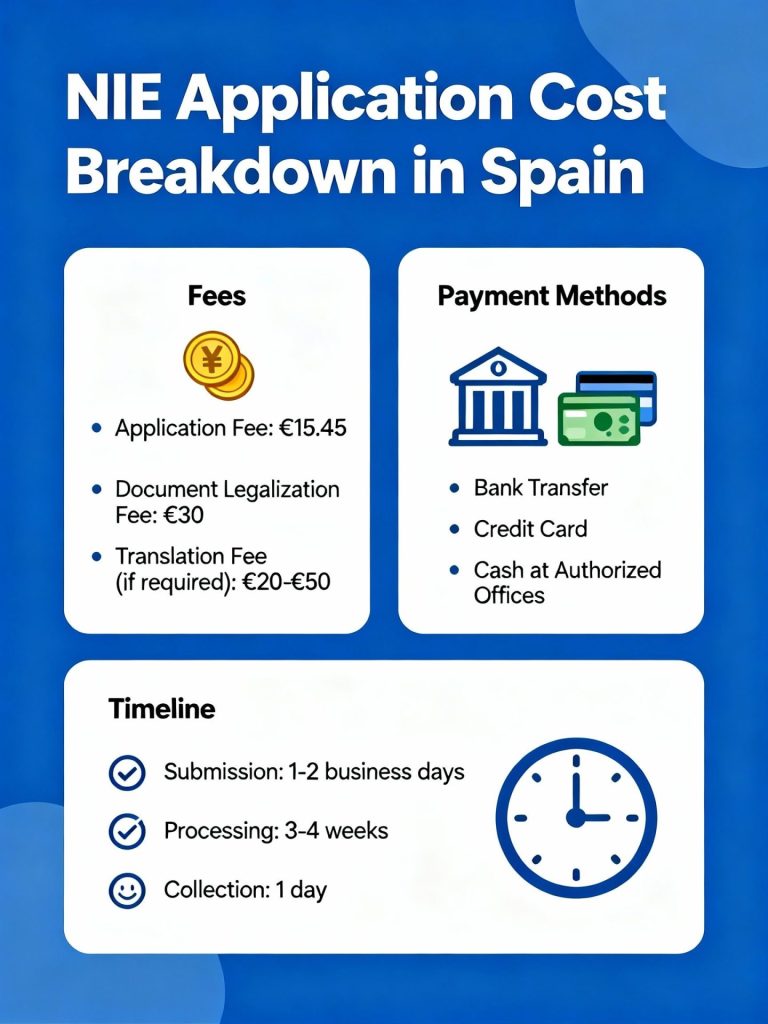
NIE Application Cost Breakdown: From €12 to €300+
For non-EU citizens, the fees can vary a bit. If you’re applying for initial residence authorization, you might pay €16–€21 instead. And if you need a TIE card (the physical residency card for non-EU residents staying longer than 6 months), that comes with its own separate fee of €19–€37, depending on your permit type.
When the Real Costs Kick In: The Hidden Expenses
Okay, so €12 sounds reasonable. Then why do some people end up spending €300 or more? Let’s dig into the stuff that actually gets expensive.
The Notary Problem
If you’re applying from abroad through a Spanish consulate, or if you need someone representing you in Spain, you’ll need a Power of Attorney document (Poder Notarial). And here’s where costs start climbing. A basic power of attorney through a notary costs between €50 and €100. But then you need it authenticated with an apostille stamp for international recognition—add another €25–€50. Need translations into Spanish? That’s €50 per document on top of everything else.
For a couple applying jointly through a representative, you’re looking at a lawyer fee of €275–€385 before taxes. With VAT (that’s 21% in Spain), you’re suddenly at €332–€465. Still cheaper than a weekend in Madrid, but definitely not the €12 you started calculating.
The Gestor Shortcut
A gestor is essentially your Spanish bureaucracy translator—a licensed professional who handles administrative nightmares for you. Want to skip the stress and confusion? Gestores charge anywhere from €100 to €250 just for the NIE application. Some promise to get your NIE in 3–5 business days, which sounds fantastic until you realize you’re paying for both speed and the privilege of someone else dealing with the mess. For comparison, doing it yourself takes 2–6 weeks depending on your city and how crowded the appointment system is.
The Translation and Legalization Rabbit Hole
If you’re applying from outside Spain or you have documents in anything other than Spanish, buckle up. Here’s what you might need:
- Sworn translator fees: €50–€150 per document
- Apostille stamps: €25 per document
- Notarization: €30–€80 per document
For someone with multiple supporting documents (passport copies, contracts, certificates of no impediment), this easily adds €200–€500 to the total.
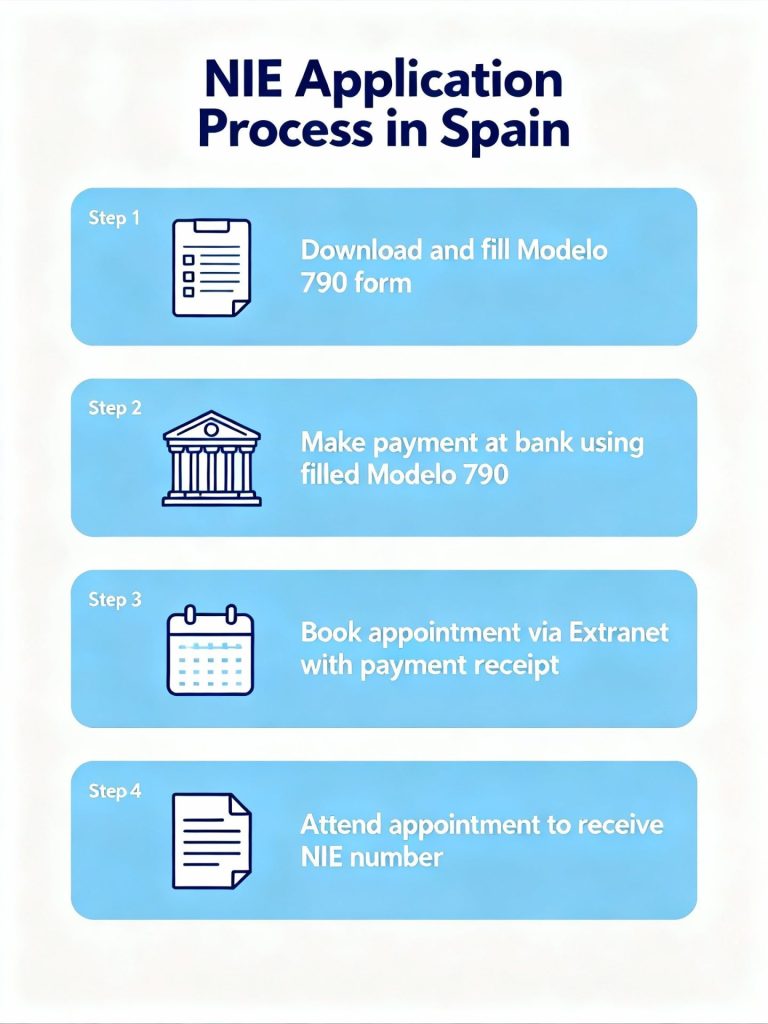
How to Get NIE in Spain: Step-by-Step Process
Understanding Modelo 790: The Payment Form Decoded
The Modelo 790 is Spain’s administrative fee form. Different procedures use different codes, and for your NIE, you’re dealing with Code 012 (NIE assignment and TIE card issuance). Here’s exactly how it works:
- Download the Modelo 790 from the National Police website
- Fill it out with your details, selecting the correct province where you’re applying
- Print all three copies (administration gets one, bank gets one, you keep one)
- Take it to any Spanish bank or ATM and pay using the barcode
- The bank stamps your copy as official proof
- Bring that stamped receipt to your appointment
Can you pay online? Nope. This is Spain—some bureaucratic procedures still require the human touch and physical paper trails. The bank stamp serves as irrefutable proof that you’ve paid, and that’s apparently essential to the whole system working.
Breaking Down the Costs by Who You Are
Your bill is going to look different depending on your circumstances:
| Who You Are | Base Fee | Total with Help | Reality Check |
|---|---|---|---|
| EU Citizen (doing it yourself) | €12 | €12–€50 | If you mess up one detail, you pay the €12 fee again |
| EU Citizen (using a gestor) | €12 + gestor | €242–€350 | Faster, less stressful, but someone else is handling your paperwork |
| Non-EU Standard Resident | €16–€21 | €50–€300+ | Depends heavily on whether you get professional help |
| Non-EU + TIE Card | €16 + €19–€37 | €100–€400+ | TIE adds fingerprinting and additional processing |
| Applying via Spanish Consulate | €12–€15 | €100–€350+ | Consulates sometimes add processing fees; translations are mandatory |
The wild card? How much professional help you decide you need and where you’re applying from. Someone applying from Barcelona can do this in their lunch break. Someone applying from Toronto? They might be hiring a lawyer.
The Timeline Factor: Why Rushing Costs Money
Here’s something most people don’t think about: time costs money in the bureaucracy game. Standard processing takes 2–6 weeks from booking your appointment to getting your certificate. Madrid and Barcelona? Expect 4–6 weeks. Smaller cities like Valencia or Alicante? Sometimes you’re done in 5–10 days.
But booking the appointment itself can take another 1–3 weeks depending on how busy the system is. So if you need your NIE urgently—job starting next month, property closing date approaching, visa expiring—suddenly that €150–€250 gestor fee doesn’t look so bad. It’s essentially buying your way to the front of the queue and having someone else manage the stress.
Real-World Cost Scenarios
Let’s get specific. Here’s what actual people probably pay:
Scenario 1: EU Citizen Handling It Alone in Spain
- Modelo 790 fee: €12
- Your time and frustration: Immeasurable
- Total: €12
- Catch: One wrong detail and you’re paying the €12 fee again to resubmit
Scenario 2: EU Citizen Using a Gestor
- Modelo 790 fee: €12
- Gestor service: €150–€250
- Total: €162–€262
- Benefit: Someone else wrestles with the bureaucracy; you get it in 3–5 days
Scenario 3: Non-EU Citizen Applying via Lawyer from Outside Spain
- Modelo 790 fee: €12
- Lawyer/representative fee: €275–€465 (including VAT)
- Power of Attorney at notary (your home country): €50–€150
- Document translation and apostille: €100–€300
- Total: €437–€927
- Benefit: Everything handled remotely; you don’t need to fly to Spain first
Scenario 4: Non-EU Citizen Needing a TIE Card
- Modelo 790 Code 052 (initial residency): €19–€37
- Modelo 790 Code 012 (TIE issuance): €16–€21
- Gestor or lawyer assistance: €200–€500
- Total: €235–€559
- Note: TIE is mandatory for non-EU residents staying longer than 6 months
The Sneaky Costs Nobody Talks About
Banks sometimes charge €1–€3 for processing your Modelo 790 payment—not a fortune, but check with yours first. Lose your payment receipt? You’re paying the fee again. Miss your appointment? You lose the slot and wait weeks for another one. Notaries love charging extra for rush jobs or translation arrangements.
And here’s the kicker: the fee amount changes every year and sometimes varies by region. What costs €12 today might be €12.50 next year. What’s €12 in Madrid might be slightly different in Barcelona. Always check official sources before paying—outdated blog posts will steer you wrong.
Can You Actually Save Money on This?
Not really—the base fee is mandatory. You can’t wiggle out of it. But you can be smart about minimizing extras:
- Do it yourself if you’re in Spain: Save €100–€250 on gestor fees
- Get your documents absolutely right the first time: Avoid resubmissions and double fees
- Apply in a smaller city: Faster processing means less waiting around and less temptation to pay for expedited services
- Start early: Booking your appointment months in advance means no rush fees
For most people, the actual cost lands somewhere between €50 and €300. It’s not going to break the bank, but it’s definitely not just €12.
Here’s what matters: The official NIE fee is €12, but total costs typically range from €50 to €300 depending on whether you use professional help, need translations, and how soon you need it. Plan ahead, prepare your documents carefully, and book your appointment early to avoid paying for services you don’t actually need.
Wrapping Up
The NIE application cost might look like sticker shock if you’re expecting a simple €12 transaction. But when you add everything together—gathering documents, navigating the system, potentially hiring professional help, managing timelines—you’re really paying for access to Spain’s system. And honestly? Compared to what other countries charge for residency and identification, Spain’s fees are pretty fair.
The key is thinking ahead. Book your appointment early. Get your documents ready. And if you’re coming from abroad or don’t speak Spanish fluently, budget for professional help as an investment in peace of mind. Because sometimes, the most expensive thing on the invoice is the stress you avoid.
FAQ
Q: Is the €12 fee the only thing I’ll pay for my NIE?
A: The €12 is the official government fee, but you might also need to pay for translations, notarization, or professional help—which can add anywhere from €50 to €500+ depending on your situation. EU citizens doing it alone in Spain typically pay just the €12; non-EU citizens or those using professional services pay significantly more.
Q: Can I pay the Modelo 790 fee online?
A: No, you must pay in person at a Spanish bank or ATM using the barcode on the printed Modelo 790 form. Online payment isn’t available for this particular fee. The bank stamps your copy as proof, which you then bring to your appointment.
Q: How much does a gestor actually charge for NIE work?
A: Gestores typically charge €100–€250 for NIE applications. If you want faster processing (3–5 days instead of 2–6 weeks), expect to pay €150–€200. Some charge more if you need additional services like translations or document gathering.
Q: What’s the difference between paying for NIE versus NIF?
A: The NIE (for foreigners) costs around €12. The NIF (for tax purposes) is free if you already have a NIE—it’s automatically assigned for tax matters. Businesses need an NIF but don’t pay a separate fee; any costs come from hiring an accountant or gestor to set it up properly.
Q: Do EU and non-EU applicants pay different prices?
A: The base NIE fee is the same (€12), but non-EU citizens applying for residency and needing a TIE card face additional charges. Initial residence authorization runs €19–€37, and TIE issuance adds another €16–€21 on top of that.
Q: Is the Modelo 790 fee mandatory, or is there a way around it?
A: The fee is mandatory—there’s no way around it. It’s the administrative charge the government requires to process your application. You can avoid extra costs by handling it yourself if you’re in Spain, but you cannot avoid the base fee.
Q: How fast can I get my NIE, and does expedited processing cost more?
A: Standard processing takes 2–6 weeks depending on your city and appointment availability. Expedited services through gestores or lawyers can cut that to 3–5 days, but they cost an additional €150–€250+. In smaller cities, processing is often naturally faster without any extra charge.
Official Resources
For the most current information, always verify details through official Spanish government sources:
National Police – NIE Application Portal
https://sede.policia.gob.es/portalCiudadano/_en/tramites_extranjeria_tramite_asignacion_nie.php
Official portal for NIE procedures, downloadable forms, and requirements.
Ministry of Interior – Immigration Services
https://www.interior.gob.es/opencms/en/servicios-al-ciudadano/tramites-y-gestiones/extranjeria/
Central government website for all immigration-related procedures and regulations.
Spanish Consulates Abroad
https://www.exteriores.gob.es
Find your nearest Spanish embassy or consulate if applying from outside Spain.
Last updated: 04.12.2025